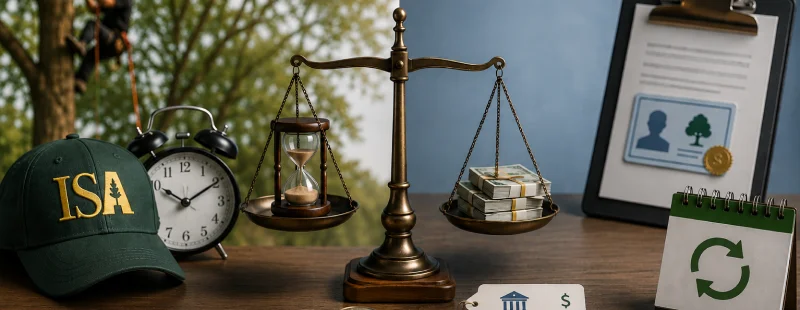
Quick Summary: There is no national arborist license in the US. A few states license arborists, tree experts or tree care businesses directly, including Connecticut, Louisiana, Maine, Maryland, New Jersey and Rhode Island, and each sets its own exam, insurance and renewal rules. Other states regulate tree work through contractor licensing or leave it to cities and counties. ISA Certified Arborist is a separate, voluntary credential that some states recognize in place of their exam.
Key entities: statewide license, Licensed Tree Expert, commercial arborist license, ISA Certified Arborist, contractor license, local permit.
You can climb in one state for ten years without anyone asking for a license. Cross a state line and the same work can require an exam, proof of insurance and a renewal every year. That's the reality of the arborist license in the US.
The rules change from state to state, and sometimes from city to city. This guide sorts out who actually needs a license, what the states that license arborists ask for, and where ISA certification fits in.
All state requirements below come from the agencies' own pages and were last checked on November 3, 2026. Rules change, so always confirm with the agency before you apply or take a job.
Is There a National Arborist License?
No. There is no federal or national arborist license in the United States.
ISA certification is often mistaken for one, but it's a voluntary credential issued by the International Society of Arboriculture, a professional society, not a government agency. It proves knowledge. It doesn't give you legal permission to work anywhere.
Instead, three layers of rules can apply to tree work:
- A state arborist or tree expert license, in the states that have one.
- A state contractor license, in states that regulate tree work as contracting.
- City or county rules, such as tree permits or tree service registration.
Depending on where you work, none, one or all three may apply to you. For the general difference between a license and a certification, see our guide to arborist license vs certification.
Which States Require an Arborist License?
A handful of states license arborists, tree experts or tree care businesses directly. The table below covers the six we verified on each state agency's own page.
| State | What is required | Issuing body | Exam | ISA certification in place of exam |
|---|---|---|---|---|
| Connecticut | Commercial Arborist License to advertise, solicit or contract arboriculture work | Department of Energy and Environmental Protection (DEEP), Pesticide Management Program | Written exam, then oral exam with tree ID and practical questions | Not stated on the agency page |
| Louisiana | Arborist License to work on trees for a fee; separate Utility Arborist License | Louisiana Department of Agriculture and Forestry (LDAF), Horticulture Commission | Yes, 70% to pass | Not stated; ISA study guide used for exam prep |
| Maine | Arborist license to perform arborist services independently | Department of Agriculture, Conservation and Forestry (DACF), Arborist Program | Yes, landscape and/or utility category | Yes, ISA Certified Arborists apply without the exam |
| Maryland | Licensed Tree Expert for tree care professionals practicing in the state | Department of Natural Resources (DNR) Forest Service | Yes, 140 questions, 70% per domain and overall | Not stated on the agency page |
| New Jersey | Business registration, with at least one licensed person working full time | Board of Tree Experts | LTE: written and field; LTCO: written | ISA Certified Arborist treated as equivalent to the LTCO certification |
| Rhode Island | Arborist license for all practitioners of arboriculture | Department of Environmental Management (DEM) | Yes, 70% to pass | May be exempt with proof of current ISA certification |
Other states may regulate tree work in ways not shown here. If your state isn't in the table, that doesn't mean no rules apply. Check with your state's agriculture department, contractor board and city before you work.
State by State
Connecticut
Connecticut's Commercial Arborist License is required for anyone advertising, soliciting or contracting to do arboriculture in the state. It's issued as category 3D under the commercial pesticide supervisor certification, so the licensed arborist is also a supervisory pesticide applicator for trees.
The process has two stages: a multiple-choice written exam, then an oral exam that starts with tree identification and continues with practical questions across ten categories. The easy thing to miss is the business side. Since October 1, 2013, arborist businesses also need a Pesticide Application Business Registration.
Louisiana
In Louisiana, the Horticulture Commission puts it plainly: an arborist license is required if you work on trees for a fee. That covers recommendations and work such as removal, pruning, cabling, fertilization and cavity work. A separate Utility Arborist License covers work along utility rights of way.
According to LDAF, the exam fee is $150, you need 70% to pass, and the license costs $125 a year. All licenses expire on January 31. To renew, you show proof of general liability and, if applicable, workers' compensation insurance, and attend a continuing education seminar each year. Licensed arborists must also use a written contract with property owners that sets out the work and the price.
Maine
Maine's arborist licensing page says that anyone performing arborist services in the state must first obtain a license. Candidates pass a test in the landscape category, the utility category or both, and must show proof of adequate insurance.
Two details are easy to get wrong. The apprentice permit requires no exam, but it's a training permit only, for work under the direct supervision of a licensed arborist. And ISA Certified Arborists, as well as arborists licensed in other states, don't take the exam but still have to apply for a Maine license using the out-of-state application.
Maryland
Maryland's DNR Forest Service states that all tree care professionals practicing in Maryland must obtain a license. The Licensed Tree Expert credential requires either three years of experience under a Licensed Tree Expert, or related college education plus one year of experience under one.
Applicants pass a 140-question exam, scoring at least 70% in each of ten domains and overall, and carry liability and property damage insurance. You'll see conflicting information online about the license term. The DNR page currently describes it as a two-year license renewed in December.
New Jersey
New Jersey works differently from the other states here. The Board of Tree Experts licenses individuals as Licensed Tree Experts (LTE) or Licensed Tree Care Operators (LTCO), but the key requirement sits with the business. Every company offering tree care for hire must register with the Board and have at least one licensed person working full time. The Board's April 2026 bulletin adds that this applies at every branch location.
Registered businesses must carry at least $1,000,000 in general liability insurance and workers' compensation coverage. To sit the exam, candidates must be 18 or older and have a high school diploma or three years of arboriculture experience. The LTE exam has written and field sections, while the LTCO exam is written only. In January 2026, the state also added enforcement and penalty provisions to the law.
Rhode Island
Rhode Island's DEM arborist page states that all practitioners of arboriculture must be licensed, including tree wardens. A standard license covers all arboriculture, while a limited utility license covers only utility line clearance.
The exam requires 70% to pass and costs $25, and the license is $25 a year. It expires on December 31 and must be renewed annually. If you hold current ISA certification, you may be exempt from the exam, but you still pay the license fee. Let a license lapse for more than 12 months and you have to take the exam again.
Run a Compliant Crew by the ArboStar Standard
Learn the numbers, processes and benchmarks a tree service company should run on, from paperwork to crew management.
States That Use Contractor Licenses or City Rules
Not every state that regulates tree work has an arborist license. Some treat tree work as contracting, and many leave it to local governments. This is where a lot of online lists go wrong, by mixing contractor licenses and arborist licenses together as if they were the same thing.
California is the clearest example. Tree work there falls under the Contractors State License Board (CSLB), through the C-49 Tree and Palm Contractor classification. According to CSLB, a C-49 contractor plants, maintains and removes trees and palms, including pruning, stump grinding and guying. Incidental pruning by a nurseryperson or gardener is excluded. Small jobs below a dollar threshold set by state law don't need a contractor license, so check the current figure with CSLB.
Cities can add their own layer. Seattle, for example, requires tree service providers to register with the city before doing tree removal, major pruning or consulting work there, and to commit to following the city's tree protection rules and ANSI A300 pruning standards. Seattle has updated these rules since they took effect in 2022, so check the city's current requirements.
The lesson is simple. Before you work in a new place, check the state agency, the contractor board and the city.
Arborist License vs ISA Certification
A license is legal permission from a state to do certain work. ISA certification is a voluntary professional credential that shows knowledge and is maintained through continuing education. They often overlap, but one doesn't replace the other.
Some states do recognize ISA certification. Maine lets ISA Certified Arborists apply without taking the exam, Rhode Island may exempt them from its exam, and New Jersey treats the ISA Certified Arborist credential as equivalent to the LTCO certification. Our guides explain what an ISA Certified Arborist is and the full license vs certification difference.
How to Get an Arborist License: The Usual Steps
Every state has its own process, but most follow a similar order:
- Find the issuing agency for your state and read its requirements directly.
- Check the experience or education rule, if there is one.
- Register for the exam, or check whether ISA certification or another state's license lets you skip it.
- Prepare for and pass the exam. Some states use ISA study materials for preparation.
- Arrange the required insurance, such as general liability and workers' compensation.
- Pay the license fee and submit your application.
- Plan for renewal dates and continuing education from the start.
If you're still at the start of your career, our guide on how to become an arborist covers training and experience.
Staying Licensed: Insurance, Renewal and Continuing Education
Getting licensed is one step. Staying licensed is the part that catches businesses out.
Licenses, insurance policies and certifications all run on their own calendars. In Louisiana, licenses expire on January 31. In Rhode Island, December 31. Maryland's license runs for two years. Insurance policies renew on their own dates, and continuing education has to be completed before renewal in states that require it. In a state like New Jersey, where the business registration depends on a licensed person on staff and on proof of insurance, a lapse can stop a company from working.
For a solo climber, keeping track is manageable. For a crew, especially one that works across state lines, it's easy for one date to slip. Keeping a simple record of every license, certification and policy, with its expiry date and the person responsible, helps you catch renewals before they become problems. ArboStar can help tree care businesses keep those records organized alongside the rest of their operations. For more on coverage, see our guides to tree service insurance requirements and workers' comp for tree climbers.
Keep Every Crew Credential and Renewal Date Visible
Keep employee records, hours and assignments in one system, so you know who is on which job and what is current.
Frequently Asked Questions
Do you need a license to be an arborist?
It depends on the state. Some states, including Connecticut, Louisiana, Maine, Maryland, New Jersey and Rhode Island, license arborists or tree care businesses directly. Others regulate tree work through contractor licenses or local rules. Check with your state agency and city before you work.
Which states require an arborist license?
The states we verified on their agency pages are Connecticut, Louisiana, Maine, Maryland, New Jersey and Rhode Island. Other states may regulate tree work through contractor licensing or local rules, so always check your own state.
Is an ISA certification the same as a license?
No. ISA certification is a voluntary professional credential. A license is legal permission from a state. Some states recognize it: Maine lets ISA Certified Arborists apply without the exam, and Rhode Island may exempt them from its exam.
Can I work as an arborist in another state with my license?
Not automatically. Each state sets its own rules. Maine, for example, lets arborists licensed in other states apply without taking its exam, but they still need a Maine license. Check the rules of the state where the work is.
Do you need a license to run a tree service business?
In some states, yes. New Jersey requires every tree care business working for hire to register with the Board of Tree Experts and employ a licensed person. Connecticut requires a business registration for arborist businesses. Elsewhere, a contractor license or local registration may apply. Our guide on how to start a tree service business covers the wider setup.
Conclusion
There is no national arborist license. What you need depends on your state, the type of work and sometimes your city. A handful of states license arborists or tree care businesses directly, others use contractor licenses, and many leave it to local rules.
The safest approach is always the same: go to the state agency first, then check the contractor board and the city. Confirm exam rules, insurance requirements and renewal dates on the agency's own page, not on a third-party list.
For more practical guides on careers, licensing and running a tree care business, explore the ArboStar education hub, and come back to this page whenever you need a starting point for checking an arborist license requirement.
Run Licensed Crews From One Platform
See every ArboStar feature in one list, from scheduling and estimating to invoicing and employee records.