

What Is an ISA Certified Arborist? Credentials, Requirements, and Why It Matters
Quick summary. An ISA Certified Arborist is a tree care professional who has passed a rigorous 200-question examination administered by the International Society of Arboriculture (ISA). The credential proves science-based knowledge across tree biology, planting, pruning, diagnosis, and safety. To qualify, a candidate needs at least three years of full-time arboriculture experience, or a relevant degree combined with the required work time. Certification is maintained through continuing education units (CEUs) – at least 30 over each three-year cycle. ISA Certified Arborists agree to a Code of Ethics and are expected to follow ANSI A300 tree care standards. Anyone can confirm a credential at any time using the ISA Verify an Arborist tool at isa-arbor.com, which makes it the only independently verifiable proof of competence in the trade.
In most of the United States, no law stops anyone from painting “arborist” on the side of a truck. There’s no license to lose. Yet the ISA Certified Arborist credential is accredited to ISO 17024 – the same international standard that governs certification bodies in engineering, medicine, and finance. So the single most rigorous, independently verifiable mark of tree-care competence is entirely voluntary. That gap is exactly why it matters who holds it. Worldwide, the ISA counts roughly 31,000 certified tree care professionals – a small fraction of everyone working in trees. This guide explains what an ISA Certified Arborist is, how to become one, and why both clients and business owners increasingly insist on the credential.
What the ISA Certified Arborist Credential Means
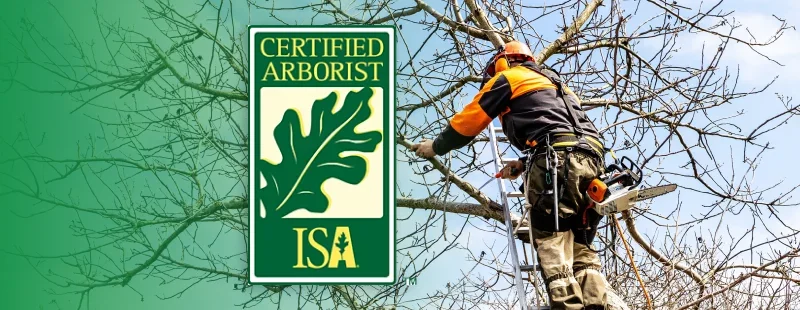
The ISA Certified Arborist is the most widely recognized credential in arboriculture. It’s administered by the International Society of Arboriculture, a global nonprofit that traces its roots to 1924 and now spans dozens of chapters across North America, Europe, Asia, Oceania, and South America.
What gives the credential its weight is the accreditation behind it. ISA certification is accredited by the ANSI National Accreditation Board (ANAB) and meets the requirements of ISO 17024, the international standard for bodies that certify people. That’s the same benchmark applied to professional certification programs far outside the green industry – which is why an ISA credential signals a genuinely verified standard of knowledge, not a self-awarded title. The exam is also offered in multiple languages, including English, French, Spanish, and Traditional Chinese, so the credential is recognized internationally rather than regionally.
One distinction matters: ISA certification is not a license. Licensing rules for tree work vary by state and country, and the ISA credential doesn’t replace them. It’s a professional certification that proves competence – and holders must abide by the ISA Code of Ethics as a condition of keeping it, which adds a layer of accountability that an unverified "certified arborist" business card simply doesn’t carry.
Requirements to Earn the ISA Certified Arborist Credential
So how do you become an ISA Certified Arborist? The ISA Certified Arborist requirements come down to experience, an exam, an application, and ongoing education.
-
Experience. You need a minimum of three years of full-time, practical work experience in arboriculture. Eligible duties include pruning, planting, fertilization, cabling and bracing, and diagnosing and treating tree problems – across employers like tree care companies, municipalities, landscape firms, and nurseries. A relevant degree shortens that requirement: a four-year degree in arboriculture, horticulture, landscape architecture, or forestry plus one year of experience, or a two-year degree plus two years, can both qualify.
-
Examination. The ISA Certified Arborist exam is a written test of 200 multiple-choice questions answered within 3.5 hours. It spans ten knowledge domains, including tree biology, tree identification and selection, soil-water relations, pest and disease diagnosis, pruning, installation and establishment, cabling and structural support, tree risk management, and safe work practices. Twenty of the 200 questions are unscored “pretest” items mixed in invisibly – so the 200-question arborist exam is as much a test of breadth as of depth.
-
Application. Candidates apply online through the ISA, documenting their experience or education, before enrolling to sit the exam at a Pearson VUE testing center, through an ISA Certification Partner, or via online proctoring.
-
Continuing education. The credential isn’t permanent. To maintain it, holders must either retake the exam or earn at least 30 continuing education units (CEUs) over each three-year cycle and pay a recertification fee. This continuing-education model is what keeps a certified arborist’s knowledge aligned with evolving best practices rather than frozen at the date they passed.
What an ISA Certified Arborist Actually Does on the Job
For a homeowner or property manager, the credential is abstract until someone shows up on site. Here’s what a certified arborist actually brings to a visit that a general landscaper typically can’t.
-
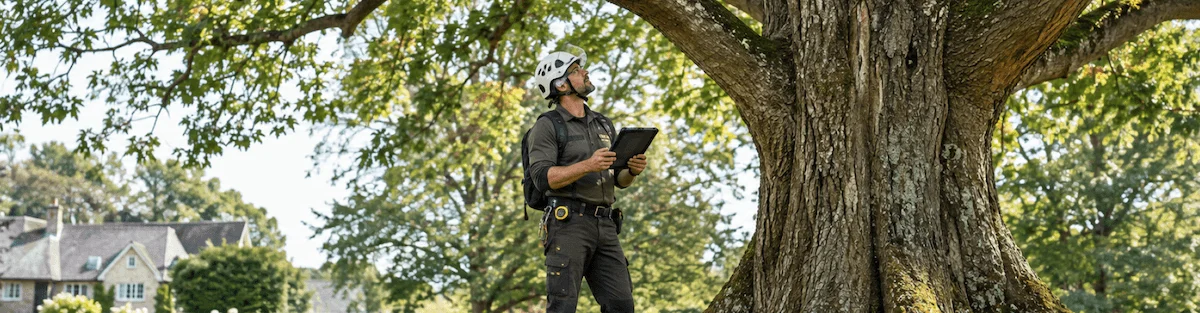
Tree health evaluation. A certified arborist performs a structured inspection of the crown, trunk, root zone, and surrounding soil, using knowledge of soil-water relations and pest diagnosis to identify disease, insect infestation, decline, or environmental stress – and to explain the cause, not just the symptom.
-
Structural assessment. They’re trained to spot defects most people walk past: codominant stems, including bark, weak branch unions, cavities, and root damage. These are the failure points that drop limbs on roofs and cars, and recognizing them is a learned skill.
-
Tree risk assessment. Using the ISA Tree Risk Assessment Qualification (TRAQ) methodology, a qualified arborist rates both the likelihood of a failure and its potential consequences, then produces a written report documenting the findings, the risk rating, and recommended actions. That document is what turns a hunch into defensible professional judgment.
-
Care recommendations. Pruning is specified to ANSI A300 standards – the recognized industry benchmark – rather than arbitrary cuts. When a tree needs structural support, the arborist designs appropriate cabling and bracing. Recommendations can also cover soil management and targeted pest and disease treatment plans.
-
Arborist reports. For permit applications, insurance claims, property-line disputes, and heritage or protected-tree assessments, a signed report from a credentialed arborist carries professional standing that an unverified opinion does not.
-
Emergency assessment. After a storm, a certified arborist evaluates which trees are safe, which need immediate removal, and which can be retained with intervention – preventing both unnecessary removals and dangerous oversights.
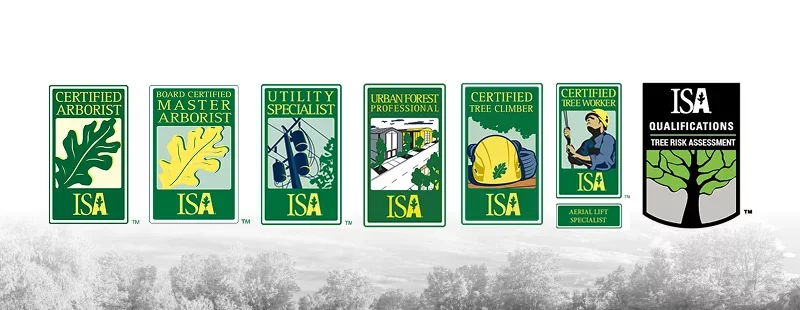
The Six ISA Certifications (Not Just One)
Many people assume “ISA Certified Arborist” is a single badge. It’s actually the entry point to a family of credentials, each earned by passing its own exam.
| ISA Credential | Purpose / Description |
|---|---|
| ISA Certified Arborist | The foundational ISA credential and the most common certification for professional arborists. |
| ISA Board Certified Master Arborist (BCMA) | The highest ISA credential. Requires an existing ISA Certified Arborist certification, additional experience, and passing a rigorous scenario-based exam. Held by fewer than 2% of ISA Certified Arborists. Common among senior consultants, expert witnesses, and urban foresters. |
| ISA Certified Arborist Utility Specialist | Designed for arborists working around power lines. Covers electrical hazard awareness, line clearance, and integrated vegetation management. |
| ISA Certified Urban Forest Professional | Intended for professionals managing municipal trees and urban forestry programs. Focuses on policy, planning, administration, and public tree risk management. Formerly known as the ISA Certified Arborist Municipal Specialist. |
| ISA Certified Tree Climber | Focuses on safe climbing techniques, rigging, and aerial tree work. Requires both a written exam and a practical climbing assessment. |
| ISA Certified Tree Worker Aerial Lift Specialist | For professionals who perform tree work using aerial lifts and elevated work platforms. |
| ISA Tree Risk Assessment Qualification (TRAQ) | Not a certification but a qualification. Authorizes arborists to conduct formal, methodology-based tree risk assessments commonly used for insurance, legal, and risk management purposes. |
Is ISA Certification Worth It for Your Tree Care Business?
For business owners, “is ISA certification worth it?” is really a question about revenue and risk. For most professional operations, the answer is yes.
Client Trust and Contract Access
Commercial clients, HOAs, municipalities, and property managers increasingly require a certified arborist on the contract. Without one on staff, your business simply can’t bid on that work – the credential is the entry ticket, not a nice-to-have.
Insurance and Liability
Certification signals to insurers that you operate to a professional standard, and written reports from a credentialed arborist carry real weight in disputes and claims. That combination can lower your exposure and, in some programs, your premiums.
Premium Pricing
Assessment, risk reporting, and consultation are higher-margin services that general tree services can’t credibly offer. A certified arborist can charge for professional judgment, not just labor – which is one of the most reliable paths to stronger margins and better leads.
Staff Development
Smaller operations often put a key crew member through the Certified Arborist exam as the first step toward building a credentialed team, directly expanding the contracts the company can pursue.
Documentation
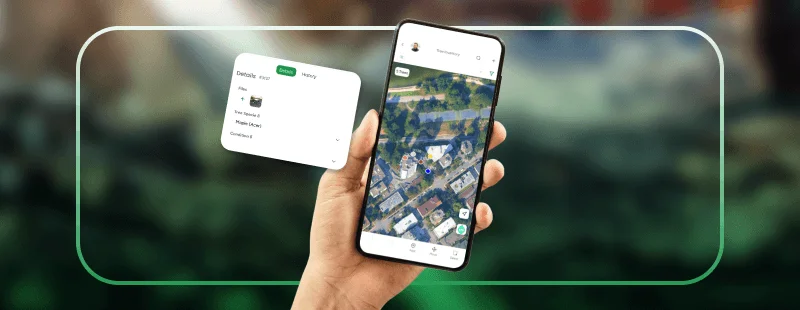
Running a certified operation means capturing assessments, risk ratings, and recommendations to a professional standard – in the field, not from memory. ArboStar’s job documentation tools (site photos, crew sign-offs, and assessment notes attached to each job record, alongside a purpose-built arborist CRM) help your paperwork match the standard the credential represents.
How to Verify an ISA Certified Arborist
Because the credential is independently verifiable, you never have to take a business card at face value. The ISA provides a public Verify an Arborist tool (at isa-arbor.com/verify) where anyone can search by name, credential number, or location.
A verification result shows the credential type, its expiration date, and whether it’s currently active. Always check before hiring – searching “ISA certified arborist near me” surfaces plenty of listings, but only the ISA Verify tool confirms that a credential is real and current. A card that reads “certified arborist” with no verifiable ISA number isn’t confirmation of anything.
FAQ
Is ISA certification worth it?
Yes, for most professional arborist businesses. The credential unlocks commercial contracts, municipal work, and permit-required arborist reports that non-certified operators can’t provide – and the cost of the exam and continuing education is usually recovered on the first higher-value contract it opens up.
How long does it take to become an ISA certified arborist?
The baseline is three years of full-time arboriculture experience before you can apply, though a relevant degree in horticulture or forestry can reduce that. Once eligible, most candidates spend roughly three to six months preparing for the exam.
How difficult is the ISA exam?
It’s substantial. The exam runs 200 questions across ten domains – tree biology, soil-water relations, pest diagnosis, pruning, cabling, planting, safety, and more – and candidates generally need to answer around three-quarters of the scored questions correctly. The ISA’s Online Learning Center, official study guide, and practice exam are the recommended preparation tools.
What’s the difference between an ISA Certified Arborist and an ISA Board Certified Master Arborist?
The Certified Arborist is the entry-level professional credential. The Board Certified Master Arborist is ISA’s highest level – it requires an existing Certified Arborist credential, additional experience, and a separate advanced exam, and fewer than 2% of certified arborists hold it. BCMAs are typically senior consultants and expert witnesses.
Can ISA Certified Arborists work internationally?
Yes. The credential is recognized internationally, and the exam is available in English, French, Spanish, and Traditional Chinese. The ISA maintains chapters in many countries, including Canada, the UK, Australia, and New Zealand.
See how ArboStar can run your tree care business
Quoting, scheduling, crews and invoicing in one place. Book a short demo and see it with your own jobs.