

Ask any homeowner what they've been told about hiring tree work and the answer comes back the same: only choose a bonded and insured tree service. Consumer guides, insurance blogs, and your own competitors all hammer it. For a tree care business owner, that repetition is worth paying attention to, because it means your prospects are already screening for these credentials before they ever pick up the phone. Understanding exactly what bonding and insurance cover, where they protect you, and how customers check them is the difference between winning that call and losing it to the company down the road.
What it means for a tree service to be bonded and insured
Bonding and insurance prove you meet the legal and financial requirements to do dangerous work on someone else's property. They are your safety net, and the customer's, when a job goes sideways: property damage, an injured worker, or a contract left half-finished. They are not interchangeable, though, and the details matter.
Understanding bonds in the tree service industry
A bond is a promise with financial teeth behind it. Technically it's a three-party arrangement between your company (the principal), the customer (the obligee), and a surety company that backs your word. If you abandon the job or fail to deliver what the contract spells out, the customer can file a claim and the surety pays out. The part that helps you as an owner: a surety won't issue a bond to a business it considers a bad risk. It vets your financial health and track record first, so telling a prospect you're bonded also tells them a third party already checked you out and vouched.
Types of insurance tree companies carry
"Insured" is a word people hide behind, so know precisely what a real tree service carries. General liability covers damage to a client's home, driveway, fence, or vehicle when a cut goes wrong. Workers' compensation covers your crew when someone gets hurt, which in this trade eventually happens. Commercial auto handles accidents involving your trucks and chip haulers on the road. Coverage limits signal how seriously you take the risk: $1,000,000 in general liability is the floor most residential clients expect, and $2,000,000 is the benchmark for larger jobs or work near high-value property. If you're still sorting out what your operation is legally required to carry, our breakdown of tree service insurance requirements covers it policy by policy.
Key differences between bonding and insurance
Both protect the customer, but against different failures. Insurance responds to accidents, the things that go wrong even with a careful crew. A bond responds to non-performance and misconduct: job abandonment, an employee stealing on site, failing to pay for permits, or work that doesn't meet the agreed standard. Insurance covers the "what ifs." The bond covers the "what if you don't deliver." Carry both and you close the gap that either one alone leaves open.
What being bonded and insured protects
For the customer, these credentials shield their home and their money. For you, they shield the business you've spent years building. Both sides of that are worth spelling out on a sales call.
Liability coverage for accidents and damages
Tree work is unforgiving. A misjudged limb lands on a roof, a climber falls, a truck clips a mailbox. With proper insurance, the carrier absorbs those costs instead of the homeowner, and instead of you. Without it, a single accident can turn into repair bills, medical claims, and a lawsuit that names you personally. That exposure is the core of the legal and liability aspects every arborist should know, and it's why underwriters and serious clients treat coverage as non-negotiable.
Protection against unfinished or substandard work
This is the bond's job. If a crew leaves debris, misses contract terms, or walks off a half-done removal, the bond gives the customer a way to recover and get the work fixed. From your side, being bonded is a statement that you stand behind the job. It removes the biggest fear a homeowner has when handing a deposit to a stranger with a chainsaw: that the money disappears and the tree is still leaning over the garage.
Benefits of running a bonded and insured tree service
Most guides frame these benefits for the homeowner. Flip them and they read as a growth strategy for your company.
It unlocks the contracts worth winning
Commercial property managers, HOAs, and municipalities almost always require proof of insurance, and often a bond, before you can even submit a bid. The higher-margin, repeat-revenue work sits behind exactly the credentials that cut-rate operators skip. No certificate, no seat at the table. If bidding is your growth path, coverage is step one, and our guide on how to win more tree service bids handles the rest.
It lets you charge what the work is worth
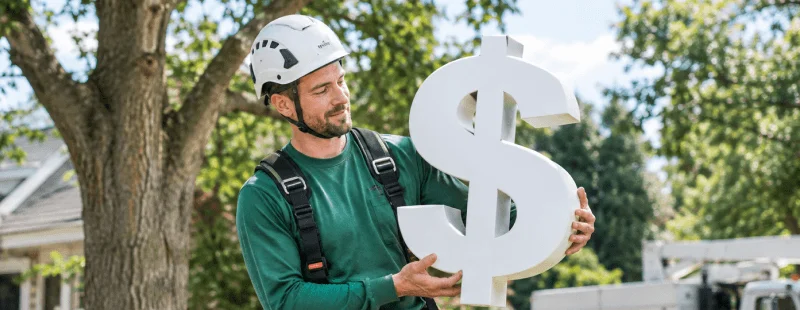
When your quote comes in higher than the guy working out of a pickup, the bond and insurance are your answer to "why does this cost more?" You're not the expensive option, you're the covered one. Every consumer article has already trained the customer to see the cheap, uninsured bid as the risky bet. Naming your credentials out loud closes that gap and protects your margin.
The risks of operating unbonded or uninsured
Skipping coverage to shave costs is a gamble against your own business, and the odds are bad.
Legal and personal exposure
Work without proper insurance and one injury or accident can land in court with your name on it. A hurt worker with no workers' comp can pursue you directly for medical bills and lost wages. Damage to a client's property with no liability policy becomes a dispute you pay to settle. The savings from dropping coverage vanish the first time something goes wrong.
Lost work and reputation damage
Beyond the legal risk, uninsured operators quietly lose business they never see. They can't bid the commercial jobs, they get filtered out by careful homeowners, and one public accident can end a local reputation built over years. In an industry with razor-thin margins on some jobs, that's a slow bleed that coverage prevents.
How customers verify bonding and insurance
Prospects are increasingly coached to check, not just trust. Knowing what they look for lets you be ready and turn the check into a sale.
What they ask for
The standard move is to request a certificate of insurance and confirm it lists current general liability and workers' comp. More careful clients call the listed agency to verify the policy is active and covers tree work, and they ask for a bond number to confirm with the surety. Keeping a clean, current certificate ready to send the moment it's requested speeds the sale, because any delay reads as a warning sign.
The red flags to never resemble
Homeowners are told to walk away from a company that won't show proof, pushes for full payment up front, has no physical address, or gets cagey about credentials. Make sure your business is the opposite of that list at every touchpoint: proof on hand, clear terms, credentials visible on the truck, the estimate, and the website. Presenting like a professional is half of being chosen as one, and it pairs with the wider tactics in our marketing ideas for tree service companies.
Keeping coverage current as you scale
The operational trap is expiration. Policies lapse, bonds renew on their own calendar, workers' comp gets audited, and a certificate that expired last month gives a client zero protection and you a dead bid. On a two-person crew you can track that in your head. Across multiple crews and dozens of active jobs, you can't. Storing certificates, renewal dates, and every crew member's credentials in one system instead of a glovebox folder is how you avoid finding an expired policy the week a commercial contract comes up for renewal. That document and compliance tracking is exactly what a purpose-built tree care management platform is built to carry for you.
Never Let a Certificate Expire Mid-Bid
Store every certificate, bond renewal date, and crew credential in one place – so you're always ready to send proof the moment a client asks.
Frequently Asked Questions
What's the difference between bonded and insured for a tree service?
Insurance covers accidents, such as property damage or injuries during the job. A bond guarantees performance, compensating the customer if the company abandons the work, does substandard work, or otherwise fails to deliver on the contract. They cover different risks, so professional companies carry both.
Is a business license the same as being bonded and insured?
No. A license is government permission to operate and gives the customer no financial protection. Insurance protects against accidents and injuries, and a bond guarantees the job is completed as agreed. A fully credentialed tree service carries all three.
How much liability insurance should a tree service carry?
For most residential work, $1,000,000 in general liability is the expected minimum. For larger jobs, commercial contracts, or work near high-value property, $2,000,000 or more is the benchmark, and higher limits double as a selling point against uninsured competitors.
What does a surety bond cover that insurance doesn't?
A bond covers non-performance and misconduct: job abandonment, employee theft on the property, failure to pay for permits, and work that fails to meet the contract. Insurance only responds to accidents, so the bond fills the gap liability and workers' comp policies leave open.
How do customers verify a tree service is really insured?
They request a certificate of insurance and often call the listed agency to confirm the policy is active and covers tree work. Because clients are increasingly told to verify, keeping a current certificate ready to send speeds up the sale and builds trust.
Why should a tree care business invest in bonding and insurance?
It unlocks commercial and municipal bids that require proof of coverage, justifies premium pricing against cheaper competitors, and protects the business from a single accident or lawsuit that could otherwise end it. It's a revenue driver, not just a cost.