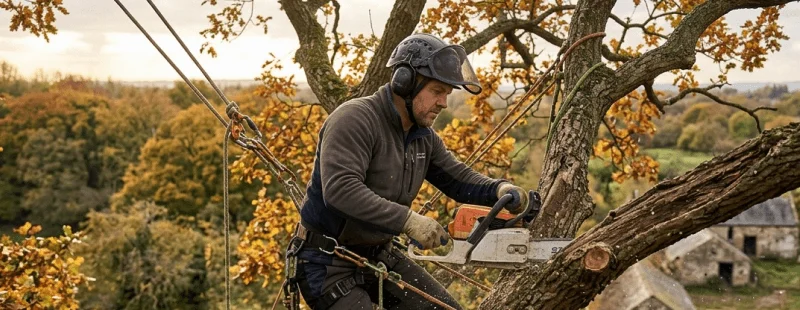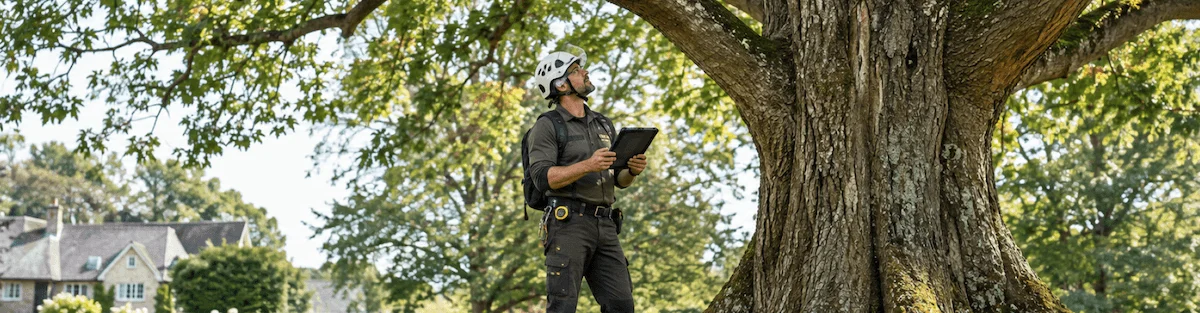


Two crews pull up to the same job. One climber wears an ISA Certified Arborist patch; the other has a state-issued license number on the truck door. A homeowner assumes they mean the same thing. So do a lot of tree care owners writing their first bid on a municipal contract. They don't. The arborist license vs certification question trips up people on both sides of the tape measure, and getting it wrong can cost you a permit, a contract, or a lawsuit.
Here's the short version: a license is a legal permission to operate, granted by a government. Certification is proof of knowledge, granted by a professional body. One is about the law. The other is about skill. You often need both, and they rarely come from the same place.
Arborist license vs certification at a glance
|
|
License | Certification |
|---|---|---|
| Who issues it | State or municipal government | Professional body (usually the ISA) |
| Required by law? | Yes, where it applies | No, it's voluntary |
| What it proves | You're legally cleared to work | You have tested knowledge and experience |
| How you get it | Application, fees, sometimes an exam or insurance proof | Three years' experience plus a comprehensive exam |
| Renewal | Varies by state, often annual | Every three years via continuing education units |
What is an arborist license?
A license is the government's way of saying you're allowed to do tree work for money inside its borders. It's a compliance requirement, not a badge of competence. Depending on where you operate, "licensed" can mean anything from passing a state arborist exam to simply carrying the right insurance and registering as a contractor.
The catch is how uneven the map is. Some states run a dedicated arborist licensing board with its own test. Connecticut issues a Commercial Arborist License. Maryland has its Licensed Tree Expert credential. New Jersey requires a Licensed Tree Care Operator or Licensed Tree Expert. Maine, Louisiana, and Rhode Island each run their own programs. California and Hawaii fold tree work into their contractor system, so you need a C-27 (landscaping) or D-49 (tree service) classification once a job crosses a dollar or size threshold.
Then there are states with no statewide requirement at all. Texas has no state licensing board for arborists, which is why the Texas Tree Surgeons team openly warns homeowners to be suspicious of anyone advertising as a "Texas licensed arborist," because the title doesn't exist there. But "no state license" almost never means "no license." Cities and counties routinely require a local tree contractor permit even where the state stays quiet. The rule you actually answer to is often written at city hall, not the capitol.
Which states require an arborist license?
Roughly fifteen to eighteen states regulate tree work at the state level, and the figure you'll see repeated online, that only a handful strictly require a license to touch a tree, glosses over the local layer. States with named arborist or tree-expert licensing include Connecticut, Maryland, New Jersey, Maine, Louisiana, Rhode Island, Kansas, and North Dakota. Contractor-based states like California, Hawaii, Oregon, Washington, and Utah reach tree work through their construction licensing boards instead.
Because the requirement moves every time you cross a line on the map, the only safe habit is to check the specific state and municipality before you bid there. If you run crews across regions, that verification becomes an operational task, not a one-time favor: what's legal in one county can be a violation two towns over.
What is ISA arborist certification?
Certification is the opposite animal. Nobody makes you get it. The ISA Certified Arborist credential, issued by the International Society of Arboriculture, exists to prove that a person actually knows the craft: tree biology, pruning standards, diagnosis of pests and disease, soil and plant health care, and safe rigging. To sit the exam you need three years of full-time arboriculture experience (or a relevant degree plus less time), and you have to pass a comprehensive test. Miss the renewal cycle and it lapses: every three years, certified arborists log continuing education units to keep the credential active, which is the mechanism that keeps their knowledge current instead of frozen at exam day.
Verification is refreshingly simple. Every ISA Certified Arborist gets a unique number tied to the state where they first certified. Anyone (a homeowner, a procurement officer, you vetting a new hire) can confirm it at treesaregood.com. If someone claims the title but can't produce a number, that tells you something. For the deeper background on what the credential covers, our breakdown of what an ISA Certified Arborist is walks through the exam and the day-to-day work it maps to.
The ISA credential ladder
"Certified" isn't a single rung. ISA runs a stack of credentials, and knowing where each sits helps you read a résumé or a competitor's marketing:
-
ISA Certified Arborist: the foundation, and the one most homeowners and contracts are asking about.
-
Specialty certifications: Tree Worker Climber, Utility Specialist, and Municipal Specialist layer targeted expertise on top of the base credential.
-
Tree Risk Assessment Qualification (TRAQ): increasingly demanded on commercial and municipal jobs where liability is the whole conversation.
-
Board Certified Master Arborist (BCMA): the top of the field. Fewer than two percent of ISA Certified Arborists hold it.
If you want to see how these titles map to actual roles on a crew, our guide to the different types of arborists lays out who does what.
Cost and time: license vs certification
The money question has two very different answers. ISA certification is cheap up front and expensive in time. The exam runs $175 for ISA members and $350 for non-members, but you can't take it until you've logged three years in the field, and most people reach it three to five years into their careers once study time is counted. A prep course adds anywhere from $1,000 to $3,000 if you go that route.
Licensing is the reverse: usually fast to obtain, priced by the state, and recurring. Connecticut's license fee sits around $200. Rhode Island charges $25 a year plus a $25 exam. Contractor-license states bundle tree work into fees that can run higher, and every one of them expects renewal. Certification renews on CEUs; a license renews on a check and, often, proof of current insurance.
Why arborist license vs certification matters for your business
For a tree care owner this stops being trivia the moment you chase bigger work. Municipal and commercial contracts frequently require an ISA Certified Arborist on staff as a condition of even submitting, and many require the right state license or contractor classification on top of it. Show up without either and your bid is dead before anyone reads your price. It's one of the quieter reasons companies lose work they were otherwise qualified to do, a theme we dig into in how to win more tree service bids.
Insurance underwriters care too. Carrying certified staff and proper licensing can shape your premiums and your coverage terms, and it's tightly bound up with the liability and legal exposure every arborist carries. Then there's the marketing edge: "ISA Certified Arborists on staff, fully licensed and insured" is a line that closes homeowners who've been burned by a cheap crew before.
The operational headache is keeping all of it current across a growing team. Certifications expire on three-year cycles, licenses renew on their own calendars, and CEU deadlines don't send reminders. Tracking who holds what, and what lapses when, inside your employee management system beats discovering an expired credential the week a big contract renews.
Do you need both a license and certification?
For a serious tree care company, yes. The license keeps you legal; skip it where it's required and you risk fines, a shut-down job, or an invalidated insurance claim. Certification keeps you competitive and credible, and it's the thing that unlocks the contracts worth having. The strongest firms treat them as two separate boxes that both get checked: licensed where they operate, certified across the crew, and able to prove both on demand. The whole point of untangling arborist license vs certification is realizing they were never competing. They're two halves of running a professional operation.
Frequently Asked Questions
Is a certified arborist the same as a licensed arborist?
No. A licensed arborist has legal clearance from a state or city to do tree work. A certified arborist has passed a professional exam, usually the ISA's, proving knowledge and experience. One is a legal permission, the other is a demonstrated skill, and they come from different authorities.
Do you need a license to be an arborist?
It depends entirely on where you work. Some states require a state arborist or contractor license, and many cities require a local tree contractor permit even where the state doesn't. Other places have no requirement at all. Always check the specific state and municipality before bidding.
How long does it take to become a certified arborist?
You need three years of full-time arboriculture experience before you can sit the ISA Certified Arborist exam, so most people earn it three to five years into their careers once study time is factored in. A relevant degree can reduce the required experience.
How much does ISA certification cost?
The ISA Certified Arborist exam costs $175 for ISA members and $350 for non-members. Optional prep courses add $1,000 to $3,000. After certifying, you renew every three years by earning continuing education units rather than retaking the exam.
Which states require an arborist license?
Roughly fifteen to eighteen states regulate tree work at the state level, including Connecticut, Maryland, New Jersey, Maine, Louisiana, and Rhode Island, plus contractor-license states like California, Hawaii, Oregon, and Washington. Local city and county permits often apply even outside these states.
Is ISA certification worth it for my tree care business?
For most companies chasing commercial, municipal, or repeat residential work, yes. Certification is often a bidding requirement, can improve insurance terms, and is a strong trust signal in marketing. It's voluntary, but it opens doors a license alone won't.
Stay Compliant, Bid-Ready, and Ahead of Renewals
Track every crew member's license, ISA certification, and CEU deadline in one place – so an expired credential never costs you a bid or a contract.