

Workers’ Comp for Tree Climbers: Costs, Class Codes, and How to Lower Your Rate
Quick summary: Workers compensation for tree climbers is almost always the single most expensive insurance line a tree company carries. Climbing and aerial work is rated under NCCI class code 0106, and premiums typically run somewhere between $8 and $15 per $100 of payroll before any adjustments – though the real number on your policy depends heavily on your state, your carrier, and your loss history. What actually moves that number is your experience modification factor (EMod), how cleanly you split climber payroll from ground payroll, your claims history, and whether you can show a documented safety program. Coverage is legally required in most states once you have employees, climbers included.
Key entities: NCCI class code 0106, experience modification factor, ANSI Z133, ISA, TCIA, exclusive remedy, payroll audit, return-to-work program.
Why Tree Climbers Are the Most Expensive Class in Workers’ Comp
Every insurance line a tree company buys – general liability, commercial auto, umbrella – gets sized up against one number, and for most outfits it’s the workers’ comp line that comes out on top, and it’s not close. The reason isn’t frequency. It’s severity. A climber working sixty feet up with a running saw, cutting storm-damaged wood or working a limb near an energized line, is one bad angle away from a claim that runs into six figures. Tree work as an occupation posts a fatality rate that industry analyses of federal labor data put at roughly 30 times the all-industry average – and that’s before counting the non-fatal falls, amputations, and crush injuries that don’t make the headlines but still drive up claims.
The ground crew carries real risk too – struck-by incidents from falling wood are a leading cause of tree-work injuries – but the climber is the one exposed to height, chain saws at extension, dead and storm-loaded wood, and proximity to power lines all at once. That combination is exactly why arborist workers compensation premiums are usually the largest line item on a tree company’s insurance bill, ahead of general liability and ahead of commercial auto, often by a wide margin. It’s also just one of several policies a tree business needs to have in place – see our Tree Removal Insurance for Arborist Businesses guide for how workers’ comp fits alongside the other four core coverages.
Is Workers’ Comp Required for Your Climbing Crew?
In the large majority of states, workers’ comp becomes mandatory the moment you have employees – climbers absolutely included. The exact trigger varies: some states require coverage from your very first hire, others set a threshold of three or more employees, and a handful carve out exceptions for close relatives or very small crews. Owners and corporate officers can often elect to exclude themselves from coverage, but that election has to be filed correctly and doesn’t extend to anyone else on the crew.
The legal mechanism behind all of this is called exclusive remedy. In exchange for guaranteed, no-fault benefits – medical care and a portion of lost wages regardless of who caused the accident – an injured employee generally gives up the right to sue their employer in civil court. That trade is the entire reason WC exists as a system, and it’s also the biggest reason to never go without it. Run bare and that shield disappears: you’re exposed to a direct lawsuit, and depending on the state, you’re also looking at fines, stop-work orders, and personal liability that can reach past the business and into the owner’s own assets. This is exactly the ground where workers comp for arborists stops being optional in any practical sense, even in the states where the statute leaves a narrow legal gap. Requirements shift from year to year, so verify the current threshold with your state workers’ comp board before assuming you’re covered – or exempt.
The Class Codes That Decide Your Rate
Before a carrier can price anything, every worker on your payroll has to be sorted into a classification code, and for tree companies, that sorting exercise is where a lot of money gets won or lost.
0106 – Climbing & Aerial Tree Work
NCCI code 0106 – officially “Tree Pruning, Spraying, Repairing, All Operations & Drivers” – is the code that covers any tree work performed above ground level: climbing with rope and saddle, working from ladders, running a bucket truck or aerial lift, pruning, spraying, and most incidental removal work. It’s the code your climbers sit in, and it’s priced accordingly – commonly somewhere in the $8 to $15 per $100 of payroll range, though actual field rates vary a lot by state and by carrier appetite for tree risk. This is the code most guides mean when they talk about tree service workers comp pricing, because for most companies it’s the code that sets the tone for the whole policy.
Ground-Level Codes
Work that genuinely never leaves the ground – dragging brush, feeding the chipper, stump grinding, loading debris – can sometimes be rated under a lower-cost classification instead of 0106, depending on your state’s rating rules and how your book of business is structured. In some states that’s a landscaping-adjacent code; in others it’s a maintenance-specific code. The lower rate only holds up if the worker in question genuinely never climbs, never runs an aerial device, and the split is backed by real records – which is the subject of its own section below. There’s no universal “the ground code is X” answer here, because state rating bureaus don’t all slice it the same way, so this is worth confirming with your agent against your specific state’s rating manual rather than assuming.
Why Misclassification Backfires at Audit
Every tree company gets an annual payroll audit, and this is where sloppy classification comes back to bite. If your records can’t demonstrate that certain employees genuinely stayed on the ground all year, the auditor reclassifies that payroll to 0106 and back-bills the difference for the entire policy term – sometimes thousands of dollars, due all at once. It gets worse if there’s ever a claim involved: an injury that happens while someone is doing above-ground work they weren’t rated for can trigger a coverage dispute right when you need the policy to perform. Accuracy beats creativity every time here.
What Workers’ Comp Actually Costs for Tree Climbers
For tree climbers, workers’ comp is rarely a fixed line item – it’s a moving target that can quietly eat into profits. State rates, payroll size, and claims history decide whether the premium stays manageable or turns into a serious burden.
Rate Per $100 of Payroll
Workers’ comp is priced per $100 of payroll, and the base rate for each class code is filed by state – meaning the exact number attached to code 0106 in Georgia is not the number attached to it in Oregon. As a rough illustration: a $10 rate applied to $60,000 in annual climber payroll works out to roughly $6,000 in base premium for that one employee, before any credits, debits, or EMod adjustment. That’s before general liability, auto, or umbrella are added in – it’s just the climbing line by itself.
The Experience Modification Factor (EMod)
The single biggest lever an owner controls isn’t the base rate – it’s the experience modification factor, or EMod. This number compares your actual claims history to what’s statistically expected for a business your size in your class code. An EMod under 1.0 gets you a discount on the base rate; over 1.0 adds a surcharge, and because it’s multiplicative, it stacks on every dollar of payroll in that code, every year, until enough clean claims history rolls off to bring it back down. A company running a 1.3 EMod is paying 30% more than a company running a 0.9 EMod for the exact same payroll and the exact same base rate – which is why claims management and safety records matter as much as shopping for a lower quote.
A Sample Premium Calculation
Illustration only – not a quote
| Payroll category | Annual payroll | Illustrative rate /$100 | Base premium |
|---|---|---|---|
| Climbing crew (code 0106) | $180,000 | $11.00 | $19,800 |
| Ground crew (documented split) | $120,000 | $4.50 | $5,400 |
| Combined base premium | – | – | $25,200 |
| Applied EMod (1.05) | – | – | $26,460 |
Change the EMod to 0.85 in that same example and the final premium drops to roughly $21,420 – a difference of over $5,000 a year, without touching a single wage or changing carriers. That gap is the whole argument for taking safety and claims management seriously rather than treating them as paperwork.
What Workers’ Comp Covers for an Injured Climber (and What It Doesn’t)
When a claim is valid, workers’ comp generally pays for medical treatment related to the injury, a portion of lost wages while the employee recovers – typically around two-thirds of average wages, subject to state-set caps – disability benefits if the injury causes lasting impairment, and death or funeral benefits in the worst cases. Falls from height and contact with energized lines are the two scenarios most likely to turn into six-figure claims, between the medical costs and the extended disability benefits that follow.
What it doesn’t cover is just as important. Injury or property damage to a third party – a client’s roof, a neighbor’s fence, a passing vehicle – falls under general liability, not workers’ comp. Most policies also exclude injuries connected to intoxication on the job, horseplay, work performed outside the scope of employment, and injuries to a subcontractor who genuinely carries their own valid coverage as an independent business, rather than someone functioning as your employee in practice.
The Payroll Split Most Owners Get Wrong
Splitting payroll between the climbing code and a lower ground-level code is a completely legitimate way to lower your premium – it’s not the same thing as misclassification, as long as it reflects reality. The difference is documentation. A split only survives an audit when you can show actual time records or job-role assignments proving which hours a given employee spent on the ground versus above it. Job tickets, crew rosters, and time-tracking by task all work. What doesn’t work is an assumption on the declarations page that isn’t backed by anything on paper – because without records, the standard audit approach is to push all the payroll for that crew into the highest-rated code they touched, which erases whatever savings you thought you had.
How to Lower Your Climber Workers’ Comp Premium
Owners who actually move the needle on tree climber insurance cost tend to be working several levers at once rather than chasing a single cheaper quote:
-
A documented safety program built around ANSI Z133 – the industry safety standard for arboriculture operations. Carriers underwriting tree risk look for it specifically, and a program that exists only verbally doesn’t count at renewal time.
-
ISA Certified Arborist credentials and TCIA accreditation on your crew and your company. These credentials signal to underwriters that training isn’t ad hoc, and some carriers price accredited companies more favorably as a matter of policy.
-
A return-to-work program that brings an injured employee back on light duty as soon as medically appropriate, rather than leaving them on full wage-replacement benefits for months. Shorter claim durations mean lower claim costs, which flows directly into a better EMod.
-
Active claims management – reporting incidents promptly, working with the adjuster, and not letting small claims linger unresolved, since an open claim sits on your loss run and affects your EMod calculation for years.
-
Pay-as-you-go billing tied to actual payroll runs, which won’t lower your rate directly but keeps cash flow predictable through a seasonal business and avoids a painful true-up at audit.
The pattern underneath all of it: the safest companies to insure are also the cheapest to insure, and underwriters are increasingly set up to actually see and price that difference rather than just guessing at it.
1099 Climbers and Subcontractors – a Costly Trap
Bringing in a 1099 climber to cover a busy stretch feels like a clean way to avoid adding payroll – until that climber gets hurt on your job site without their own valid coverage. In that situation, your policy is very often the one that ends up paying the claim, because the state will typically look at who directed the work and treat the “subcontractor” as your employee for workers’ comp purposes regardless of the 1099 paperwork. Your annual audit will also pick up their payroll as if they were on staff, at whatever code applies to the work they did.
The fix is simple and cheap compared to the alternative: collect a current certificate of insurance (COI) proving the subcontractor carries their own workers’ comp before they set foot on a job, and keep it on file, current, for every job they work – not just the first one. An expired COI protects you exactly as well as no COI at all.
How Job Documentation Protects You at Audit and Claim Time
Pull the threads of this article together and they all lead to the same place: paper. The payroll split that lowers your climber rating needs time records to survive an audit. The safety-program discount needs written procedures, not a verbal understanding among the crew. Every 1099 climber needs a current COI on file before they’re allowed on a job. And your EMod, over time, is really just a reflection of how well your claims get handled and how quickly people get back to work.
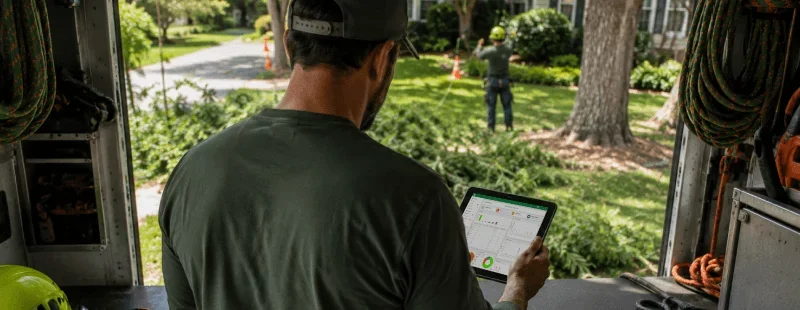
This is the part where good job management software earns its keep rather than sitting idle. ArboStar’s job management and CRM tools let a crew log roles per job, attach site photos, keep signed estimates and completion records tied to each work order, and pull that history back out the moment an auditor or adjuster asks for it – which is exactly the paper trail that defends a payroll split, backs up a safety-discount application, and speeds up a claim instead of dragging it out. None of that replaces a broker or an insurance agent, but it’s the difference between scrambling for records at audit time and having them ready in a few clicks.
Keep Your Audit Paper Trail Ready
Log crew roles per job, attach site photos, and keep signed estimates tied to every work order – so the records that defend your payroll split are a few clicks away, not a scramble
FAQ
Does workers’ comp cover an independent 1099 tree climber?
Only if that climber genuinely operates as an independent business and carries their own valid workers’ comp policy, evidenced by a current certificate of insurance. If they don’t, and they get hurt on your job, your policy is very likely to be the one on the hook, and your next payroll audit will pick up their wages under whichever class code applies.
How much does workers’ comp cost for a tree climber?
Base rates for the climbing classification, NCCI class code 0106, commonly fall somewhere between $8 and $15 per $100 of payroll, though the number that actually shows up on your policy depends on your state, your carrier, and your experience modification factor. Get a current quote rather than relying on any published range, since rates are refiled and adjusted regularly.
What is class code 0106?
It’s the NCCI classification covering above-ground tree work: climbing, ladder work, aerial lift and bucket truck operation, pruning, spraying, and most tree removal. It’s the code your climbing crew is rated under, and it’s one of the higher-priced classifications in the entire NCCI system because of the injury severity associated with the work.
Can I exclude myself as the owner from coverage?
In many states, yes — owners and corporate officers can typically file an election to exclude themselves from workers’ comp coverage. The exact rules, forms, and eligibility vary significantly by state, and the exclusion generally applies only to the owner, not to any other employee, so it’s worth confirming directly with your state’s workers’ comp board or your agent before assuming it applies to your situation.
Will a safety certification actually lower my premium?
It can. ISA certification, TCIA accreditation, and a documented ANSI Z133 safety program are all things underwriters look for when pricing tree risk, and some carriers apply specific credits for them. The bigger, longer-term effect is indirect: fewer and less severe claims push your EMod down, which lowers your premium every year the improved history stays on your loss run.
What happens to my rate after a climber is injured?
The claim enters your loss history and feeds into your experience modification factor calculation, typically affecting rates for the next one to three policy years depending on your state’s rating rules. How the claim is managed matters almost as much as the injury itself – a claim that’s reported promptly, medically managed well, and resolved through a return-to-work program tends to cost less and affect your EMod less than the same injury left to drag on.
Get Your Climbing Crew’s Paperwork Ready for the Next Audit
The companies that end up cheapest to insure aren’t the ones who found the one carrier willing to shave a point off the rate – they’re the ones whose payroll splits hold up, whose safety program is written down instead of assumed, and whose claims get closed instead of left open. Workers compensation tree climbers coverage will always be the priciest line on your policy because the work is genuinely dangerous, but the gap between a well-run company’s premium and a poorly-documented one’s premium is real money, every single year.
Get your class codes right, keep records that back up your payroll split, put your safety program on paper, and manage claims instead of letting them sit. If you want to see how ArboStar helps tree companies keep crew roles, job records, and safety documentation organized in one place, book a demo and we’ll walk through it with your operation in mind.