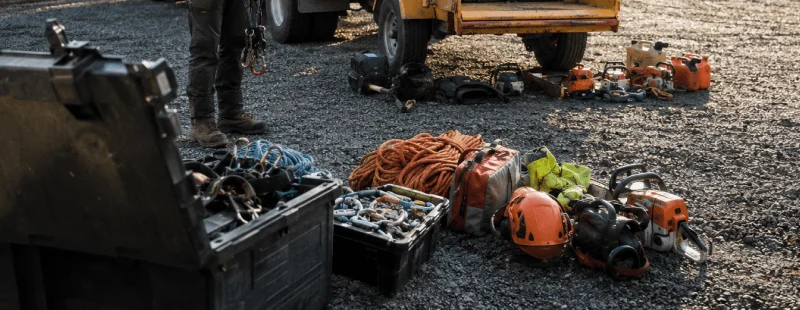


Here is the short answer most operators are looking for. If you run crane jobs a few times a month, renting almost always wins. Once a crane is booked most weeks and you are turning down big removals because you cannot get a machine on site fast enough, buying starts to pencil out. The tree removal crane cost that matters to your business is not the day rate. It is the total of the day rate, your labor, and the jobs you win or lose because of how you get a crane on site.
This guide walks through both sides. What a crane costs to rent per job, what it really costs to own one, and the utilization math that tells you which side of the line your company sits on.
What crane-assisted tree removal actually costs
Before you can compare renting to owning, you need real numbers for both. Crane-assisted removal uses a hydraulic crane to lift trunk and canopy sections straight up and out of the work zone while a climbing arborist rigs each pick. It replaces slow, high-risk rope-and-rigging work on the trees that are too big, too dead, or too close to a structure for standard takedowns.
Crane rental rates
Most tree crews rent the crane with an operator by the hour or by the day. A common structure is around $150 per hour with a four-hour minimum for a mid-size machine. Some crane-owning tree companies quote other tree services at a flat rate, for example $150 per hour on an eight-hour minimum, which tells you they would rather sell you a full day than a half. After-hours and weekend storm work often adds roughly $25 per hour on top.
By the day, the crane alone usually runs $500 to $1,500 for a small-to-mid machine and higher as tonnage climbs. If the crane has to travel more than 30 to 40 miles from its yard, expect a mobilization fee somewhere between $300 and $800 before the boom ever swings. The table below reflects the ranges tree crews see across most US markets in 2026.
| Crane class | Typical rental (with operator) | Fits |
|---|---|---|
| Small, 30 to 60 ton | $500 to $1,500 per day | Trees under 60 ft, moderate trunk weight |
| Medium, 70 to 90 ton | $1,500 to $3,000 per day | 60 to 90 ft trees, heavy trunk sections |
| Large, 100+ ton | $3,000 to $5,000+ per day | 90 ft+ trees, long reach or extreme weight |
Total job cost by tree size
The rental is only part of what the homeowner pays. Your quote also carries the climber, the ground crew, rigging hardware, chipping, and haul-away. Once you stack all of that, a crane job usually lands like this:
| Tree | Standard removal | Crane-assisted removal |
|---|---|---|
| Medium, 30 to 50 ft | $800 to $2,500 | $2,000 to $4,500 |
| Large, 50 to 75 ft | $1,500 to $4,500 | $3,500 to $8,000 |
| Very large, 75 to 100+ ft | $3,000 to $8,000 | $6,000 to $15,000+ |
Those spreads are wide for a reason. The same 80-foot loblolly costs very differently depending on whether the crane parks in the driveway or has to reach 90 feet over a roof from the street.
What drives the cost on any crane job
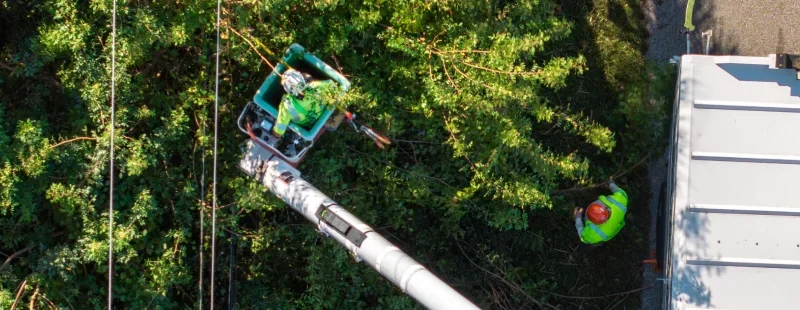
Five things move the number more than anything else, and they apply whether you rent or own. Tree size and weight set the crane class. An 80-foot pine with a 30-inch trunk can weigh 15,000 to 20,000 pounds, which means a bigger machine and most of a day. Reach matters as much as weight, since a tree at the back of a lot needs more crane than the same tree next to the setup point.
Then there is access. Narrow streets, soft ground, gated communities, and overhead wires all decide whether a crane fits and where the outriggers can land. Travel distance adds the mobilization fee. Permits come into play when the crane sets up on a public road or right-of-way, usually $100 to $500 depending on the municipality. Finally, duration. Most residential crane removals run four to eight hours, and the jump from a half day to a full day can swing your crane cost by $500 to $2,000.
The real cost of owning a crane
Now the other side of the ledger. Buying a crane is not one number on a purchase agreement. It is a fixed monthly obligation that shows up whether the machine works or sits. Underestimating the carrying cost is the most common mistake owners make when they get emotional about owning iron instead of renting it.
Purchase and financing
A used boom truck or knuckle-boom crane suited to tree work commonly runs somewhere from the low six figures into the mid six figures, depending on tonnage, hours, and condition. New, purpose-built units go well past that. Most operators finance, so the number that actually hits your P&L is the monthly payment, often several thousand dollars, plus interest, spread across five to seven years. That payment is due in your slow season too.
Operator, insurance, and certification
A crane needs a qualified operator, and for tree work that means someone who understands both the machine and the rigging. The industry credential is the National Commission for the Certification of Crane Operators, or NCCCO certification. A certified operator commands a real wage premium, and if you do not already have one on staff, that is a new hire or a training investment before the crane earns a dollar.
Insurance is the line that surprises people. Adding a crane pushes your general liability and equipment coverage up sharply, because the exposure on a heavy lift over a house is nothing like a standard climbing job. Budget for a meaningful jump in your annual premium, not a small rider.
Maintenance, inspection, and storage
Cranes carry an annual inspection requirement, and a formal crane inspection commonly runs around $600 before you touch routine service. Add hydraulic maintenance, wire rope replacement, tires, and the occasional major repair, and the yearly upkeep on an older machine can climb fast. You also need somewhere to park it. A boom truck ties up yard space or a leased bay, and it depreciates every year whether it worked 40 weeks or four.
Put together, a fair rule of thumb is that owning a crane costs you a fixed several thousand dollars a month before the first tree comes down. That fixed cost is the whole reason the rent-versus-buy question comes down to how often you actually use it.
Renting vs buying: the break-even math
This is the calculation worth doing before you sign anything. Owning only beats renting once the machine is busy enough to spread that fixed monthly cost across enough billable jobs.
Work a simple example. Say ownership carries a fixed cost of roughly $6,000 a month once you total the payment, insurance, storage, and a maintenance reserve. Renting the equivalent crane with an operator costs you about $1,200 for a typical day on site. Divide the fixed cost by what you would otherwise spend renting, and you get your break-even: around five crane days a month just to match renting, before the machine has earned any profit over the rental option.
So the honest test is this. Can you keep a crane booked at least one full day a week, every week, on jobs that need it? If yes, ownership stops the rental fees from bleeding out and the machine starts building equity and margin. If you are running crane jobs a handful of times a month or less, renting keeps that $6,000 as variable cost you only pay when a paying job is on the calendar. Plug your own payment, premium, and typical rental rate into that same three-step math and the answer usually gets obvious fast.
One more factor that does not show up in the spreadsheet: control and response time. Owning your own crane means you say yes to a storm-damage call at 6 a.m. instead of waiting on a rental yard. For companies chasing emergency and high-end removal work, that availability can be worth more than the raw cost comparison suggests.
A third option most operators skip
Rent or buy is not actually the whole menu. If your crane utilization sits in the awkward middle, where renting feels wasteful but you cannot quite keep a machine busy, two hybrid moves can tip the math.
The first is subcontracting the crane in. You bring another tree company's crane and operator onto your job for the day, keep your own crew running the climb and cleanup, and skip both the rental-yard markup and the ownership burden. The second, once you do own a machine, is renting your crane out to other tree services during the weeks your own schedule is light. That is exactly why some crane-owning companies advertise a flat operator rate to other tree crews. Those rental days help carry the payment. As TCIA has noted in its coverage of crane ownership, plenty of owners treat the decision as a personal call about how they want the business structured, and some end up selling the crane to focus on recurring service revenue instead of chasing enough removals to keep it busy.
How crane work changes your pricing and margins
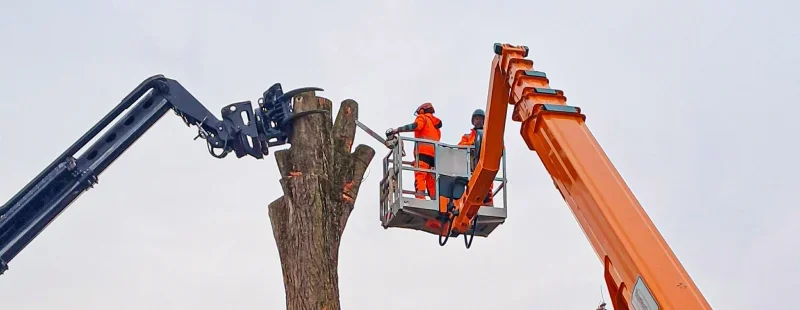
A crane does not just add a cost line. It changes the kind of work you can bid and how fast you clear it. A takedown that would eat two full days of rope-and-rigging labor on a big, hazardous tree can wrap in four to six hours with a crane. That speed cuts your labor hours per job and lets the same crew turn more work in a week, which is where the crane quietly earns back part of its cost.
It also opens the high-ticket tier of jobs. The dead 70-foot oak leaning over a house, the storm-snapped pine on a roof, the removal that a two-person outfit simply cannot bid safely. Those are the jobs with the best margins, and a crane is often your ticket to quoting them at all. Pricing them well still depends on tracking your true cost per hour, machine included, so you are not underbidding the very jobs that justify the equipment.
Tracking crane job profitability
Whichever way you go, the decision only stays right if you measure it. Owners get burned when they buy on gut feel, then never track whether the crane actually hit the utilization they assumed. You want to know, per job, what the crane truly cost you: the operator hours, the fuel, the share of insurance and the payment, against what that job billed.
That is a job-costing habit, not a spreadsheet you build once. Tree care management platforms like ArboStar let you tag equipment to each work order and see crane job margins next to your standard removals, so the rent-versus-buy call is backed by your own numbers instead of a rule of thumb. If you are weighing the purchase, run three months of your real crane jobs through that lens first. See a plan built for tree service operations before you commit six figures to a machine.
Know Your Real Crane Job Margins
Tag equipment to every work order and see crane job costs next to your standard removals – so the rent-or-buy call is backed by your own numbers, not a rule of thumb.
Frequently Asked Questions
How much does crane tree removal cost?
For the property owner, crane-assisted removal generally runs $2,000 to $15,000+ depending on tree size, crane class, access, and cleanup. The crane rental alone is usually $500 to $5,000, and the rest covers the climbing crew, ground crew, rigging, and haul-away. Most residential crane removals land between $3,500 and $8,000.
How much does it cost to rent a crane for tree removal?
A crane with an operator commonly costs around $150 per hour with a four-hour minimum, or roughly $500 to $1,500+ per day for a small-to-mid machine. Larger cranes run higher, and a mobilization fee of $300 to $800 applies if the machine travels more than 30 to 40 miles.
Is it worth buying a crane for a tree business?
Buying pays off once you can keep a crane booked roughly one full day a week or more on jobs that need it. Below that, the fixed monthly cost of the payment, insurance, certified operator, and maintenance usually outweighs what you would spend renting. Run your own break-even before committing.
How much does a crane cost to own each month?
Between the financed payment, higher insurance, an NCCCO-certified operator premium, storage, and a maintenance reserve, a used tree-work crane commonly carries a fixed cost of several thousand dollars a month, often in the $5,000 to $7,000 range, before it removes a single tree.
When do you actually need a crane instead of standard rigging?
A crane is the right call when the tree is too large or heavy for safe rope work, dead and unsafe to climb, tucked in a tight space with no drop zone, hanging over a structure, or tangled near power lines. In those cases it is often the safest option, not just the fastest.