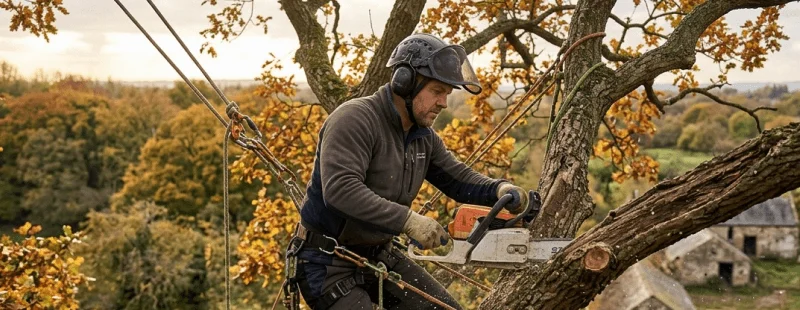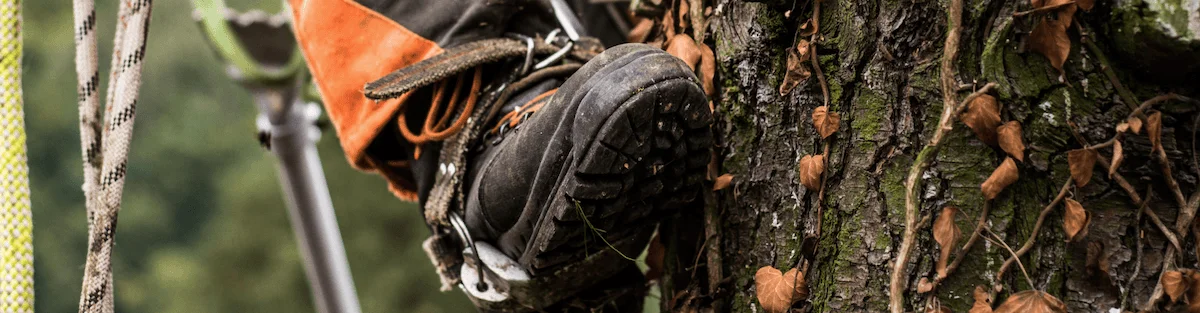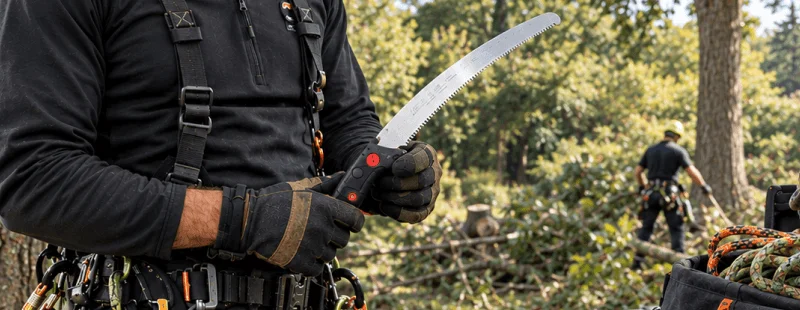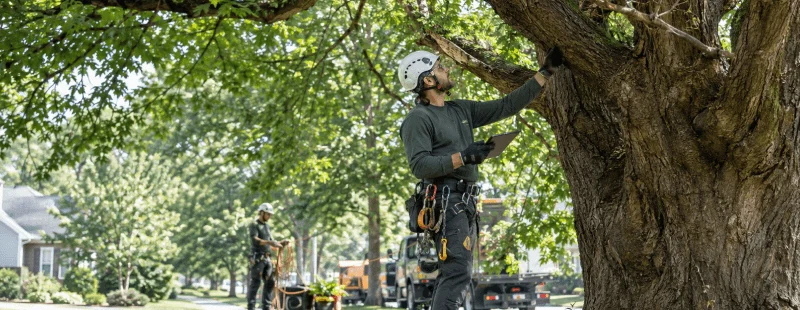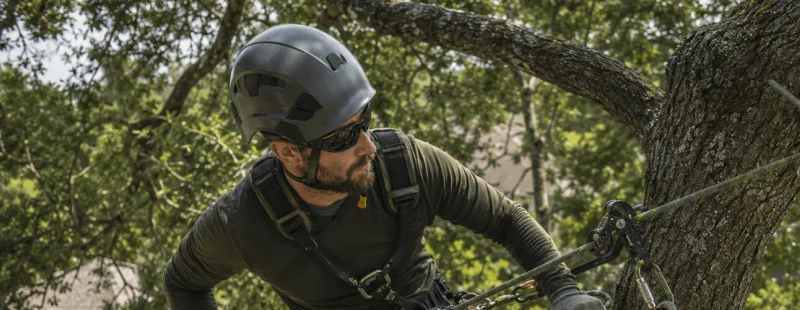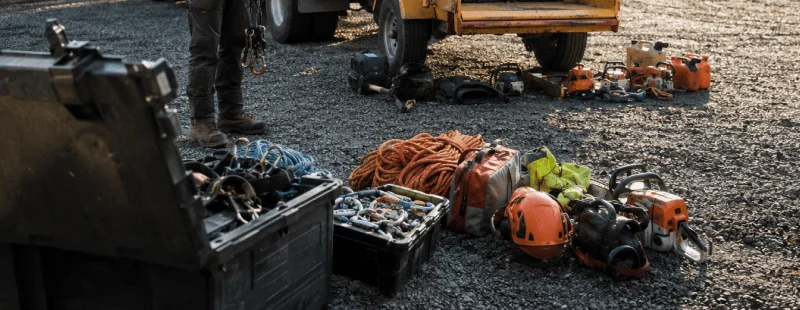
Quick Summary: An arborist saddle and a climbing harness are often treated as the same thing, but they are built differently. A saddle has thick leg and back padding plus D-ring attachments for a flip line, and it is built for hours of suspended work. A general climbing harness favors mobility and low weight over long-term comfort. Whatever you choose as the best arborist harness and saddle for your work, it should meet ANSI Z133 and the fall protection requirements it references, along with EN 813 for the sit harness itself.
You will spend more hours hanging in your saddle than using any other piece of gear you own. A bad one shows up as sore hips by early afternoon, numb thighs during a long rig, and sloppy cuts late in the day because you are fighting your equipment instead of working the tree. A good one disappears. You stop thinking about it.
Shopping for one is harder than it should be. Retailers, manufacturers, and review sites swap “saddle” and “harness” freely, sometimes in the same paragraph, and certification labels read like alphabet soup. This guide sorts out what the terms actually mean, which features matter in the canopy, which standards you should check for, and four proven models worth a close look.

Arborist Saddle vs Climbing Harness: What’s the Real Difference?
Here is the part most guides skip. Among arborists, “saddle” and “arborist harness” usually describe the same category of gear: a purpose-built work positioning harness for tree work. Notch calls the Sentinel a harness, dealers list it as a saddle, and Petzl describes the Sequoia as an arborist sit harness. Nobody is wrong.
The real dividing line sits between purpose-built arborist gear and general climbing harnesses designed for rock, gym, or mountaineering use. That is the distinction people are actually reaching for when they search arborist saddle vs harness, and it is the one that matters for your safety and your back.
| Feature | Arborist saddle | General climbing harness |
|---|---|---|
| Primary job | Hours of suspended work positioning | Short climbs, belaying, catching occasional falls |
| Padding | Wide, often semi-rigid back and leg support | Thin, minimal, built to save weight |
| Attachment points | Side rings for a positioning lanyard, a bridge with a sliding ring, often front rings | Tie-in points and one belay loop |
| Tool carrying | Heavy-duty gear loops, chainsaw lanyard point, suspender connections | Small loops for light hardware |
| Weight | Roughly 4 to 7 pounds for the models in this guide | Usually about 250 to 500 grams (roughly half a pound to a pound) |
| Typical certification | Z133, ASTM F887, European work positioning and sit harness standards | Recreational climbing standards such as UIAA and EN 12277 |
Why does this matter in practice? A thin sport harness concentrates load on narrow webbing, which gets painful fast when you are hanging for an hour while you climb out a leader. It also has nowhere to clip a lanyard on each hip, so you cannot lean back into a stable, hands-free position to run a saw. The arborist saddle exists because tree work asks you to sit, lean, rotate, and carry tools all day, not just climb and come down.
What to Look for in an Arborist Harness or Saddle
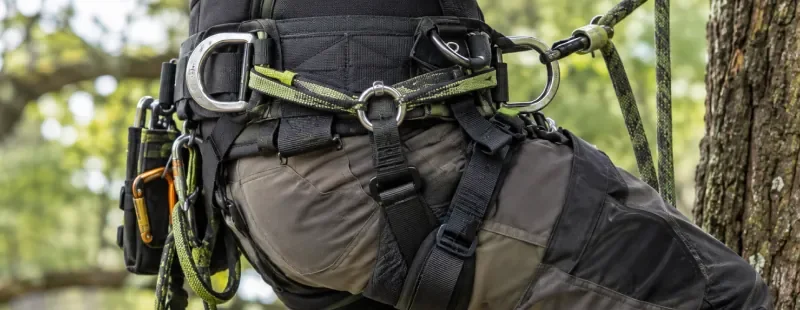
Three design decisions shape how a saddle feels by the end of a long day. Get these right and the brand name matters a lot less.
Padding and Back Support
A good arborist climbing harness spreads your weight across a wide back pad that wraps forward over the hips. Semi-rigid designs hold their shape and resist the “taco” effect when you lean back hard on a lanyard. Softer pads feel great on the shop floor but can fold under load.
Breathability matters more than most buyers expect. Contoured mesh and molded foam with ventilation channels keep you noticeably cooler in July than solid closed-cell foam. Replaceable pads are worth paying for too, since padding usually wears out before the webbing does.
Think about what you hang off the belt. If you run a top-handle saw on a lanyard most of the day, look for a reinforced, dedicated saw attachment point and a back pad stiff enough to carry the load without sagging. Our breakdown of what professional climbers actually run for climbing saws is a useful companion here, because saw weight directly changes how much support you need.
D-Rings and Flip Line Attachment
The side rings carry your positioning lanyard, so their shape and placement affect every cut you make. Flared or angled rings are easier to clip with one gloved hand. Mobile or pivoting side points follow the lanyard as you shift position, which reduces twisting and side loading on the connector. Fixed rings are simpler and some climbers prefer their predictability.
On spur removals, your flip line wraps the trunk and clips to both side rings, so ring height matters. Rings set too low pull you into a slouch, and rings set too high can pinch your ribs when you lean back.
Then there is the bridge, the short length of rope or webbing across the front where your climbing system attaches. A bridge with a sliding ring lets you rotate around the stem without the whole saddle twisting. It is also a wear item. Look for a saddle with a replaceable bridge and inspect it closely, because it takes constant friction from the ring. How the bridge, ring, and line work together is covered in more depth in our guide to choosing the right climbing line for your system.
Leg Straps vs Traditional Sit Style
This tradeoff rarely gets explained on its own, but it shapes the whole feel of a saddle. Traditional sit-style saddles put a seat strap or a rigid batten seat under your thighs. For long static hangs, a board under your legs is hard to beat, and many old-school removal climbers still swear by it.
The catch is mobility. A seat restricts how freely your legs move, which makes walking limbs, high steps, and ascending on a single rope awkward. Leg loop designs give your legs a full range of motion while you are weighted. Many newer, high-end arborist harnesses use leg straps instead of the traditional seat style, though some newer models accept an optional batten seat.
A practical way to decide: if most of your day involves pruning and moving through large canopies, leg loops win. If you spend long stretches hanging in one spot on spurs during removals, a seat or a leg loop saddle that accepts one is worth considering. Your preferred system also plays a role, and our article on climbing techniques and safety tips for arborists covers how SRT and MRS setups change what you need from a saddle.
Safety Standards: ANSI Z133 and EN 813
In the United States, the industry consensus safety standard for tree work is ANSI Z133. The ANSI Z133-2024 is now the most current edition, and the previous 2017 edition remained in effect until May 26 of this year. The revision was long expected under the name Z133-2024, so you may still see that label in older articles, but it was published as the 2026 edition. If your crew’s safety manual still cites the 2017 version, now is a good time to update it.
Z133 is voluntary, but that does not make it optional in practice. There is still no federal tree-care-specific OSHA standard, so inspectors rely on general industry standards and the General Duty Clause when no specific rule fits. In fiscal year 2024, the General Duty Clause was the most frequently cited OSHA provision in tree care inspections, used to address hazards already covered in Z133. OSHA’s tree care standards page lays out which general rules apply to tree work and is worth bookmarking.
EN 813 is the European standard for the harness itself. The standard was updated in 2024, though many harnesses on the market are still labeled to the 2008 edition. But the basic European standard for seat belts is EN 813:2008. It covers requirements, testing, and marking for sit harnesses used in restraint, work positioning, and rope access systems where a low attachment point is required. Sit harnesses covered by the standard are not suitable for fall arrest. If the harness has additional side or back positioning points, those must comply with EN 358. That is why you will often see both standards printed on the same label.
Two more labels show up on North American gear. ASTM F887 is the U.S. specification for personal climbing equipment, and CSA Z259.1 matters for Canadian buyers. Premium saddles often carry most of these at once. The Petzl Sequoia, for example, is certified to CE EN 813, CE EN 358, ANSI Z133, ASTM F887, and CSA Z259.1.
One point deserves emphasis. A sit harness is designed for work positioning and suspension, not for catching a free fall. If you work from an aerial lift, follow your employer’s program and the lift manufacturer’s requirements, which often call for a full-body harness rated for fall arrest. And never modify a saddle with unrated hardware or remove its label. An unreadable label makes the gear impossible to verify.
Keep Every Climber's Records in One Place
Keep employee records in one place and see who is assigned where across your crews, from hours to time off.
Best Arborist Harness and Saddle Options to Consider
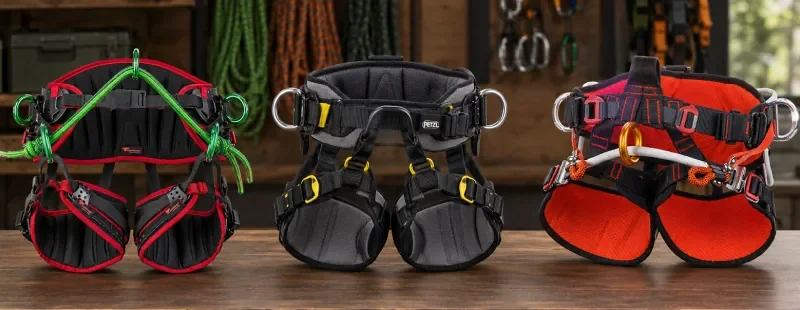
Picking the best arborist harness and saddle comes down to matching the design to your climbing style, body, and budget. These four are widely used by working climbers in North America. If this reads like a tree climbing harness buyer’s guide with opinions, that is on purpose. Prices and model generations change often, so confirm current versions with your dealer before buying.
Petzl Sequoia
The Sequoia is the safe, well-rounded choice that many crews standardize on. It uses a wide, rigid waist belt and leg loops with sculpted 3D foam padding. The wide front attachment points accept up to two bridges, and the mobile side attachment points follow the lanyard’s orientation as you move.
Its front rings can also accept a seat through shackles for longer suspension comfort, which makes it a good middle ground in the leg loop versus seat debate. It sits in the upper-middle price tier and suits climbers who want broad certification coverage and predictable fit.
Notch Sentinel
The Sentinel is built around low weight and easy adjustment. Contoured mesh padding on the back and legs provides breathability, and an elastic waistband keeps the saddle sitting snugly on the waist. The leg loops, waist belt, and bridge position are all adjustable with thumb-release buckles.
It comes in two sizes, covering 28 to 36 inch and 36 to 44 inch waists, and weighs about 4.1 to 4.2 pounds. You can also customize where the chainsaw lanyard connects, and replacement bridges are available. It is a strong pick for climbers who move a lot in the canopy and work through hot summers.
Teufelberger TreeMOTION Pro
The treeMOTION line has been a benchmark for highly adjustable European-style saddles, and the current version is sold as the treeMOTION Pro. It features Cobra quick-release buckles in the waist and legs, an openable side ring for replacing hip and leg connections, four attachment points for suspenders or a chest harness, and double bridges in long and short lengths.
Teufelberger rates it for a 10-year lifetime from the date of manufacture, and every size lists a maximum user weight of 330 pounds. Its listed standards include EN 813:2024, EN 358:2018, Z133-2017, ASTM F887-23, and CSA Z259.1-05. Expect premium pricing, and expect a saddle you can dial in very precisely.
Weaver Cougar Tree Saddle
The Cougar is a sensible first purpose-built tree climbing saddle for climbers moving up from older leather gear. It marked Weaver’s shift from traditional leather designs to a fully synthetic build. Retailers describe it as a good-quality, entry-level floating bridge harness weighing about 6.5 pounds.
It uses memory foam in 4 inch leg pads and an extra wide 7 inch back, and the fixed side rings use a two-bar design that is easy to clip one-handed. Weaver also offers a batten seat version, which helps if you want traditional sit-style support with a modern bridge. It is heavier than the others here, so weigh the price savings against carrying those extra pounds all day.
Fit and Sizing: Getting It Right
Even the most expensive saddle is the wrong saddle if it does not fit. The waist belt should sit above your hip bones, snug enough that it cannot slide over them even when you hang upside down. The leg loops should allow a flat hand to slide underneath, but not a fist.
Size ranges overlap, so choose the size that puts you in the middle of the range rather than at an edge. That leaves room for layers in winter without the belt running out of adjustment in summer. Fit the saddle while wearing the clothing you actually climb in, including your chainsaw-protective legwear. Bulky chainsaw protection pants can change leg loop sizing more than you might think.
Then hang in it. Rig a low anchor, sit back on the bridge for ten minutes, and pay attention to pressure points. Adjust the rise so the bridge sits at a comfortable height in front of you. Also check the maximum user weight, and remember to count your tools. A climber near the limit with a saw, rope, and full rack of hardware may need a different model.
Keeping Harnesses Inspected and Tracked Across a Crew
One climber with one saddle can keep track of things in their head. A crew with six climbers, spare bridges, and gear bought over several years cannot. That is where inspection discipline usually breaks down.
Every climber should inspect their saddle before each climb, checking stitching, webbing, buckles, rings, and the bridge for cuts, glazing, fraying, or chemical contamination. Beyond that, most manufacturers call for periodic detailed inspections by a competent person, and many set a maximum service life measured from the date of manufacture. Bridges and lanyards wear out much faster than the saddle body, so they need their own replacement schedule.
The practical problem is records. Who is climbing in which saddle? When was that bridge last replaced? Which harness is approaching its retirement date? If those answers live on a clipboard in one truck, they get lost. Treat saddles like any other critical equipment in your fleet, alongside the rest of your arborist tools and equipment.
If your company already uses ArboStar to run crews and schedules, it makes sense to keep inspection dates and replacement notes in the same system where your team’s work is planned. That way an upcoming inspection gets scheduled like any other task instead of slipping until somebody notices a worn bridge mid-job.
Know Which Saddle Belongs to Which Climber
Track tools and machinery, schedule maintenance and tie each piece of equipment to the crew and job that uses it.
Frequently Asked Questions
These are the questions climbers ask most often when choosing new gear.
What’s the difference between an arborist saddle and a climbing harness?
An arborist saddle is a work positioning harness built for long suspended work, with wide padding, side rings for a positioning lanyard, and a bridge for your climbing system. A general climbing harness is lighter and thinner, built for recreational climbing and belaying. Many arborist brands call their saddles "harnesses," so focus on the design and certification, not the name.
Can I use a rock climbing harness for tree work?
No. Rock harnesses are certified for recreational climbing, not work positioning, and they lack side rings for a lanyard. They also lack the padding and tool-carrying capacity needed for hours of tree work, and they will not satisfy the expectations of Z133 for arboricultural operations.
What safety standard should a tree climbing harness meet?
In the United States, look for compliance with Z133 and ASTM F887. Internationally, look for EN 813 for the sit harness and EN 358 for the positioning points. Canadian buyers should also look for CSA Z259.1.
How do I know if my harness fits correctly?
The waist belt should sit above your hip bones and not slide over them. You should be able to slip a flat hand, not a fist, under each leg loop. Most importantly, a ten-minute test hang should not create sharp pressure points or numbness.
Are leg strap harnesses better than traditional saddles?
Not universally. Leg straps offer far more mobility and work better for canopy movement and single rope ascents. Traditional seat designs can be more comfortable during long static hangs. Some modern leg loop saddles accept an optional seat, which gives you both.
Conclusion
Most confusion around tree climbing gear comes from vocabulary. “Saddle” and “arborist harness” usually mean the same purpose-built equipment, and the real distinction is between that gear and lightweight recreational climbing harnesses that do not belong in a tree. From there, focus on padding that suits your climate and workload, side rings and a bridge that fit your system, and the leg loop versus seat question based on how you actually climb. Check the label for Z133, ASTM F887, and the European sit and positioning standards, then make fit and inspection a habit across your crew. Choosing the best arborist harness and saddle is about matching the gear to your work, and the ArboStar education hub has more guides to help you build out the rest of your kit.
Run Your Crews and Jobs From One Platform
See every ArboStar feature in one place, from estimating and scheduling to GPS tracking and invoicing.