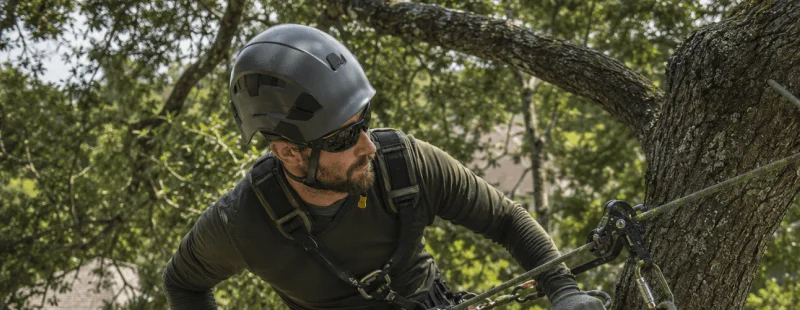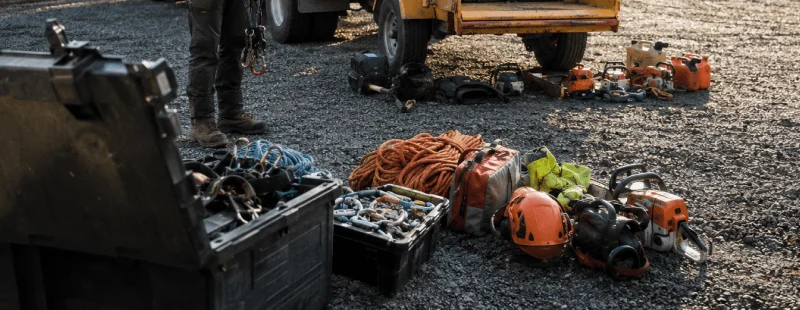


Best Climbing Rope for Arborists: How to Choose the Right Line for Your System
A tree climbing rope and a rigging rope look similar coiled on a truck, but they solve different problems, and swapping one for the other is how climbers get hurt. If you run a crew, the real question isn’t which rope wins in the abstract. There’s no single best climbing rope for arborist teams across the board. It comes down to which system your climbers use, which devices they carry, and which construction actually holds up to bark, grit, and a full season of daily use.
This guide covers moving rope systems versus stationary rope systems, the strand-count constructions on the market, the diameters that matter, and the specific ropes crews are buying in 2026, including Teufelberger Safety Blue, Samson Velocity, Yale Blue Moon, and Petzl FLOW. Every rope named here meets ANSI Z133, the baseline US standard for arboriculture. None of them lasts forever. Plan on 3 to 5 years of service under regular use, and retire a line immediately after a hard fall or a deep cut, no matter how it looks afterward.
Climbing Rope vs. Rigging Rope: Why You Cannot Use One for the Other
An arborist climbing rope is a life-safety line. It’s certified to hold a person, built with controlled elongation, and inspected before every climb. A rigging rope has a different job entirely: it lowers branches and whole stems, and it’s built to absorb shock loads and abrasion from crotches and bark that a climbing line was never designed to handle.
OSHA and ANSI Z133 climbing rope requirements are direct about this: a rigging rope does not go under a climber, and a climbing rope does not carry rigging loads. The two ropes fail differently under stress, and treating them as interchangeable removes the safety margin both were built around.
Rock climbing rope belongs in its own category, separate from the climbing rope vs rigging rope arborist comparison above. Dynamic rope stretches on purpose, to absorb the force of a lead fall on a cliff. That stretch is exactly wrong for tree work: too much elongation and a climber bounces, hardware grabs unpredictably, and positioning gets sloppy. If a rope wasn’t built and labeled for arboriculture, it isn’t a tree climbing rope, whatever its breaking strength tests at.
MRS vs. SRS: Choose Your System Before Choosing Your Rope
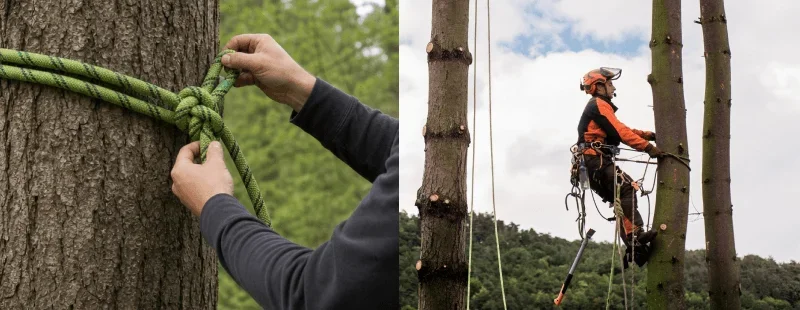
Before comparing brands, settle which system your crew actually climbs. A moving rope system (MRS) runs the line through a natural crotch or a friction saver, with the climber ascending on a hitch such as a Blake’s or a Distel that travels up the rope with them. A stationary rope system (SRS) anchors the rope at the top of the tree, and the climber ascends a fixed line using a mechanical device.
The system changes which construction actually works well for you. Below is a quick reference before we get into specific rope models.
| System | Constructions That Fit | Why |
|---|---|---|
| MRS | 16-strand, 24-strand double braid | Grips a natural crotch, flexes well for hand-tending a hitch |
| SRS | Kernmantle, 24-strand, 32-strand | Low stretch suits mechanical ascenders; smooth jacket sheds bark abrasion |
A kernmantle arborist rope is built for SRS. Its core carries the load and its jacket takes the wear, which is exactly what a mechanical device like a Zigzag or a Rope Wrench wants: minimal stretch, a smooth surface, predictable friction. Run that same rope through a natural crotch on an MRS climbing rope arborist setup, though, and the same smooth jacket that helps it glide through a device also means less grip against bark and faster wear at the crotch.
An SRS climbing rope arborist teams standardize on doesn’t have to be kernmantle exclusively. 16-strand and 24-strand double braid ropes work across both systems, but they trade off differently: 16-strand is firmer and easier to inspect, while 24-strand flexes more and holds knots slightly better.
Rope Construction: What the Strand Count Actually Means
12-Strand
A solid braid with no separate core, which makes it simple to inspect since nothing hides under a cover. It stretches more than a 16-strand rope of the same diameter, and it handles abrasion well. Climbers who work without a friction saver, taking direct bark contact on every ascent, often prefer it for that reason.
16-Strand
The cover carries the strength here; the core adds bulk rather than load capacity. This is the classic 16-strand arborist rope: the industry standard for MRS with a Blake’s Hitch or a natural crotch. Damage shows up on the surface, so it’s easy to inspect, and it resists abrasion well enough to survive years of bark contact.
24-Strand Double Braid
Both the core and the cover carry load in a 24-strand rope, which makes it more flexible than 16-strand and better at holding knots without slipping. It works for MRS and SRS, which is why several manufacturers build their general-purpose climbing lines this way. For a crew that wants one rope across both systems, 24-strand is usually where they land.
Kernmantle
Kern (the core) carries the load, mantle (the sheath) takes the abrasion, and the two work independently. That split is what gives a kernmantle rope its minimal stretch, and it’s the standard construction for SRS and for mechanical ascending devices. Ropes certified to EN 1891 Type A meet the European static-rope standard; in the US, look for ANSI Z133 alongside it. Skip kernmantle for MRS work: the smooth jacket that helps it glide through hardware doesn’t grip a natural crotch the way a braided cover does.
32-Strand
A newer construction that pushes elongation even lower, aimed at climbers who want maximum precision on a mechanical device. Teufelberger drenaLINE is a good example: an 11.8mm kernmantle-core rope wrapped in a 32-strand cover, rated for both SRT and DdRT so a crew can standardize on one line instead of stocking two constructions. It sits at the premium end of the market, priced to match.
Diameter Guide: How to Match Rope to Your Devices
Arborist rope diameter runs from about 10mm to 13mm on the ropes crews actually buy, and the right size depends on your hardware more than your glove size.
-
10-11mm: the lightest options, built for SRS and mechanical devices like the Zigzag or Akimbo. Harder to hold bare-handed on a long descent, but the weight savings add up on tall climbs.
-
11.7-12mm: the size most crews settle on. It balances weight against grip and works with the widest range of hardware.
-
12.7-13mm (1/2"): the heaviest option and the easiest to hold bare-handed. Climbers who skip gloves, or who simply prefer a rope that feels substantial in hand, often land here.
Whatever size you land on, check the manufacturer’s spec sheet for your specific device before buying. A device rated for an 11.5-13mm range won’t necessarily perform the same at both ends of it, and running rope outside a device’s tested diameter voids the safety margin the manufacturer built in.
Top Arborist Climbing Ropes in 2026
Teufelberger Safety Blue (16-strand, 12.7mm)
The industry-standard 16-strand arborist rope in the US, and still the most widely stocked climbing line on the market. Safety Blue holds its round shape under load instead of flattening out, which keeps it running smoothly through a Blake’s Hitch or a friction saver. The polyamide core is dyed blue, so if the cover ever wears through or gets cut, the exposed core acts as a built-in warning to retire the rope. Certified to ANSI Z133 and EN 1891A.
Samson Velocity (24-strand, 11mm)
The Samson Velocity arborist rope line is one of the lightest climbing ropes built in the 11mm size, popular with competition climbers and working crews who spend all day on rope. Samson’s Sure Grip finish gives it a broken-in feel straight out of the bag, and the 24-strand double braid construction runs well through a Blake’s or a Distel on MRS. One caution: Samson advises against a second splice on this rope, since a double termination increases the risk of milking.
Samson Arborfreak (16-strand, 12mm)
Built with a nylon core under a polypropylene-polyester cover, Arborfreak trades a little weight for maximum firmness. Climbers who want a sturdy, classic-feel line for MRS, and don’t mind the extra ounces, tend to reach for this one over lighter options. It splices cleanly on both ends without the milking issues some double braids run into.
Yale Blue Moon (24-strand, 11.7mm)
Yale Blue Moon climbing rope splits the difference between an 11mm rope’s light weight and a 1/2" rope’s familiar hand feel. Its 24-strand Tite-Braid cover resists milking, and the polyester core keeps stretch low enough for SRS work while staying flexible enough for MRS. It’s one of the few ropes here that genuinely performs well in both systems, which is why it shows up in kit lists for crews running mixed climbing methods.
Petzl FLOW (kernmantle, 11.6-11.8mm)
Petzl FLOW rope is built specifically to pair with Petzl’s tree care hardware, the Zigzag and Chicane in particular. The EverFlex treatment keeps the rope flexible even after repeated exposure to water, dust, and mud, which matters for crews working through wet seasons without swapping lines. The factory splice is sized to pass through a Zigzag’s friction chain, so there’s no field-splicing needed before it’s ready to climb on.
Sterling HTP (kernmantle, 11mm)
A 100% polyester kernmantle arborist rope built for very low stretch, which makes it a solid choice for long ascents on SRS or for high-angle rescue work where predictable rope behavior matters. The tight cover holds up well against repeated ascender use. Certified to ANSI Z133 and NFPA 1983, and available in a range of diameters beyond the 11mm most arborists reach for.
Yale XTC Fire (16-strand, 1/2")
A tight 16-strand polyester braid around a high-twist core, finished in a multicolor cover (yellow, orange, red) that’s genuinely hard to lose track of in a crown full of branches. That visibility matters most on jobs where two or more climbers work the same tree on separate lines. The construction resists cover milking without a break-in period, and it works for both MRS and SRS.
Spliced Ends: Which Termination Do You Need?
-
Tight-eye splice: the most compact option and the most common choice across the ropes above. It runs through most hardware and friction savers without catching.
-
Standard splice: a larger loop, useful for certain rigging-adjacent techniques or when a device calls for a bulkier termination.
-
Bartacked or sewn loop: less refined-looking than a spliced eye, but functional, and often faster to produce at scale when a crew orders several lines at once.
One buying note worth remembering: don’t order a rope with splices on both ends unless you have a specific reason to. A single termination leaves room to cut back a damaged section and re-splice, which extends the working life of the rope. A rope spliced on both ends has already used up that option.
Safety Standards and Inspection
ANSI Z133 is the standard that matters most for US arborists, covering everything from rope construction to inspection and retirement criteria. Ropes marketed as static kernmantle lines often carry EN 1891 Type A as well, the European standard for low-stretch rope.
Inspect a climbing rope before and after every climb, not just on a schedule. Look for sheath damage, flat spots where the rope has been loaded repeatedly at the same point, and glazing, a shiny, hardened patch that signals heat damage from friction. Any of those is reason enough to pull a rope from service.
Plan for a working life of 3 to 5 years under regular use, shorter if the rope sees heavy daily wear, and retire it immediately after any fall that puts a hard shock load through the line, regardless of appearance afterward. For a crew running several lines across several climbers, keeping track of which rope is due for retirement gets hard fast. ArboStar’s equipment tracking logs issue dates and replacement schedules per employee, so a rope quietly passing its service life doesn’t slip through the cracks.
For the full inspection standard, see ANSI Z133 through TCIA or ANSI directly, and check ISA’s resources for broader arboriculture safety guidance.
Related reading: our guide to choosing an arborist helmet covers the other piece of PPE crews replace on a similar cycle, and our job management software for tree care page covers how ArboStar ties equipment, scheduling, and crews together in one system.
Conclusion
There’s no single best climbing rope for arborist crews everywhere. What suits an MRS team on 16-strand or double braid won’t be the right pick for a climber running SRS on a mechanical ascender, and the diameter that fits one device won’t necessarily fit another. Match the rope to the system first, the device second, and the brand third, and most of the ropes covered here will serve a working crew for years. If tracking which rope is on which climber, and when it’s due for replacement, has turned into a spreadsheet nobody updates, see how ArboStar handles it instead.
Know Which Rope Is Due for Retirement
Track issue dates and replacement schedules for every rope, per climber, so a line quietly aging past its service life never gets missed.