

Most tree companies do not start with both trucks. They start with one, run it hard, and add the second when the work forces the decision. If you are weighing a bucket truck for tree service against a chip truck as your next purchase, the honest answer is that they do two different jobs and you will eventually want both. The real question is sequencing: which one earns its keep first given the work you do now, and how do you avoid tying up six figures in iron that sits in the yard half the week.
This guide breaks down what each truck actually does, where they overlap, and how growing outfits usually stage the buys.
What a bucket truck does for tree service
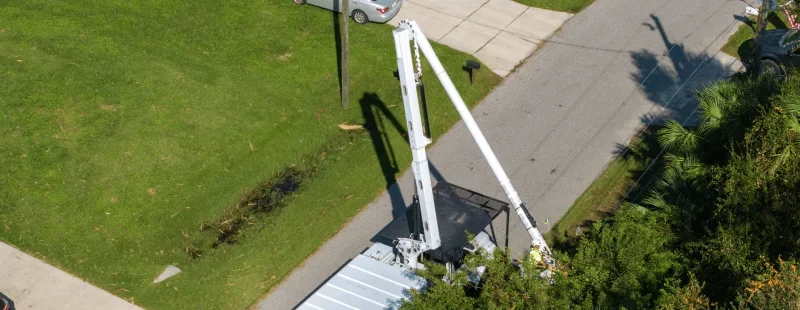
A bucket truck, also called an aerial lift or arborist truck, puts a worker in an enclosed platform on a hydraulic boom. Instead of a climbing arborist spurring up the stem and setting a tie-in, the operator rides up, repositions the bucket, and works the canopy from a stable platform. That changes the math on pruning and removals near structures, driveways, and wires, where a ladder cannot reach and climbing is slow or hazardous.
The tradeoff is access. Bucket trucks are big, and a rig that cannot get down a narrow side yard or onto soft turf is no help on a tight residential lot. Plenty of backyard jobs still come down to a climber because the truck simply cannot get in position.
Working height and side reach
Two numbers matter on the spec sheet, and they are not the same thing. Working height is how high the platform gets, and entry-level forestry bucket trucks land around 45 to 55 feet, with heavier boom builds pushing past 75 feet using an elevator section. Side reach is how far the boom stretches horizontally, which is what actually matters when the tree sits behind a garage or over a fence and the truck has to park at the curb.
An overcenter boom design adds several feet of side reach and lets the operator work multiple positions before repositioning the truck. Forestry booms are also dielectrically rated, which offers a measure of protection if the boom accidentally contacts an energized line. That rating is a safeguard, not a license to work hot lines, and line-clearance work still falls under its own qualifications and ANSI Z133 safety rules.
Forestry bucket vs rear mount
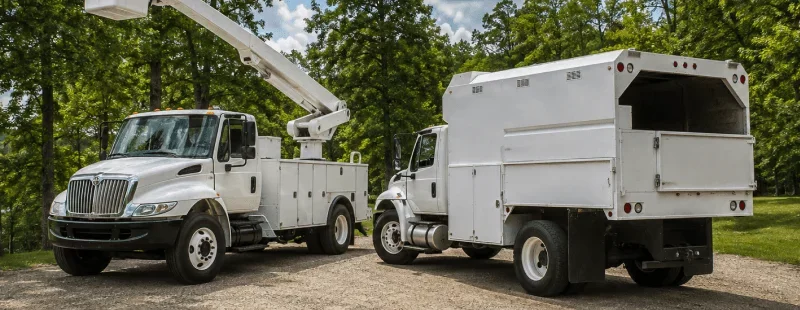
Here is the detail that muddies the whole "bucket vs chip truck" question. A true forestry bucket truck usually comes with a chip box built onto the same chassis, with the aerial mounted right behind the cab. So one forestry unit can lift, prune, remove, chip, and haul debris on its own. A rear-mount bucket truck puts the aerial over the rear axle and skips the chip box, so it does aerial work only and needs a separate truck for debris.
For a first-time buyer, that combined forestry bucket truck with a chip box is often the smartest single purchase, because it is the closest thing to a do-all truck. The rear mount makes more sense once you already own a dedicated chip truck and want a nimble second aerial for bigger jobs.
What a chip truck does
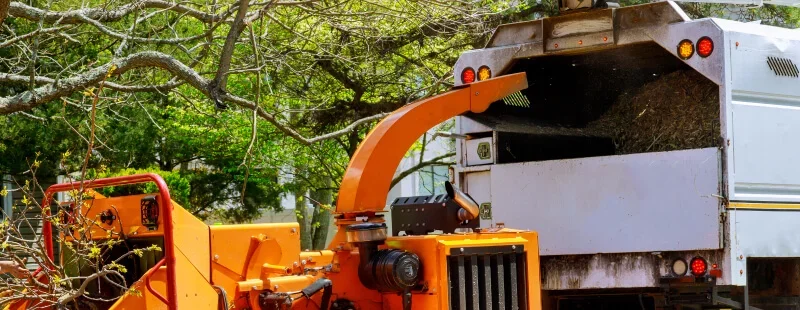
A chip truck is the debris workhorse. It carries an enclosed chip box that catches the output of a tow-behind chipper, plus lockable side cabinets for saws, rigging, and PPE. The workflow is a loop: cut, feed the chipper, blow chips into the box, and haul them off when full. On a busy removal, that loop runs all day, and a truck that keeps the crew fed instead of stopping to load a pickup is where a lot of your labor efficiency comes from.
Chip box capacity and payload
Chip boxes generally run 10 to 30 cubic yards. Residential outfits often start around 10 to 14 yards, while municipal and line-clearance crews size up. The number that trips people up is weight, not volume. Wet wood chips weigh roughly 400 to 500 pounds per cubic yard, so a 14-yard box packed with green chips can hit around 7,000 pounds before you add saws, gear, and a full fuel tank. Spec the gross vehicle weight rating to your real debris density, or you will run into overweight problems fast.
Payload also decides your towing headroom. A tow-behind chipper commonly runs 3,500 to 7,000 pounds, and a fully loaded chip box plus a chipper on the hitch can push a lighter chassis past its limit. Match the chassis to the whole rig, not just the box.
Bucket truck vs chip truck: the side-by-side
Stripped down, the two trucks solve opposite ends of the same job. One gets your crew up into the tree, the other gets the wood off the property.
|
|
Bucket truck |
Chip truck |
|
Main job |
Aerial access for pruning and removal |
Chipping and hauling debris |
|
Key spec |
Working height 45 to 75+ ft, side reach |
Chip box 10 to 30 cu yd, GVWR |
|
Best for |
High or hazardous limbs, work near wires and structures |
Volume removals, constant brush disposal |
|
Limitation |
Access on tight or soft-ground lots |
No aerial capability on its own |
|
Combined option |
A forestry bucket truck carries a chip box and does both on one chassis |
|
Which one should you buy first?
It comes down to the work you are turning away. If you already climb well and your bottleneck is cleanup, hauling, and the hours lost loading brush into a pickup, a chip truck is the buy that pays back first. A lot of newer outfits go this route, keep climbing for the aerial work, and add a chip truck to move real volume.
If instead you are turning down or subbing out the tall, wire-adjacent, over-the-roof jobs because climbing them is too slow or too risky, the aerial capability is what unlocks higher-ticket work. In that case the combined forestry bucket truck with a chip box gives you both aerial reach and debris handling in one purchase, which is why it is the common first "real" truck for a company graduating from a pickup and a trailer.
Either way, this is a business-plan decision, not just an equipment one. If you are early, our guide on what you need to start a tree removal service puts the truck buy in context with licensing, crew, and cash flow.
Running both: the fleet math that keeps crews moving
Once you are busy enough to run two trucks, sequencing them on site is where the productivity shows up. The classic setup is a rear-mount bucket paired with a forestry bucket truck. Both aerials work the tree, and when the forestry truck's chip box fills, it drives off to dump while the rear mount keeps cutting. The job never stops for a dump run. That is the difference between finishing a big removal in a day versus bleeding it across two.
The same logic applies to a bucket-plus-chip-truck pairing. The point is to keep the expensive asset, your crew, cutting instead of waiting. A truck that sits idle while another dumps is lost margin, so utilization is the number to watch as your fleet grows. Tracking which trucks and crews are actually billing hours, not just parked, is where equipment management software earns its place in a growing operation.
CDL, insurance, and the costs behind the truck
The sticker price is the start, not the whole cost. Bigger forestry chassis can push into CDL territory depending on gross weight and configuration, which affects who on your crew can legally drive it. Manufacturers do build under-CDL forestry bucket trucks specifically so any licensed driver can run them, and that flexibility is worth real money when you are scheduling around a small crew.
Then there is what it costs to keep the truck working. PTO-driven hydraulics, boom inspections and dielectric testing on the aerial, tires, and general maintenance all carry annual cost, and aerial equipment pushes your liability and equipment coverage higher than a plain chip truck does. Budget the carrying cost before you sign, the same way you would with any heavy asset. Our tree service equipment cost list and a look at tree removal insurance requirements are both worth reviewing before you commit.
Matching trucks to your job mix and margins
The right truck is the one that fits the work you actually book, not the flashiest rig on the lot. A company doing mostly residential pruning in tight neighborhoods needs maneuverability and side reach more than a 75-foot boom. A crew running municipal removals and storm contracts needs chip volume and payload above all. Buying the wrong end of that spectrum ties up capital in capability you rarely bill for.
That fit only stays profitable if you price and schedule around what each truck costs you per hour. Underprice the aerial jobs that justify the bucket truck, and the truck becomes a liability instead of a margin driver. Keeping crews, trucks, and job costs in one system with arborist scheduling software is how operators see which truck-and-crew combinations actually make money. When you spec the next bucket truck for tree service work, back the decision with your own utilization numbers. See ArboStar pricing before you build out the fleet.
Frequently Asked Questions
What is the difference between a chipper truck and a bucket truck?
A chip truck hauls and contains debris. It has a large chip box and tool cabinets and works with a tow-behind chipper. A bucket truck uses an aerial lift and boom to raise a worker for trimming and removals. They do opposite ends of the job, and most tree companies eventually run both.
Which truck should a tree service buy first?
If your bottleneck is cleanup and hauling, buy the chip truck first and keep climbing for aerial work. If you are turning down tall or wire-adjacent jobs, a forestry bucket truck with a built-in chip box gives you aerial reach and debris handling in one purchase, which is why it is a common first dedicated truck.
Do you need a CDL to drive a bucket truck?
It depends on the truck's gross vehicle weight rating and configuration. Larger forestry chassis can require a CDL, but manufacturers build under-CDL forestry bucket trucks so any licensed driver can operate them. Confirm the GVWR against your local rules before you buy.
Can one truck handle both trimming and chipping?
Yes. A forestry bucket truck mounts the aerial behind the cab and carries a chip box on the same chassis, so it can prune, remove, chip, and haul on its own. A rear-mount bucket truck does aerial work only and needs a separate chip truck for debris.
How big a chip box do I need?
Residential crews usually start with a 10 to 14 cubic yard box, while municipal and line-clearance work scales to 30 or more. Size to weight, not just volume: wet chips run 400 to 500 pounds per cubic yard, so match the GVWR to your typical debris load to avoid overweight violations.
See how ArboStar can run your tree care business
Quoting, scheduling, crews and invoicing in one place. Book a short demo and see it with your own jobs.