

Search for the best arborist chainsaw and half the results will try to sell you a $60 mini saw from Amazon that no professional would clip to a harness. Ask an actual climbing arborist and the answer narrows fast: a handful of top-handle saws from Stihl, Husqvarna, and Echo do the overwhelming majority of production tree work in North America. This guide covers those saws, when battery models earn a place on the truck, and a question the affiliate listicles never touch: how to buy saws when you are equipping three crews instead of one climber.
What Makes an Arborist Chainsaw Different
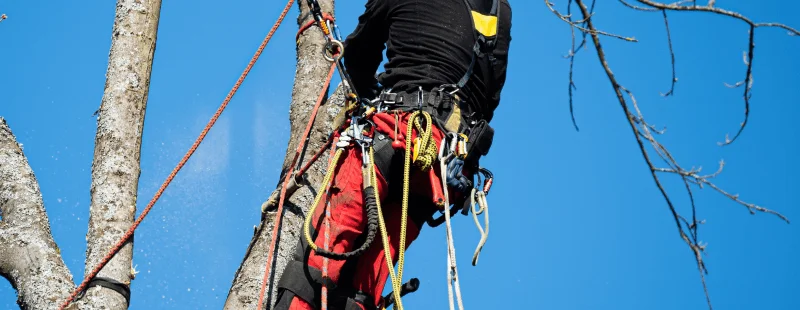
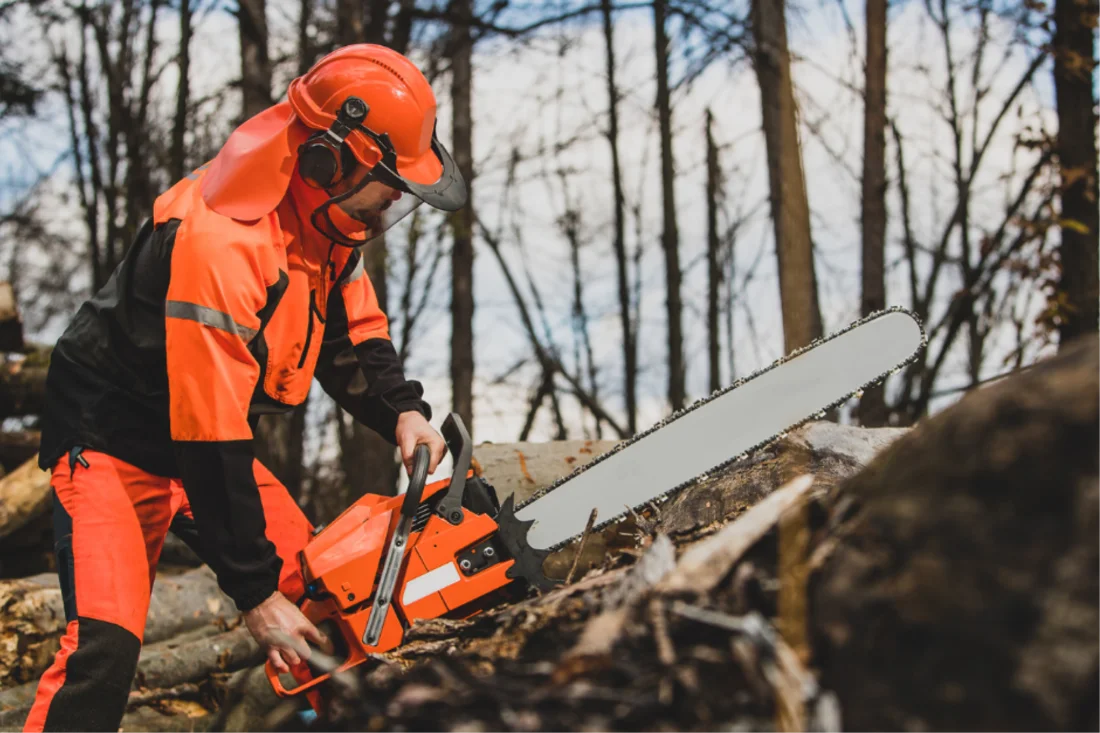
An arborist chainsaw, also called a climbing saw or top-handle saw, moves the rear handle to the top of the powerhead. The result is a compact, short-coupled tool that can be maneuvered in a canopy, clipped to a saddle by its lanyard ring, and operated in positions a rear-handle saw was never designed for. Powerheads in this class typically run 25 to 40 cc and weigh 5.5 to 9 pounds before the bar goes on, with 12 to 16 inch bars covering nearly all in-tree work.
The compact format exists for work at height, and that is the only place it belongs. The ANSI Z133 safety standard restricts top-handle saws to trained operators working in trees, and one-handed operation, common as it looks on YouTube, remains a leading cause of serious climber injuries. Ground cutting belongs to rear-handle saws. For a wider look at what goes on the truck beyond saws, see our overview of arborist tools and equipment.
The Best Arborist Chainsaws for Professional Tree Work
Every saw below is a professional-grade tool that earns its keep on production crews. Prices move around by dealer and season, so treat the figures as ballpark.
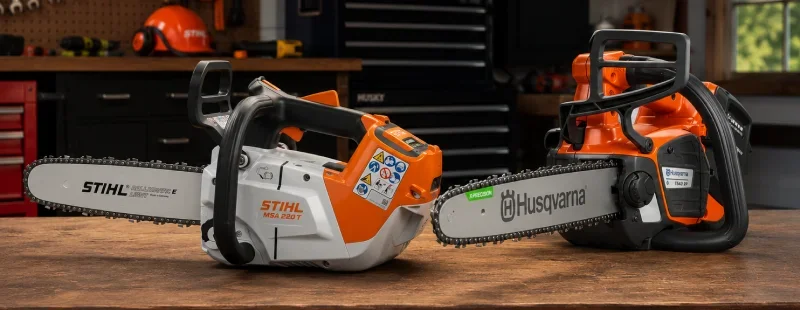
Stihl MS 201 T-C M: the industry standard
Walk onto ten tree care job sites and you will find this saw on most of them. The MS 201 T-C M runs a 35.2 cc engine with M-Tronic electronic engine management, which means no carburetor tuning between sea level jobs and elevation, and consistent starts in cold weather. It pulls a 12 to 16 inch bar, balances predictably in the hand, and parts availability through the Stihl dealer network is unmatched. Expect to pay roughly $700 to $800. The complaints are minor: it is not the lightest saw in the class, and dealers rarely discount it. As a first climbing saw for a new hire or the standard issue across a fleet, it is the default for a reason.
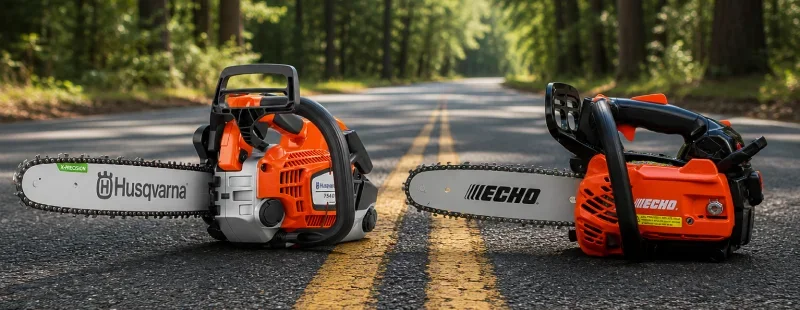
Husqvarna T540 XP Mark III: the power pick
Husqvarna's answer runs a 37.7 cc engine and cuts noticeably harder than anything else in the top-handle class. The Mark III generation added AutoTune engine management and better ergonomics, and climbers who run big removals tend to prefer it: more displacement means fewer bar-buried moments in oak and hickory. It is priced close to the Stihl, around $750 to $850. Weight is the trade-off, and some crews report longer dealer turnaround for parts compared to Stihl in rural markets. If your work skews toward heavy removals rather than fine pruning, this is the one.
Echo CS-2511T: the lightweight favorite
At 25 cc and roughly 5.2 pounds for the powerhead, the CS-2511T is the lightest gas climbing saw sold in the US, and it has a near-cult following among production climbers. All-day pruning work is where it shines, since every pound matters by hour six on rope. The newer CS-2511TN variant runs a .325 low-profile chain that cuts a thinner kerf, which climbers report improves both cut speed and fuel economy. It gives up outright power to the Stihl and Husqvarna, so big wood goes slower. At around $450 to $550 it is also the cheapest pro saw here, which makes it a popular second saw even on crews standardized on another brand.
Stihl MSA 220 T: battery for pruning-heavy crews
Stihl's battery top-handle runs on the same AP battery platform as its blowers, pole saws, and hedge trimmers. That ecosystem is the real argument: a crew already carrying AP batteries adds a climbing saw with zero new charging infrastructure. Instant throttle response, no idle, and low noise make it a strong choice for residential pruning, municipal contracts with noise ordinances, and early morning starts. Runtime is the constraint. Plan on multiple batteries per climber per day, and keep a gas saw on the truck for removals.
Husqvarna T542i XP: the strongest battery saw
The T542i XP is the closest a battery top-handle currently gets to gas performance, with output Husqvarna positions against 40 cc class saws. Climbers who have run it describe smooth, consistent power delivery and a clutch, which most battery saws lack. It is expensive once you price in batteries and chargers, easily crossing $1,000 all-in. For companies with utility or municipal contracts that reward quiet, emission-free operation, the math can still work out well.
For the ground crew: Echo CS-590 and Husqvarna 572 XP
The climbing saw never does the whole job. Bucking trunks and processing brush on the ground calls for rear-handle power: the Echo CS-590 Timber Wolf at 59.8 cc is the value pick at around $450, while the Husqvarna 572 XP at 70.6 cc is a full professional felling saw for crews that run daily removals. Companies doing crane work often add a Stihl MS 500i, whose fuel-injected 79 cc powerhead has become the standard big saw in that niche. Budgeting for the whole lineup is its own exercise, and our tree service equipment cost list breaks down what a fully outfitted crew actually costs.
Gas vs Battery for In-Tree Work
Five years ago this was not a real debate. It is now. Battery top-handles start instantly at height, need no fuel mixing, and remove exhaust from the climber's breathing zone, a benefit anyone who has spent a day in a conifer canopy will appreciate. They also cut idle noise to zero, which matters for residential work and for communication between climber and ground crew.
Gas still wins on two counts: sustained power in big wood, and energy density. A tank of mix weighs ounces and refills in a minute from the truck. Batteries weigh pounds each, cost $200 to $400 apiece, and a climber cannot swap one mid-stem without riding down. The practical pattern on most professional crews in 2026 is a split fleet: battery saws for pruning routes and noise-sensitive contracts, gas for removals and storm work. Buy for your job mix, not for the technology argument.
How to Choose: Bar Length, Weight, and Ergonomics
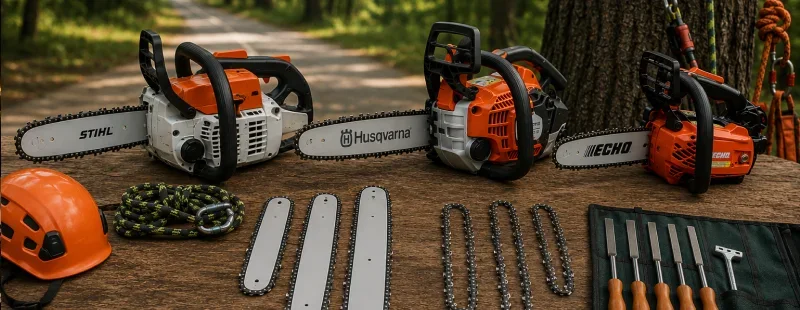
Bar length first. A 12 inch bar covers most pruning; 14 inches is the versatile default that handles small removals without punishing the climber; 16 inches only makes sense on the higher-powered saws, and mostly for climbers who regularly dismantle large stems. Longer bars add weight at the worst possible place, out front, where they wreck the saw's balance for one-position cuts.
On weight, think in terms of hours rather than pounds. The difference between a 5.2 pound and a 7 pound powerhead sounds trivial on paper and feels enormous during the two-hundredth cut of a pruning day. Match the saw to the climber's actual workload. Ergonomics come down to details you only notice at height: how the lanyard ring hangs, whether the chain tensioner can be worked with gloves on, how the saw balances during a one-position undercut. Have your climbers demo saws before you standardize on one; most pro dealers will arrange it.
Chain choice gets overlooked and probably matters more than the badge on the powerhead. Low-profile 3/8 and the newer .325 narrow-kerf chains dominate the climbing class because they cut fast with less power draw, and a sharp budget chain outcuts a dull premium one every time. Standardize on one or two chain types, teach every climber to file in the field, and keep loops pre-made in the truck. Nothing kills canopy productivity like sending a climber up with a rocked chain and no spare.
Whatever you buy, certification bodies like the ISA and training programs from TCIA treat saw handling as a skills matter, not an equipment matter. A $900 saw in untrained hands is a liability, not an asset.
Buying Saws for a Crew, Not Just a Climber
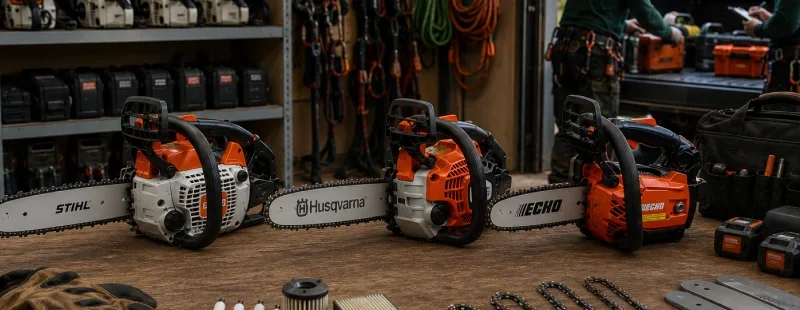
Individual climbers argue Stihl versus Husqvarna forever. Business owners have a different problem: keeping eight saws across three crews running, tracked, and maintained. Standardization solves most of it. One brand and model of climbing saw across the company means shared bars, chains, filters, and spark plugs in inventory, one dealer relationship, and mechanics who know every saw on the shelf. The second saw brand you add doubles your parts inventory. The battery decision compounds this: committing to one battery platform across saws, blowers, and trimmers is worth more over five years than any individual spec advantage.
Run the numbers on total cost of ownership rather than sticker price. A $750 climbing saw in professional use typically lasts three to five years, which puts the capital cost around $15 to $20 a month. Chains, bars, filters, and shop time add several times that. A saw that saves ten minutes a day through better cutting or fewer breakdowns pays for itself inside a season, which is why experienced owners buy the saw their mechanic can service and their dealer can support, not the one that won a spec-sheet comparison.
Maintenance discipline decides how long any of this equipment lasts. Climbing saws live a hard life, dropped on lanyards, run in rain, buried in chip dust, and a saw that dies mid-climb costs a lot more than the repair bill. Our guide to equipment maintenance covers the service rhythm; the operational half is knowing where every saw is, which crew has it, and when it was last serviced. ArboStar's equipment management software keeps that record per unit, so a $800 saw stops disappearing into the back of truck three. Book a demo to see how fleet tracking works alongside scheduling and job costing.
The short version: for most companies the best arborist chainsaw is the Stihl MS 201 T-C M or Husqvarna T540 XP Mark III standardized across crews, an Echo CS-2511T where weight rules, and battery models added deliberately where your contracts reward them. Pick one lineup, train on it, track it, and let the saws pay for themselves.
Know Where Every Saw Is, Every Day
Track equipment by unit – assigned crew, service history, and location – so a $800 saw never disappears into the back of truck three. Runs alongside scheduling and job costing in one platform.
Frequently Asked Questions
What chainsaw do most professional arborists use?
The Stihl MS 201 T-C M is the most common climbing saw on professional crews in North America, with the Husqvarna T540 XP as its main rival and the Echo CS-2511T popular as a lightweight pruning saw. On the ground, mid-size rear-handle saws in the 60 to 70 cc range do most of the bucking work.
What makes an arborist chainsaw different from a regular chainsaw?
The handle sits on top of the powerhead instead of behind it, making the saw compact enough to maneuver in a canopy and clip to a climbing saddle. Top-handle saws are restricted by the ANSI Z133 standard to trained operators working at height and are not intended for ground use.
Are battery chainsaws good enough for professional tree work?
For pruning, yes. Saws like the Stihl MSA 220 T and Husqvarna T542i XP handle production pruning with instant starts, no exhaust, and low noise. For large removals, gas saws still win on sustained power and quick refueling, which is why most crews run a mixed fleet.
Who makes the best climbing chainsaw: Stihl, Husqvarna, or Echo?
All three build professional-grade climbing saws, and crews run all of them successfully. Stihl leads on dealer network and parts availability, Husqvarna on outright power, and Echo on weight and price. For a company, dealer proximity and fleet standardization usually matter more than the badge.