

Quick summary: Arborist spikes, also called spurs or climbers, are the full leg worn device used to ascend a tree, while the gaff is the pointed metal spike on the bottom that actually digs into the bark. Spikes are for tree removal or dead wood work only, never for pruning a tree that will stay alive, since the gaff punctures leave permanent wounds. Gaff length runs from about 1.75 inches for pole work up to 2.75 inches or more for thick barked removal trees, and the leg piece itself comes in steel, aluminum, or carbon fiber.
A single gaff puncture in living bark does not heal so much as it gets walled off, and the scar stays in the wood for the rest of the tree's life. That is the entire reason arborist spikes and gaffs come with a hard rule attached: removal and deadwood work only, never routine pruning on a tree that is staying put. It is also where a surprising number of articles on this topic get the terminology backwards, using spur, spike, and gaff as interchangeable words for the same part. They are not. This guide separates the spur from the gaff, covers gaff length and material choice, reviews four specific climber sets worth buying, and walks through the ANSI and OSHA rules that govern when spikes belong on your legs at all.
What Are Arborist Spikes and Gaffs? Clearing Up the Terminology
Most buying guides on this topic use spur, spike, gaff, and climber as if they all mean the same thing. They do not, and the confusion causes real problems when a crew orders parts or a report needs to describe what actually happened to a tree.
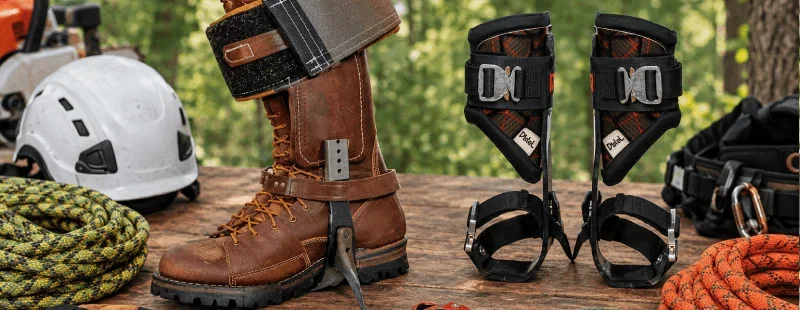
The spur, also called a climber, is the whole leg worn device: the leg iron or shank, the cuff that wraps the calf, the stirrup the foot sits in, and the straps that hold it all in place. The gaff is one specific part of that device, the pointed metal spike bolted or forged onto the bottom of the shank, and it is the gaff alone that actually punctures the bark and holds the climber's weight against the trunk. Every spur has a gaff, but the gaff is a replaceable, wearable component, not the tool itself. When someone says "my gaffs are dull," they mean the spike needs sharpening or swapping, not that the whole leg iron is worn out. Getting this distinction right matters beyond vocabulary: a report that says "the spur damaged the cambium" and one that says "the gaff damaged the cambium" describe the same event, but only the second one is precise about what actually made contact with the tree.
When Should You Use Climbing Spikes?
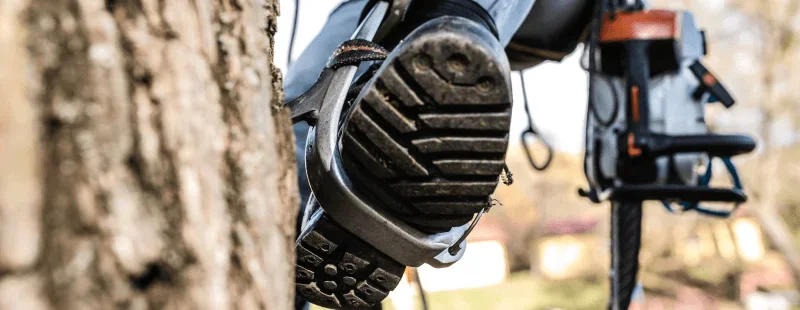
The rule is simple and worth repeating because it gets ignored constantly: climbing spikes are for tree removal and deadwood work only. ANSI A300 pruning standards treat spur use on a living tree that is staying in place as acceptable only in narrow circumstances, generally when no other safe means of access exists, and even then the arborist is expected to justify it. Every gaff puncture wounds the cambium layer, the thin band of living tissue just under the bark that the tree uses to grow and to wall off damage. On a tree headed for removal, those wounds are irrelevant since the whole tree is coming down anyway. On a tree that is staying, each puncture becomes a permanent entry point for decay organisms and a lasting scar, which is exactly why a climbing arborist doing routine pruning work uses a rope and saddle system instead and saves the spikes for removals, storm damage cleanup, and dead or dying wood where the tree's long term health is no longer a consideration.
Gaff Length: Matching Spikes to the Tree
Gaff length is not a preference, it is a fit problem. A gaff that is too short for the bark will not hold, and one that is too long overpenetrates and can lever out under load. Most manufacturers sell two gaff lengths per model line.
Pole Gaffs
Pole gaffs run short, typically 1.5 to 1.75 inches, and are built for shallower penetration on utility poles or thin barked trees where a longer spike would blow through to the softer wood underneath and lose its bite.
Tree Gaffs, Short vs. Long
Tree gaffs run longer, from roughly 2.25 inches up to 3 inches or more on some permanent gaff sets, and are shaped to reach through thicker, rougher bark into solid wood. A gaff that is too short for a thick barked removal tree, an old oak or a mature pine, will not seat properly and increases the risk of a gaff out, where the spike pulls loose mid climb.
| Bark and Tree Type | Typical Gaff Length |
|---|---|
| Utility poles, thin barked trees | 1.5 to 1.75 in (pole gaff) |
| Standard removal trees, medium bark | 2.25 to 2.75 in (tree gaff) |
| Thick barked mature trees (oak, older pine) | 2.75 to 3 in (long tree gaff) |
When in doubt, buy a set with replaceable gaffs rather than a permanent gaff model, since it lets a crew swap lengths for the job instead of owning two full climber sets.
Materials: Steel vs. Aluminum vs. Carbon Fiber
Steel is the traditional choice and still the most common: it is heavy, typically 4.5 to 6 pounds per set without straps and pads, but it is durable, inexpensive relative to the alternatives, and forgiving of rough treatment. A steel climber that gets dropped or knocked around on a truck bed generally survives fine.
Aluminum splits the difference, cutting weight noticeably compared to steel while staying more affordable than carbon fiber. It is a reasonable middle ground for a climber who is on spikes often enough to feel the weight difference but is not ready to pay a premium price.
Carbon fiber is the lightest option by a wide margin, often under 4 pounds per pair complete with straps and gaffs, and it reduces leg fatigue on long removal days more than any other single upgrade to a climbing kit. The tradeoff is price, carbon fiber sets typically cost two to three times what a comparable steel set runs, and while modern carbon fiber climbers are built to handle real job site abuse, they are generally treated with a bit more care than a steel set that can be thrown in a truck bed without much thought.
Know Where Every Piece of Gear Is
Track saws, ropes, trucks and chippers, who has them and when they are due for service, in one place.
Top Arborist Spikes and Gaffs to Consider
Prices below are approximate and vary by retailer, gaff length, and strap or pad configuration; confirm current pricing before buying.
Notch Gecko Steel Tree Climbers
The Gecko Steel Climbers give a well built steel option without the premium price of Notch's aluminum or carbon lines. The set features a rust proof steel leg iron, an adjustable high impact plastic molded cuff with integrated padding, and hot forged replaceable steel gaffs available in short pole or long tree lengths. It adjusts from 14.75 to 21 inches in quarter inch increments, weighs 5.9 pounds per pair, carries a 350 pound weight capacity with gear, and meets the ASTM F887 standard for tree climbing spurs. Expect to pay roughly 300 to 370 dollars depending on retailer.
Klein Tree Climbing Spurs
Klein's set is a longtime standard among utility and tree crews, built with contoured leg irons and offset gaffs designed for maximum penetration with a Torx bit replacement system. It adjusts from 15 to 19 inches in quarter inch increments, weighs about 4.5 pounds per set without straps and pads, and is available with 2.75 inch tree gaffs or roughly 1.5 inch pole gaffs. Made in the USA, it typically runs 270 to 350 dollars depending on configuration and retailer.
Buckingham Steel Gaffs Complete Set
Buckingham's complete set is one of the most widely used climber sets in the industry, prized for affordability and durability rather than cutting edge weight savings. The permanent gaff version ships with 3 inch tree gaffs that cannot be replaced once worn, adjustable sleeves from 16.25 to 18.75 inches, leather L-pads, and straps, all in a 6.1 pound package. A replaceable gaff version at a 23 degree angle is also available for crews that would rather swap spent gaffs than retire the whole set. Pricing generally falls between 480 and 620 dollars for the complete set depending on the gaff style chosen.
Distel Carbon Fiber Tree Climbers
Distel's carbon fiber climbers are the premium, lightest weight option in this guide, built around a forward angled carbon shank with a Vibram rubber sole for grip and protection. A complete pair with straps, pads, and gaffs weighs roughly 3.8 to 4.2 pounds, height adjusts from 13.5 to 18.8 inches, and the set is rated for a maximum user weight with gear of 240 pounds. The reduced weight is most noticeable on long removal days that involve hours on spikes rather than short jobs. Expect to pay 670 to 770 dollars depending on strap style and retailer.
Pads, Straps, and Fit
A climber set that fits poorly is a full day of discomfort even if the gaffs themselves are perfect. Pads sit against the shin and calf and come in foam, leather, or a hybrid construction, with leather generally lasting longer against sap and sawdust and foam offering a bit more cushioning on a long climb. Upper straps, usually in the 22 to 26 inch range, wrap the calf and need enough length to fit over work pants or chaps without cutting off circulation, while lower straps secure the foot in the stirrup and come in nylon, leather, or quick connect buckle styles that trade a small amount of durability for faster on and off time between jobs. Most sets ship with a standard adjustable sleeve length, and several manufacturers sell extra long sleeves separately for taller climbers who need more range than the stock configuration provides. Fit should be checked on the ground before the first climb of the day, not adjusted mid tree, since a stirrup sitting even slightly off center changes how the gaff seats on the next step.
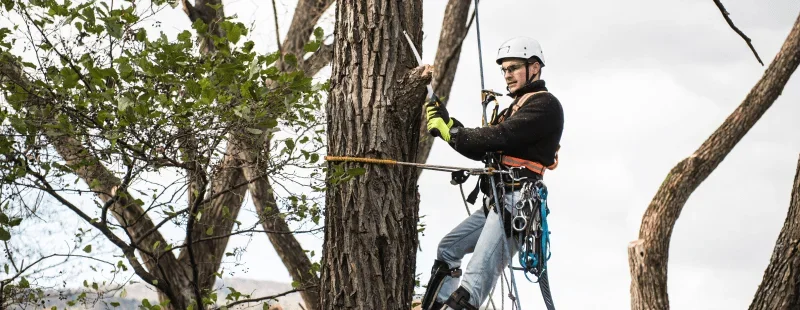
Safety Standards: ANSI Z133 and OSHA Requirements
Two standards govern spike use in the United States, and they work together rather than separately. ANSI Z133 is the arboricultural operations safety standard that directly addresses climbing methods, including when spur use is appropriate, and ANSI A300 covers pruning and tree care practices more broadly, including the guidance that spurs are not used on a tree that will remain unless no safer alternative exists. OSHA does not currently have a dedicated tree care standard of its own, so tree care work falls under OSHA's general industry standards (29 CFR 1910), covering personal protective equipment, fall protection, and related requirements, and OSHA has stated it looks to ANSI Z133 as the recognized industry consensus standard when evaluating tree care safety. In practice this means a crew following Z133 climbing guidance and A300 pruning restrictions is also positioning itself correctly with respect to OSHA's general duty expectations. For the climbing techniques and PPE requirements that pair with spike use, ArboStar's guide to climbing techniques and safety tips for arborists covers the broader system spikes fit into.
Keeping Spikes Ready and Tracked Across a Crew
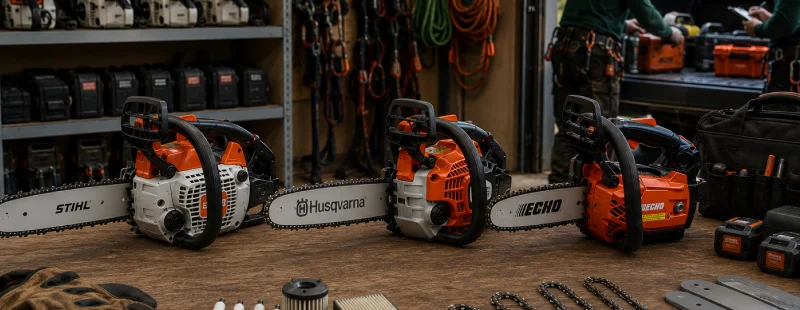
A single set of spikes on one climber's saddle is easy to keep track of. A crew running several sets across multiple climbers is a different story: gaffs wear down at different rates depending on who is using them and on what species, straps stretch and need replacing, and a set with a chipped or overly worn gaff can fail at exactly the wrong moment mid climb. The same logic that applies to tracking a crew's chainsaws applies here, and it pairs with the rest of a climber's kit covered in ArboStar's overview of arborist tools and equipment and its breakdown of what tools you need for climbing trees. Logging spike sets by unit, assigning them to a specific climber, and scheduling gaff replacement before it becomes a mid job surprise keeps a several hundred dollar set of climbers from being the thing nobody remembers to inspect until it fails. ArboStar's equipment tracking handles this alongside scheduling and job costing, so gear condition is not a separate spreadsheet nobody updates.
Frequently Asked Questions
What's the difference between a climbing spur and a gaff?
The spur is the entire leg worn device, the leg iron, cuff, stirrup, and straps. The gaff is the pointed metal spike bolted or forged onto the bottom of the spur, the single part that actually punctures the bark.
Can you use tree climbing spikes on a living tree?
Only in limited circumstances. ANSI A300 guidance restricts spur use on a tree that will remain standing to situations where no safer means of access exists, since every gaff puncture wounds the cambium layer permanently. For routine pruning on a healthy tree, a rope and saddle system is standard practice instead.
What gaff length do I need for my tree type?
Short pole gaffs, around 1.5 to 1.75 inches, suit utility poles and thin barked trees. Standard tree gaffs in the 2.25 to 2.75 inch range cover most removal work, and long gaffs up to 3 inches handle thick barked mature trees like older oaks.
Which material is best, steel, aluminum, or carbon fiber?
Steel is the most durable and least expensive, aluminum trims weight at a moderate price increase, and carbon fiber is the lightest and most expensive, best suited to climbers who spend long days on spikes and feel the weight difference.
Do climbing spikes require ANSI or OSHA certification?
The spikes themselves are generally built to meet a materials and load standard like ASTM F887, while ANSI Z133 governs the climbing methods and A300 governs when spur use is appropriate. OSHA does not certify individual gear but expects tree care operations to follow these recognized consensus standards under its general industry rules.
Conclusion
Arborist spikes and gaffs are two different things bolted together: the spur is the whole leg worn device, the gaff is the replaceable spike that does the actual puncturing, and mixing up the terms leads to mixing up the rules. Spikes belong on removal and deadwood jobs, never on a tree that is staying, and gaff length and material should match the bark and the workload rather than whatever happens to be in the truck. Whether that means a budget steel set like the Buckingham or Notch Gecko, or a premium carbon fiber pair from Distel for long days aloft, the fit, the gaff length, and the ANSI and OSHA rules around when to use spikes at all matter more than the brand name. For the rest of the climbing system spikes work alongside, ArboStar's climbing rope guide and education hub cover the harness, rope, and rigging choices that round out a full setup.