

5 Reasons Tree Service Companies Fall Behind Schedule (And Lose Jobs Because of It)
Most tree service companies don’t fall behind schedule because of what happens on the job site. They fall behind schedule because of what happens before the crew ever arrives. Poor estimating, incomplete job information, weather disruptions, weak planning, and communication breakdowns can create problems long before a chainsaw starts running.
A homeowner who takes a day off work and waits for a crew that never arrives is unlikely to call you again. A property manager who can’t get an accurate update on a delayed job is probably calling another tree company next season.
Here are the five biggest reasons tree companies fall behind schedule and what the best operators do differently.
Why Scheduling Failures Hit Tree Service Harder Than Other Trades
Tree jobs depend on weather, heavy equipment, and unpredictable durations. Unlike plumbing or electrical work, timing is much harder to control. If a roofer runs late, the next job is delayed by an hour. If a tree crew is delayed on a crane removal, it can disrupt the entire day’s schedule.
One scheduling failure doesn’t just affect one client. It compresses the next day, creates overtime, and reduces reliability in the client’s eyes.
Online reviews and Reddit threads about tree services often mention “they never showed up” or “I had to call three times to reschedule”. These are scheduling issues that turn into reputation problems – and they are usually preventable.
Problem #1 – The Estimate Didn’t Match Reality
Many scheduling problems are actually estimating problems. For example, unpredictable job durations are the most common source of scheduling problems for tree service companies, and also the most underestimated.
Inexperienced estimators, poor training, or missing job information often create problems that don’t show up until the crew arrives on site. When a crew shows up and discovers:
-
Limited backyard access
-
Additional rigging requirements
-
Utility conflicts
-
Traffic control requirements
-
Extra brush volume
-
Equipment access issues
-
Equipment required but not planned for
-
Insufficient access for equipment
-
Underestimated production hours
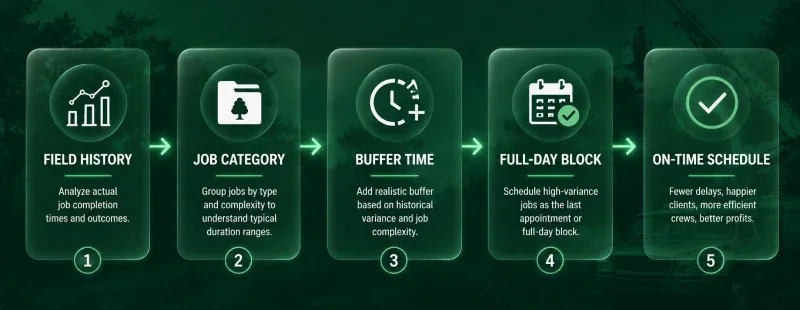
The schedule starts to break down immediately. A good estimator should catch most of these issues before the job is sold. More accurate estimates make it easier to schedule crews efficiently.
Some surprises are unavoidable. Hidden decay, customer-added work, equipment failures, and changing site conditions happen in every tree company. But most scheduling problems come from incomplete job information before the job is even booked.
How to Fix It
Spend time in the field with new estimators. Make sure they understand how your crews operate, what equipment is available, and what different jobs actually require.
Create estimator cheat sheets that include:
-
Crane dimensions with outriggers fully extended
-
Crane reach at different boom percentages
-
Equipment widths and lengths
-
Access requirements
-
Real-time schedule updates
-
Production expectations by job type
Provide tools like range finders to measure distances, clearances, and access points accurately. Use systems like ArboStar, where employee rates, crew man-hour rates, equipment rates, and production data are built into the estimating process.
Track estimated hours versus actual production hours. If jobs consistently take longer than estimated, don’t blame the schedule. Investigate the cause instead.
Ask:
-
What information did the estimator have?
-
What did the crew encounter on site?
-
Did the scope match the work order?
-
Was the right crew assigned?
The best schedules are built on accurate field information.
Problem #2 – Weather Cancellations Have No Recovery Plan
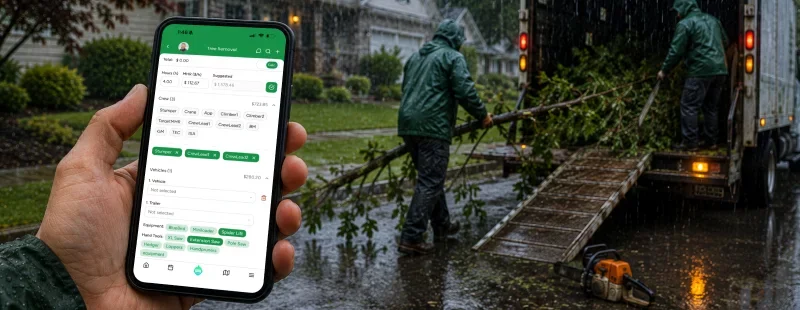
Every tree company deals with weather. Rain, wind, lightning, frozen ground, and storms can wipe out a full day of production. The issue is not the cancellation itself. The issue is what happens next.
Many companies cancel and say: “We’ll call you”. Follow-up often happens too late. Clients start calling other providers. The job is lost. The best operators already have a plan before the weather hits. So, weather disruptions in tree service are unavoidable. Losing clients because there is no rescheduling system is not.
Many small tree service businesses handle cancellations by calling or texting the client and waiting for a response. A large share of clients never call back. They use the gap to get other quotes and book elsewhere.
The rescheduling gap is where revenue quietly leaks. A company handling 3–5 weather cancellations per week without an automated rebook workflow loses repeat clients over time, often without noticing. Spring and storm seasons make this worse. One weather event can cancel an entire day of work, and the revenue is often not recovered.
This pattern also weakens seasonal stability. Maintenance clients who are cancelled twice in one spring season often start to doubt reliability.
How to Fix It
Every weather cancellation should trigger immediate rescheduling. Instead of waiting for customers to call back, offer a new date right away and make it easy to confirm.
Consider keeping a buffer day available for at least one crew every couple of weeks. It gives you flexibility to absorb weather delays, overruns, and emergency work without disrupting the entire schedule. The faster a cancelled job gets back on the schedule, the less revenue leaks out of the pipeline.
Problem #3 – Storm Work Takes Over Everything
This is one of the most damaging scheduling problems tree service companies face, and it is almost never discussed.
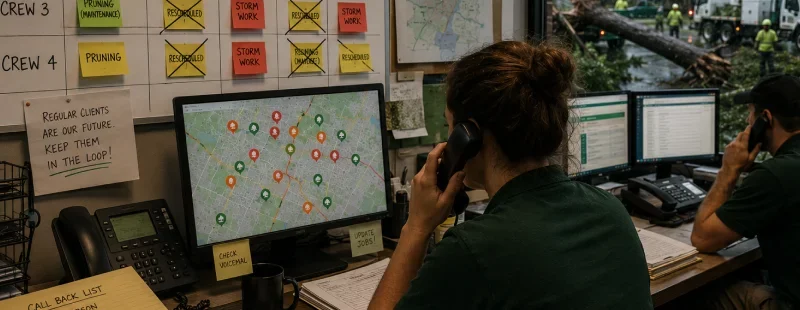
Imagine… Every owner knows the feeling. A storm rolls through. The phone starts ringing. Emergency storm work scheduling takes over the calendar, and the temptation is to take every job possible.The temptation is to chase every storm job possible. Unfortunately, many companies end up sacrificing their regular customers in the process. Pruning jobs get pushed back. Maintenance work gets delayed.
Long-term customers stop getting updates. The company looks busy for two weeks and then wonders why the schedule feels lighter a month later. Storm work can create massive short-term revenue. Repeat customers create long-term stability. Both matter.
Moreover, crews drive past each other, backtrack across service areas, and rack up windshield time in tree service that quietly eats into the revenue the storm jobs were supposed to generate. Field service route optimization breaks down entirely when every new job gets added to whatever gap exists in the schedule.
The consequence: the storm revenue boost gets partially offset by overtime, fuel costs, and regular client churn. The business looks busy for two weeks and then faces a quieter-than-usual pipeline for the next month.
How to Fix It
Have a storm plan before storm season starts.
Decide:
-
Which jobs take priority
-
How customers will be updated
-
How regular work continues during demand spikes
-
Which crews handle emergency work
The goal is to capture storm revenue without damaging existing customer relationships.
Problem #4 – Nobody Confirms the Job Before the Crew Arrives
Just because a job was scheduled two weeks ago doesn’t mean it is ready to go. Especially while labor shortages in arborists’ fields get going. Customers forget. Access arrangements change. Property managers have new requirements. Gate codes change. Vehicles block access.
The climber needed for the job is on vacation. The crane operator is unavailable. The certified arborist assigned to the job has been moved to another project. Without confirmation, crews sometimes arrive only to discover the work cannot start. Now the crew loses production time and the day becomes harder to recover.
One more reason: clients move, change their mind, book a second company, or simply forget about a tree care appointment scheduled weeks in advance. Without a confirmation step in the 24–48 hours before the appointment, crews show up to empty driveways. A no-show tree service crew costs: the crew’s drive time to the site, the schedule block that could have been filled with a confirmed job, and the equipment mobilisation cost – especially for jobs requiring a crane or chipper.
Commercial clients add another layer of complexity. Property managers, council contracts, and HOA accounts often have site access requirements or permit conditions that change between the booking date and the job date. Without a confirmation call or message, the crew can arrive and be unable to start work. For commercial tree care appointment scheduling, this is not a rare edge case – it happens regularly.
How to Fix It
Confirm jobs 24 to 48 hours before arrival.
Verify:
-
Customer availability
-
Access requirements
-
Equipment access
-
Key crew member availability
-
Certified arborist availability
-
Crane operator availability
-
Climber availability
-
Site conditions
-
Scope of work
A five-minute confirmation often prevents hours of wasted production. Utilize automations in ArboStar for confirmations and reminders so issues are identified before crews leave the yard. Unconfirmed jobs should flag in the tree service dispatch software so the scheduler can follow up directly before the morning brief. This single step catches most no-show situations before they become a wasted day.
Problem #5 – Poor Communication Creates Most Customer Complaints
Most customers understand that delays happen. What they don’t understand is silence. A crew running two hours behind isn’t usually the problem. The problem is nobody told the customer. Many of the bad reviews tree companies receive aren’t about tree work at all. They’re about communication. The homeowner doesn’t know where the crew is. The office doesn’t have an update. The foreman is busy running the job. Everyone gets frustrated.
Crew routing in field service operations depends on knowing where crews are. Without that visibility, dispatch decisions are based on guesswork. Route optimization in tree care is theoretical. Double booking tree service slots becomes a genuine risk – two jobs get committed to the same crew with no way to catch the conflict until it is too late.
How to Fix It
Create a communication process between the office, the crew, and the customer.
Customers should know:
-
When the crew is on the way
-
If delays occur
-
When arrival times change
-
What to expect next
Whether that communication happens through software, text messages, phone calls, or GPS tracking is less important than making sure it happens consistently.
Good Schedules Start Long Before the Calendar
Most tree company scheduling problems aren’t really scheduling problems. They’re estimating problems. Production planning problems. Communication problems. Weather management problems.
The companies that consistently stay on schedule understand that scheduling starts long before a crew leaves the yard. When estimating is accurate, crews are assigned properly, customers are informed, and weather disruptions are managed proactively, schedules become far easier to maintain.
And when schedules stay on track, customers stay happier, crews stay productive, and fewer jobs end up going to a competitor.
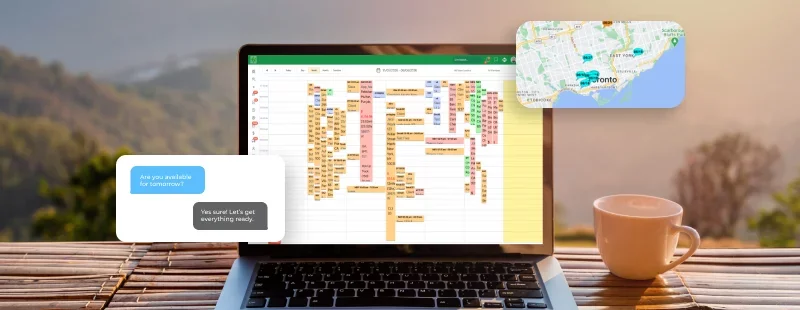
Arborist-specific tree service scheduling software connects all five: job duration tracking informs how future jobs of the same type get blocked, weather cancellations trigger automatic rebook workflows, GPS shows crew location in real time, and automated confirmations reduce no-show jobs before they happen. Route optimization by geographic area keeps crews efficient instead of criss-crossing the service area.
ArboStar’s scheduling, GPS tracking, and client communication tools are built for tree care operations – from single-crew companies managing a full weekly calendar to multi-crew operations balancing emergency storm work and recurring maintenance contracts at the same time. The platform also helps prevent problems caused by an overbooked tree service schedule by improving visibility, dispatch coordination, and workload planning.
Every job that falls through because of a preventable scheduling failure is revenue that went to a competitor. The tools to stop that from happening exist. Book a demo to see how ArboStar helps tree service companies stop losing jobs to preventable scheduling problems.
FAQ
What is the cheapest time of year to schedule tree removal?
Late fall and winter – November through February in most regions – when seasonal demand drops and crews have more availability. Some companies offer off-season pricing discounts to maintain cash flow and keep crews productive through slower months.
Why do tree service companies cancel or no-show so often?
Most cancellations come from weather, equipment and tree service scheduling issues, or a previous job running long due to duration variability. No-shows are almost always a communication failure, not an operations failure. Companies without automated client notifications leave clients waiting with no update – and clients who receive no update assume the crew is not coming.
How do tree service companies handle storm season scheduling?
The best-run companies designate separate storm crews and protect their regular maintenance schedule from emergency and seasonal demand surges. Storm work booked on top of a full regular schedule leads to crew burnout, late arrivals across the board, and regular client churn that shows up in the following quarter’s pipeline.
What should I look for in tree service scheduling software?
Real-time GPS crew tracking, automated client notifications, job duration tracking by job type, booking confirmation workflows, and route optimization by geographic area all help reduce delays and prevent skill mismatch scheduling issues. Software that connects scheduling directly to CRM, dispatch, and invoicing eliminates the double-entry and communication gaps that cause most of the problems described above.
See how ArboStar can run your tree care business
Quoting, scheduling, crews and invoicing in one place. Book a short demo and see it with your own jobs.