

Top 5 Invoicing Mistakes Tree Service Companies Make – and What It’s Costing You
The most costly invoicing mistakes tree service companies make come down to five recurring failures: bundling all charges into one vague line item, omitting payment terms and due dates, failing to document permits and job site address specifics, sending invoices that don’t match the original estimate, and having no structured system for following up on unpaid work. Each mistake triggers payment delays, client disputes, or silent revenue loss – problems that compound fast as a business scales.
Tree service invoicing demands more precision than most trades. High job variability, permit requirements, subcontractors, and expensive equipment mean every invoice is a liability document as much as a payment request. A $4,000 removal invoice with a single vague line item creates far bigger problems than anything you’d encounter in a simpler service business. Here’s where tree companies consistently go wrong – and exactly how to fix it.
Why Tree Service Invoicing Is Different
A lawn care company can send a flat-rate invoice for a recurring service and rarely hear back. Tree work doesn’t work that way.
Jobs range from $500 lot clearings to $15,000 crane removals. Scope changes mid-job. Council permits get required at the last minute. A subcontractor shows up for rigging, and suddenly there are COI questions. Debris ends up at a green waste facility the client wasn’t expecting to pay for. Every one of those variables needs to be documented – not just to get paid, but to protect the business if a client disputes the work six weeks later.
The common invoicing mistakes tree service make below aren’t small administrative oversights. In tree care, they translate directly into delayed payments, written-off receivables, and disputes that damage client relationships the business spent years building.
Mistake #1 – Bundling All Charges Into One Line Item
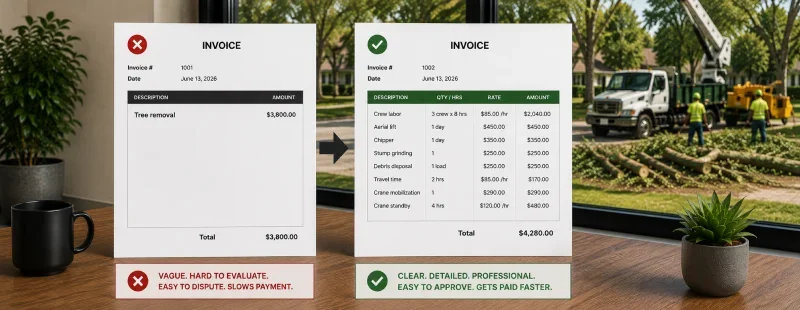
“Tree removal – $3,800”.
That’s an invoice that answers nothing. Clients can’t evaluate it, can’t compare it to the estimate, and can’t pass it through a commercial approval process. And when they feel uncertain about a number that size, they stall.
What that line item should actually contain: crew labor broken out by hours and rate, equipment charges for the chipper, aerial lift, or stump grinder, debris disposal as a separate item, travel time on rural or multi-site jobs, and crane mobilization and standby if applicable. Crane jobs are a specific failure point – if mobilization isn’t broken out as its own line, clients assume it was always included in the base rate. That assumption turns into a dispute the moment they see a higher total than expected.
There’s a second problem that goes overlooked: the wording has to match the estimate. “Stump removal” and “stump grinding invoice to 300mm below grade” are not the same thing to a client reading both documents side by side. Even when the total is correct, mismatched vague service descriptions raise red flags that slow payment.
How to fix it: Build standard line-item templates for each service type to avoid inaccurate service descriptions – removal, grinding, pruning, emergency tree service billing, crane mobilization. When your invoicing system converts an approved estimate directly to an invoice, the wording carries over automatically. No retyping means no drift.

Mistake #2 – Missing or Vague Payment Terms
“Due upon completion” isn’t a payment term. It’s a placeholder that gives the client no urgency and gives you no legal footing when the invoice hits 30 days with no payment.
Without a specific due date, you can’t technically classify an invoice as overdue. You can’t charge a late fee. You can’t escalate to collections with any clear reference point. You’ve built the collection problem into the invoice before the client even receives it.
Every tree service invoice needs three things beyond the total: a due date stated clearly (Net 15 or Net 30, not a vague phrase), the accepted payment methods, and a late fee policy. The late fee doesn’t need to be aggressive – even a modest monthly charge creates a reason to pay on time rather than defer.
Deposit handling creates its own confusion. If a client paid a 30% deposit upfront, the invoice should show the original total, the deposit applied, and the balance due – not just the remaining amount. Balance-only invoices look like errors. Clients call to ask if the deposit was credited, which slows everything down.
Commercial clients add another requirement: a purchase order number. Without it, the invoice won’t enter their payment system regardless of how well the work was done. Councils, HOAs, and property managers operate on structured procurement processes. If your invoice doesn’t include the PO number they gave you, it gets set aside until someone tracks it down – and that someone is usually you, weeks later.
How to fix it: Set payment terms as a default in your invoicing system so they appear on every document automatically. Don’t rely on adding them job by job.
Mistake #3 – No Documentation of Permits, Site Conditions, or Scope
This is the gap that separates tree service invoicing from almost every other trade, and it’s the one no generic invoicing guide covers.
When a job involves a council-controlled tree, a heritage species, or protected vegetation, the permit number needs to appear on the invoice. Commercial clients – councils, strata managers, local government contractors – won’t process payment without it. This isn’t bureaucratic friction; it’s a compliance requirement on their end. If the permit number isn’t there, the invoice gets returned.
Beyond permits, scope specifics are what make an invoice defensible. “Removed 2 × Lemon-scented Gum (~22m), stump ground to 300mm below grade, debris chipped on-site and removed” can be verified. “Tree removal” cannot. When a client claims work was incomplete or different from what was agreed, the vague invoice offers no counter-evidence.
Disposal documentation matters for commercial clients specifically. Where did the green waste go – a licensed tip, a green waste facility, left on-site for the client to manage? Councils and property managers often need this for their own compliance records. If it’s not on the invoice, they’ll ask, and the back-and-forth delays payment.
Before-and-after photos referenced as invoice attachments close disputes before they start. A client who claims a stump wasn’t fully ground has no argument when the invoice references photos showing the finished depth. Subcontractor COI is a related issue – if a sub handled rigging or an aerial platform, their certificate of insurance should be on file. An uninsured subcontractor’s accident becomes the tree company’s liability.
How to fix it: Build documentation into the job workflow, not the office process. Photos, site notes, and permit numbers should be captured in the field before the crew leaves. ArboStar attaches job documentation to every invoice automatically, so nothing gets left behind when the paperwork is done.
Mistake #4 – Inconsistency Between Estimate and Invoice
Clients remember what they agreed to. When the invoice looks different – different wording, different line items, or a higher total with no explanation – they push back. Even when the work was done exactly as planned, inconsistency creates the impression that something changed without authorization.
The most common version of this problem: a scope change happened mid-job, the crew handled it without documenting a change order, and the invoice came in higher than the estimate. The client’s first reaction isn’t to accept the extra charge – it’s to question whether the work was actually necessary. Without a client-approved change order, there’s nothing to point to.
A subtler version happens in growing companies. Multiple estimators develop their own shorthand for the same services. One writes “pruning to AS4373 standard”, another writes “crown lift and thinning”. These are effectively the same job, but when a commercial client compares three invoices from the same company and sees different descriptions each time, it looks like disorganized operations – not a business worth a long-term contract.
Delayed or disorganized invoicing makes all of this worse. The longer the gap between completing work and sending the invoice, the more the client’s memory of the scope fades. An invoice that arrives two weeks after completion is more likely to generate questions than one sent the same evening.
One administrative mistake that compounds quickly: if an incorrect invoice was already sent, never just send a corrected version. Issue a formal credit note to cancel the original, then reissue. Two invoices for the same job with different totals create accounting problems on the client’s end and signal a disorganized operation on yours.
How to fix it: Standardize service descriptions across your estimating team. Use estimate-to-invoice conversion so the exact approved wording carries through to billing. Invoice same day or next day – before the job fades from everyone’s memory.
Mistake #5 – No Follow-Up System for Unpaid Invoices
Next, we have to review one of the most popular tree service invoice example mistake.Most tree companies send an invoice and consider the job done. Then the invoice sits. The owner notices it’s late three weeks in, sends a follow-up email, and waits again. By the time any real action happens, the invoice is 45 days past due and the client has moved on to other priorities.
Sending the invoice is not the end of the process.
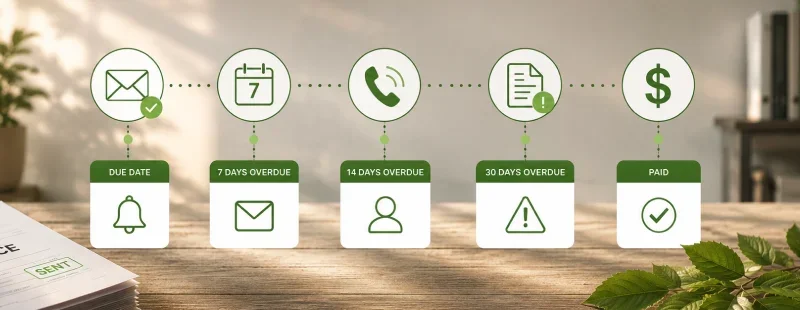
A structured follow-up sequence looks like this: an automated invoice processing or reminder on the due date, a second reminder at seven days overdue, a personal call at 14 days, and a formal notice at 30 days. Each step escalates the seriousness without burning the relationship. Most invoices get paid after the first or second reminder – the issue isn’t client bad faith, it’s that nothing prompted them to act.
Invoice aging visibility is the underlying problem for most businesses using spreadsheets or paper systems. Without a live view of which invoices are 30, 60, and 90+ days outstanding, the follow-up process depends entirely on whoever notices a gap in cash flow. That’s not a system – it’s hope.
Storm work is the highest-risk category for late payment. Clients who call in a panic after wind damage agree to anything in the moment. Once the tree is cleared and the emergency feeling passes, payment slows. Storm jobs should be flagged for early follow-up, not treated like routine residential billing.
How to fix it: Automate payment reminders at each stage of the sequence. Review invoice aging as a fixed weekly task, not an occasional one. The job isn’t complete until the invoice is paid – and your system should make that visible.

How the Right Software Prevents All Five Mistakes
Generic tools – Word, Excel, basic accounting and tree service invoicing software – weren’t built for tree service job structure. They don’t handle equipment day rates, permit fields, or estimate-to-invoice conversion. Every invoice gets built from scratch, which means every invoice is an opportunity for wording drift, missed line items, or forgotten documentation.
Arborist-specific software handles the full workflow: standardized line items that carry through from estimate to invoice, field documentation that attaches automatically, permit and scope fields built into the job record, and automated payment reminders with invoice aging reports. Nothing falls through because the system is designed around how tree work actually operates – not adapted from a generic billing template.
ArboStar was built specifically for tree care companies. From field estimate to payment tracking, every step is connected, and every invoice reflects the documented scope of the job.
Book a demo to see how ArboStar keeps your invoicing consistent and your cash flow visible.
FAQ
What are common invoice mistakes to avoid in tree service?
The five most costly are: missing itemization, no payment terms or due date, no permit or scope documentation, inconsistency between the estimate and invoice, and no follow-up system for unpaid invoices. Each one affects cash flow differently, but all five are preventable with the right process.
What happens if my tree service invoice amount is wrong?
Issue a formal credit note to cancel the original invoice, then send a corrected one. Never just resend with a new total – two invoices for the same job with different amounts create accounting problems on the client’s side and can delay payment further.
Should I separate labor and equipment on a tree service invoice?
Yes – you have to separate labor from equipment costs, especially on jobs over $1,000. Separate line items for crew costs and hours, equipment, disposal fees, and travel make the total easier to evaluate and much harder to dispute. Bundled totals invite questions; itemized services invoices answer them.
How do I get paid faster as a tree service company?
Invoice same day or next day while the job is fresh. Set a specific due date, not “due upon completion”. Accept digital payments so there’s no barrier to paying immediately. Automate reminders at zero, seven, and 14 days overdue – most invoices get paid after the first prompt.
Do I need permit numbers on a tree removal invoice?
Yes, whenever a permit was required. Council work, heritage trees, and protected species all fall into this category. Missing a permit number on commercial invoice audits isn’t just an oversight – it’s often the specific reason payment gets held up.
See how ArboStar can run your tree care business
Quoting, scheduling, crews and invoicing in one place. Book a short demo and see it with your own jobs.