

You land a job. You’re busy all week. The crew works hard, the client is happy, the invoice gets paid. Then you look at your bank account at the end of the month and wonder where the money went.
Most owners think their 3-man crew costs $60–70/hr. The real number is closer to $180–200/hr.
This is one of the most common experiences in the tree care industry – and it almost always comes back to pricing. Not bad work. Not slow crews. Pricing.
The problem isn’t that you’re charging too little on a single job. The problem is that most tree care companies don’t actually know what a job costs to deliver. They price off instinct, off what competitors charge, or off what “feels right” for the size of the tree. That works fine when you’re a solo operator with low overhead. It quietly destroys you when you start adding employees, equipment, and infrastructure.
So, how to price tree service jobs? This guide walks through how to build a stump grinding pricing model based on your real numbers – so every job you win is a job that moves your business forward.
The “Guesstimate” Trap: Why Solo Prices Don’t Work for Growing Teams
When you were running solo, your math was simple. Cover your truck, your insurance, your equipment payment, take home enough to live on. A rough man-hour billing rate in your head got you close enough.
The First Trap
The moment you hire your first employee, that math breaks. Now you have payroll taxes, workers’ comp premiums, potential benefits, and the administrative overhead of managing someone else’s time. Your cost structure has changed – but most owners don’t update their pricing to match. They keep quoting jobs the way they always have, just now with more expenses underneath.
The Second Trap
There’s a second trap: pricing against competitors. You see a competitor undercut you on a bid, and the temptation is to match them. Don’t. You have no idea what their cost structure looks like. They might be underinsured. They might be paying themselves nothing. They might be burning through cash and not know it yet. Matching their price without knowing your own numbers is how you end up "winning" jobs that cost you money.
Revenue and profit are not the same thing. A company doing $800,000 a year with 8% net margin is taking home $64,000. A company doing $500,000 with 18% net margin is taking home $90,000 – and has far less stress. Being busy is not the goal. Being profitable is.
Step 1: Calculate Your “Loaded” Labor Rate
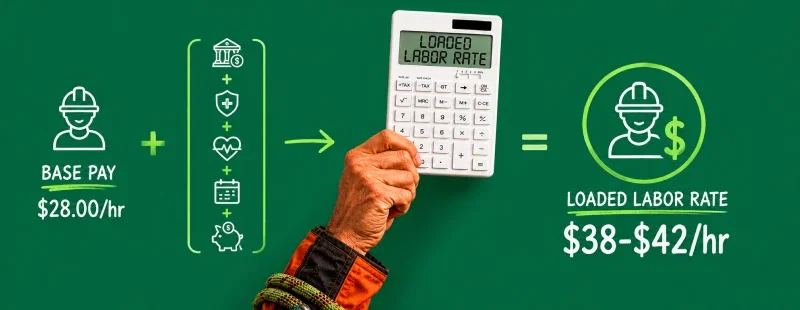
This is the most important number in your business, and most tree care companies either don’t know it or significantly underestimate it. Your loaded labor rate is what it actually costs you – per hour – to put a worker in the field. Not what you pay them. What it costs you.
Here’s why the gap matters: if you pay a climber $28/hour, your actual cost is closer to $38–42/hour once you account for everything layered on top of base wages.
A climber at $42/hr + two groundworkers at $28/hr each = $98/hr in loaded labor alone. Add equipment and overhead and a standard chip truck crew costs $170–200/hr to put in the field.
What Gets Added to Base Pay
Payroll taxes (FICA, FUTA, SUTA) typically add 10–12% to base wages. Workers’ compensation insurance for tree care is one of the highest-rated classifications in the industry – TCIA guidance puts rates for climbers and groundworkers in the range of $15–30 per $100 of payroll depending on your state and claims history. Add health benefits if you offer them, paid time off, and any other employer contributions.
The result: base pay is often only 60–65% of your true labor cost.
The Formula
Loaded Labor Rate = Total Annual Payroll Expense ÷ Total Annual Billable Hours
Total annual payroll expense includes everything above – wages, taxes, insurance, benefits – for every field employee. Total annual billable hours is the actual hours spent on client jobs, not total hours on payroll (account for travel time, shop time, training, and downtime).
Run this for each role separately – your lead climber costs more per hour than your groundworker. Build your estimates around the actual crew composition for each job, not a blended average.
See how ArboStar automates your job costing. Book a free, personalized demo today.

Step 2: Equipment – The Asset that Pays for Itself (or Doesn’t)
Every piece of equipment you own has an hourly cost, whether it’s running or sitting in the yard. The job of pricing is to recover that cost across the hours you actually use the equipment.
-
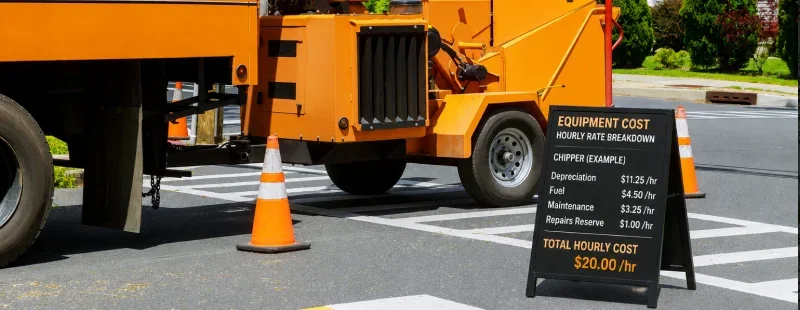
Start with depreciation. A $90,000 chipper has a useful life of roughly 8–10 years. That’s $9,000–$11,000 per year in depreciation – money you need to be setting aside so that when the machine dies, you can replace it without a crisis. Divide the annual depreciation by the annual hours you run that machine, and you have your base depreciation cost per hour.
-
Add operating costs. Fuel consumption at current diesel prices, routine maintenance (blade sharpening, oil changes, filters), and a buffer for repairs. A chipper running 800 hours a year might cost $8–12 in fuel and maintenance per hour on top of depreciation.
-
Do this for every major piece of equipment: aerial lift, stump grinder, log truck, skid steer. Each gets its own hourly rate. When you build a job estimate, you note which equipment is needed and for how long, then add those costs directly to the job.
This is where most companies leave money on the table. They charge for the chipper as a vague “equipment fee” – a flat add-on that doesn’t reflect actual usage. A stump grinding job that requires two hours of machine time should have two hours of stump grinder costs in the estimate, full stop.

Step 3: Overhead – The “Invisible” Profit Eater
Overhead is everything you pay to keep the business running that isn’t directly tied to a specific job. It’s real, it’s constant, and it has to be covered by every billable hour your crew works.
Common Overhead Line Items for Tree Care Companies
-
Office rent or home office allocation
-
Administrative staff salaries
-
Marketing and advertising
-
Software subscriptions (estimating, scheduling, CRM – tools like ArboStar)
-
Vehicle insurance for non-field vehicles
-
Accounting, legal, and professional fees
-
Phone, internet, and utilities
Add these up for a month. That’s your monthly overhead.
The Formula
Hourly Overhead Rate = Total Monthly Overhead ÷ Total Monthly Billable Man-Hours
If your overhead is $12,000/month and your crew logs 600 billable man-hours, your overhead rate is $20/man-hour. Every hour a field worker spends on a client job needs to recover $20 in overhead – on top of their loaded labor cost and equipment costs.
This number will surprise most people who’ve never done the math. It’s also the number that explains why you can be busy and still barely break even.
Putting It All Together: The Core Pricing Formula
Once you have your three cost components – labor, equipment, overhead – the pricing formula is straightforward.
Job Price = (Direct Labor + Equipment + Overhead) ÷ (1 − Target Margin %)
The division step is what builds your margin in. If you just add a percentage on top of costs, you end up with a markup, not a margin – and they’re not the same. A 25% markup on $1,000 in costs gives you $1,250 in revenue and a 20% gross margin. To target a 25% gross margin, you divide by 0.75.
Example: Pricing a tree removal
A residential job: one large oak removal, moderate site access, one full day.
-
Crew: 1 climber + 2 groundworkers, 8 hours each
-
Loaded labor: $42/hr climber, $28/hr groundworkers × 2
-
Labor cost: ($42 + $56) × 8 = $784
-
-
Equipment: chipper 6 hrs ($18/hr) + aerial lift 4 hrs ($35/hr)
-
Equipment cost: $108 + $140 = $248
-
-
Overhead: 3 workers × 8 hours × $20/hr = $480
-
Total cost: $1,512
Crew cost reality check: $784 in labor ÷ 8 hours = $98/hr in loaded labor for this crew – nearly double what you'd get just adding up their hourly wages. Factor in equipment and overhead, and the true all-in cost to run this crew is ~$190/hr. That's what every hour on this job has to recover before you see any profit.
-
Target gross margin: 65%
-
Job price: $1,512 ÷ 0.35 = $4,320
That price might feel high if you’re used to quoting $2,500 for a day of work. But $2,500 on that job – after labor, equipment, and overhead – leaves you with roughly $988 in gross profit, which is a 40% gross margin. After sales expenses, vehicle and estimating tree removal costs, and any unexpected issues on the job, your actual net on that job could be close to zero.
Know your numbers. Quote your numbers.
Common Pricing Mistakes to Avoid in 2026
Time to look at the main tree service pricing mistakes:
-
Ignoring windshield time. Drive time is labor cost. If your crew spends 45 minutes each way getting to a property in the suburbs, that’s 2.5 man-hours of loaded labor cost before a single branch hits the ground. Far-away jobs need a location premium built into the price – a flat travel fee or an increased hourly rate for that job. Companies that don’t account for this end up subsidizing their clients’ remote locations out of their own margins.
-
Underestimating site access. There’s a massive difference between a job where the chipper parks 20 feet from the work and one where the crew carries brush 200 yards to the street by hand. Site access adds hours. Hours add windshield time cost. Always walk the full path from the work zone to the equipment before you quote. One difficult access condition can turn a profitable job into a break-even.
-
Pricing hazardous work at standard rates. A leaning dead ash over a roof is not the same job as a healthy oak in an open yard, even if they’re the same diameter. Hazardous conditions increase time, risk, and the skill required. They should increase the price. Build a risk premium for hazardous trees into your estimating process – a percentage add-on for decay, lean, confined drop zones, or proximity to structures. OSHA guidelines on tree work hazards exist for a reason, and that reason should be reflected in what you charge.
-
Fear of “no”. Walking away from a low-margin job is a legitimate business decision. Every hour your crew spends on a job that barely covers costs is an hour they’re not available for a profitable job. Low-ball clients often create the most callbacks, the most hassle, and the least repeat business. Price your work at what it costs to do it right, and let the clients who don’t value that find someone else.

Using Technology to Automate Your Estimating
The math above is not complicated. But doing it manually for every job, across every estimator on your team, with different crews and equipment mixes – that’s where consistency breaks down. Estimating software solves this by storing your rates once and applying them every time. You set your loaded labor rates by role, your equipment rates by machine, your overhead allocation – and every estimate your team builds pulls from those same numbers. A new estimator on their third week quotes jobs the same way your most experienced person does.
ArboStar’s estimating tools are built around this structure. You configure your cost rates once, build service templates around them, and generate accurate estimates in the field without loaded labor rate calculation from scratch each time. The same system tracks actuals against estimates – so after a job closes, you can see whether the quoted hours matched reality, and adjust your rates if they didn’t.
That last part is underrated. Most companies never close the loop between estimated and actual hours. They quote a job at 8 hours, it takes 11, and they absorb the difference without asking why. Over time, that gap is the difference between a healthy margin and a company that can’t figure out where the money goes. Standardized estimating, connected to job tracking, connected to reporting – that’s the system that lets you actually manage your tree service profit margins instead of guessing at them.
Conclusion: Profitable Pricing is a Discipline
High revenue is not the goal. Healthy margin on growing revenue is the goal. A company doing $1.2M with 8% net profit is more stressed, more fragile, and taking home less than a company doing $700K with 18% net.
Knowing your numbers – your real labor cost, your equipment burden, your overhead per hour – is the foundation everything else is built on. It’s what lets you quote confidently, walk away from bad jobs without anxiety, and grow the business without wondering why profits aren’t keeping up. The math isn’t hard. The discipline is doing it consistently, updating your rates when costs change, and not letting “what the market charges” override what your business actually needs to survive.
Start with your loaded labor rate. Build from there. The price of every job like the business depends on it – because it does.
Want to see how ArboStar handles tree care job costing and margin tracking in practice? Explore the estimating features or book a demo to walk through a real estimate with your numbers.