

Tree service companies compete in a local market where timing, visibility, and trust determine who gets the call. This guide covers practical tree service marketing ideas across every major channel: local SEO, Google Business Profile, seasonal campaigns, paid ads, social media, reviews, content, and performance tracking. Whether you run a two-truck operation or a larger crew, these strategies apply directly to tree care businesses – not generic service marketing.
What Is Tree Service Marketing?
Tree service marketing is the system a tree care business uses to reach property owners who need its services, convert them into paying clients, and build enough local reputation to generate repeat work and referrals. That system spans multiple channels – local search, paid ads, reviews, social media, email, and referral partnerships – and works best when those channels reinforce each other instead of operating in isolation.
The goal is not just visibility. The goal is to appear at the right moment – when a homeowner searches for tree removal after a storm, or when a property manager needs a contractor for seasonal pruning – and give them enough reasons to choose your company over a competitor.
Why Tree Service Companies Need a Marketing Plan
Posting occasionally on Facebook, running a one-off Google Ad when jobs slow down, and offering a spring discount every year does not constitute a marketing strategy. It produces inconsistent results and makes it hard to know what actually drives revenue.
A working marketing plan defines which services to promote, which geographic areas to target, which channels to invest in, how campaigns align with seasonal demand, what budget each channel requires, and what metrics determine success. Without that structure, spending increases without a clear return – and the business stays dependent on word of mouth alone.
1. Optimize Google Business Profile for Local Visibility
A Google Business Profile is one of the most effective tools for local tree service marketing. It surfaces your company in map results and local search packs when nearby property owners search for tree care – and it does so without a paid ad budget.
A complete, well-maintained profile covers:
-
Service areas – All service areas where your crew operates
-
Services – Core services listed individually: tree removal, trimming, pruning, stump grinding, emergency response
-
Photos – Before-and-after photos from actual jobs, added consistently
-
Posts – Regular posts for seasonal campaigns, promotions, and project highlights
-
Q&A – Active Q&A section with pre-answered common questions
-
UTM tracking – UTM parameters on your website link to track profile-generated traffic separately from other sources
Reviews on the profile also function as a conversion factor. A company with 80 reviews at 4.7 stars appears more credible than a competitor with 12 reviews at 5.0. The volume matters as much as the score.
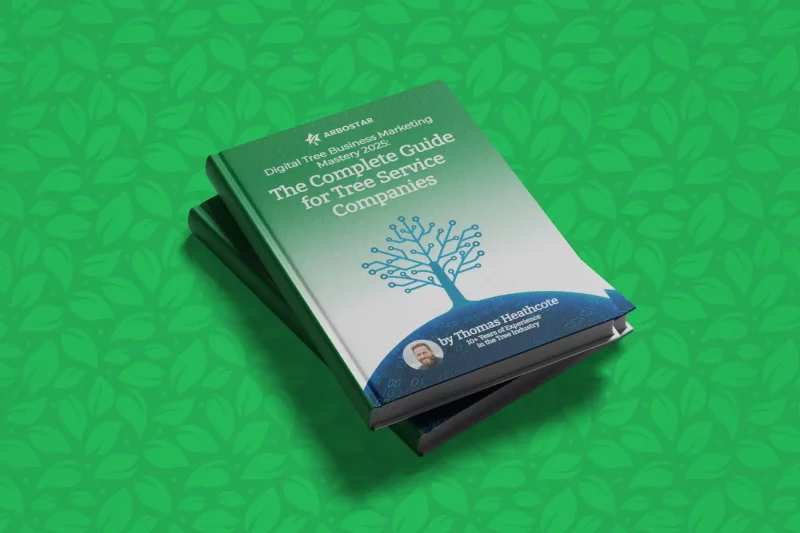
Maximize Your Tree Business Growth in 2025!
Unlock the secrets to success with our ultimate guide! The Digital Tree Business Marketing Mastery 2025 eBook is your go-to resource for staying ahead in the tree care industry. Discover cutting-edge strategies, proven digital marketing tactics, and expert insights that will revolutionize the way you attract clients and grow your business.
What’s inside?
✅ The latest trends in tree care marketing
✅ Must-know strategies for lead generation
✅ SEO, social media, and Google Business optimization
✅ How to automate your marketing and scale faster

2. Build Local SEO Pages for Core Tree Services
Most tree service websites have a single services page that lists everything in a few sentences. That structure does not rank well for specific service searches. Dedicated landing pages for each core service – with local signals built in – perform significantly better.
Pages worth building for tree removal marketing and broader tree services marketing include:
-
Tree removal (city/region-specific page)
-
Emergency tree removal
-
Tree trimming and pruning
-
Stump grinding and removal
-
Plant health care
-
Land clearing
Each page should target a specific search phrase, describe the service clearly, include real photos from local jobs, list service areas, and carry a direct call to action. Tree removal marketing benefits most from this approach – it is a high-intent, high-ticket search where page relevance directly affects whether you appear in results.
3. Use Seasonal Tree Service Marketing Campaigns
Tree service demand follows a seasonal pattern. A company that plans campaigns around that pattern captures clients at the exact moment they need the service – rather than spending on broad awareness year-round with inconsistent returns.
Campaigns worth building into an annual marketing for tree services calendar:
-
Late winter / early spring: pruning campaign focused on dormant-season tree health and structural shaping before new growth
-
Late spring: tree health inspection season – targeting property owners who want to assess tree condition before summer
-
Summer: storm preparation campaign – hazardous tree identification, clearance from structures, weak branch removal
-
Early fall: cleanup and leaf removal campaign for residential and commercial properties
-
Late fall / early winter: winter hazard inspection – dead or leaning trees that pose risk under snow and ice load
-
Post-storm: emergency cleanup campaign – fast response, same-day estimates, storm damage documentation support
Each campaign should run across Google Business Profile posts, social media, email if you have a list, and paid ads if the budget supports it. The seasonal angle also gives your content a reason to exist – it addresses a timely concern rather than repeating generic messaging.

4. Run Tree Service Advertising Campaigns
Paid advertising for tree service companies works best when it targets high-intent searches and geographic boundaries precisely. The three main channels worth considering:
Google Search Ads
Google Ads capture property owners who are actively searching for a service right now. Searches like “tree removal near me”, “emergency tree removal”, and “tree trimming [city]” carry strong commercial intent. A well-structured campaign – with tightly matched keywords, local radius targeting, and landing pages that match the ad – converts at a significantly higher rate than broad awareness campaigns.
Tree service advertising on Google requires ongoing bid management. Cost-per-click in competitive markets can run $15–$40 for tree removal terms. Track cost per booked job, not just cost per click.
Local Services Ads
Google Local Services Ads (LSAs) appear above standard search results for local queries. They display your company name, rating, and a direct call button. LSAs charge per lead rather than per click, and Google-verified badges on the profile add a trust signal. Not all markets and service categories qualify, but where available, they are worth testing alongside standard search ads.
Facebook and Instagram Ads
Social ads work differently from search ads. The audience is not actively searching – so the ad needs to interrupt attention with a visual reason to engage. Before-and-after photos of tree removal jobs, storm damage cleanup footage, and time-lapse trimming videos perform well in this format. Use social tree service advertising for seasonal campaigns, post-storm response pushes, and retargeting visitors who landed on your website but did not convert.
5. Use Tree Removal Marketing Separately
Tree removal is the highest-ticket, highest-intent service most tree care companies offer. It deserves its own marketing approach – not just a line on a general services page.
Tree removal ads and campaigns perform best when they address the specific reasons a property owner needs the service:
-
Storm damage – fallen or partially fallen trees requiring fast removal
-
Dead or dying trees – disease, decay, or pest damage
-
Hazardous trees – proximity to structures, power lines, or driveways
-
Property development or construction clearance
-
Neighbor disputes or municipal compliance requirements
Each of these situations carries urgency. Effective tree removal marketing reflects that – fast estimates, same-day or next-day availability where possible, clear safety credentials, and evidence of experience with complex removals (large trees, tight access, aerial work).
In ad copy and page content, lead with the outcome the client wants: the tree is gone, the risk is removed, the property is safe. Credentials and equipment matter, but they support the outcome argument – they do not replace it.
For a deeper breakdown of lead sources and follow-up tactics, read our guide to
For a deeper breakdown of lead sources and follow-up tactics, read our guide to tree service lead generation.
6. Create Before-and-After Visual Content
Tree work produces some of the most visually compelling before-and-after content of any service industry. A property that looked dangerous or overgrown looks clean, open, and safe after the job – and that transformation is immediately legible to any homeowner. Visual content from real jobs is your most versatile marketing asset.
Use job photos and videos across:
-
Google Business Profile – before/after photos consistently improve profile engagement
-
Service pages – site-specific photos outperform stock imagery
-
Facebook and Instagram – visual posts from real local jobs build local recognition
-
Paid ads – before/after images in Facebook and Google Display ads outperform text-only creative
-
Email campaigns – photos in seasonal campaign emails increase click-through rates
-
Estimate follow-ups – sending a photo recap of the job scope helps close undecided clients
Content ideas worth capturing consistently on job sites:
-
Before/after of tree trimming and crown reduction
-
Stump removal process – before, mid-grind, after
-
Storm cleanup on residential or commercial properties
-
Hazardous tree removal with aerial or crane work
-
Crew and equipment photos – these humanize the business and build local brand recognition
-
Short educational clips: how to identify a hazardous tree, what to expect during a removal

7. Improve Tree Service Social Media Marketing
Social media for tree service companies works best as a local presence tool rather than a direct response channel. Regular posts keep the company visible to followers – property owners, neighbors of past clients, local community groups – and build the kind of recognition that converts when someone needs service.
Content that performs consistently on Facebook and Instagram for tree services marketing:
-
Before/after job photos from recent work
-
Storm damage examples and post-cleanup results
-
Seasonal reminders – spring pruning, fall cleanup, winter hazard checks
-
Crew photos from the field – real people, real equipment
-
Short videos: equipment at work, tree removal from start to finish, stump grinding
-
Tree care tips relevant to the season and local tree species
-
Customer reviews and testimonials in a graphic format
-
Local project highlights – large jobs, complex removals, notable properties
Post frequency matters less than consistency. Two or three posts per week of relevant, visual content outperforms daily posting of generic filler. A simple system – document every job with photos, sort by visual quality, post weekly – requires minimal effort and builds a strong local archive over time.
8. Write Better Tree Service Business Descriptions
A well-written business description improves click-through rates on Google Business Profile, directories, and local search results. It should communicate what the company does, where it operates, and why a client should call – in under 150 words.
General Tree Service Company
[Company name] provides residential and commercial tree services across [service area]. Our ISA-certified arborists handle tree removal, trimming, pruning, stump grinding, and emergency response. We offer free estimates, same-day emergency availability, and professional-grade equipment for jobs of any size. Licensed, insured, and trusted by [X] local homeowners and property managers.
Tree Removal-Focused Company
[Company name] specializes in safe, efficient tree removal for residential and commercial properties in [service area]. From dead and hazardous trees to storm damage and land clearing, our crew handles complex removals with full insurance coverage and detailed cleanup. Call us for a same-day estimate.
Arborist / Tree Care Company
[Company name] is an ISA-certified arboriculture practice serving [service area] with expert tree care, diagnostics, and maintenance. We provide structural pruning, plant health assessments, pest and disease management, and risk evaluations – alongside full tree removal and stump grinding services. Every job follows industry-standard safety protocols.
9. Turn Reviews Into Marketing Assets
Reviews do more than affect your Google ranking. They function as conversion tools at every stage of the client decision process – and most tree service companies underuse them.
A review strategy covers both collection and deployment:
Collection: ask directly after a completed job, while the client is still standing in the yard and satisfied with the result. A text message with a direct link to the Google review form converts significantly better than a generic email follow-up three days later.
Deployment: use reviews across every channel where a potential client might evaluate your business:
-
Google Business Profile – your primary review surface; respond to every review, positive or negative
-
Service pages – add three to five relevant reviews to each service page
-
Paid ads – Google Ads can display star ratings; LSAs display your review count by default
-
Social media – turn strong reviews into graphics and post them as social proof
-
Email campaigns – include a client quote in seasonal campaign emails
A company with 200 reviews and an active response pattern signals operational maturity. Clients hiring for a $2,000 tree removal job want to see that kind of track record before they call.

10. Track Marketing Performance
Traffic and impressions tell you how many people saw your marketing. Revenue per channel tells you whether it worked. Tree service companies that track at the channel level – rather than looking at total jobs booked – make significantly better decisions about where to allocate budget.
The metrics worth tracking for each marketing channel:
-
Campaign source – Google organic, Google Ads, LSAs, Facebook, referral, direct
-
Calls and form submissions per channel
-
Estimates generated per source
-
Jobs booked per source
-
Revenue per channel
-
Cost per booked job
-
Close rate by channel – some sources convert at 60%, others at 20%
ArborStar provides the operational data layer that connects marketing activity to revenue outcomes. The platform covers:
-
Marketing Reporting – track which campaigns generate estimates, jobs, and revenue
-
Sales Reporting – close rates, proposal values, and revenue by service type
-
Business Intelligence Module – operational dashboards with cross-channel performance data
-
Workflow Automation – automate follow-ups, review requests, and estimate reminders
-
Communication Module – centralize client communication across calls, texts, and email
-
Estimating Software – build and send professional estimates directly from the field
-
CRM – manage leads, clients, and follow-up sequences in one place
Tracking at this level shifts marketing from an expense line into a managed investment. Companies that know their cost per booked job by channel can scale what works and cut what does not.
FAQ
What are the best tree service marketing ideas?
The highest-impact tree service marketing ideas combine local SEO, an optimized Google Business Profile, Google Search Ads for high-intent queries, seasonal campaigns aligned to tree care demand, and a consistent review collection system. Visual content from real jobs – before/after photos and short videos – amplifies every channel.
How do I market a tree service business?
Start with local search visibility: claim and complete your Google Business Profile, build service-specific landing pages for your core offerings, and target your service area in both organic and paid results. Add seasonal campaigns to capture demand at peak times, and build a review system to convert interest into booked jobs. Track results by channel to allocate budget toward what generates revenue.
What are good tree service advertising ideas?
Effective advertising tree service include Google Search Ads targeting high-intent phrases like “tree removal near me” and “emergency tree service”, Local Services Ads where available, Facebook and Instagram ads using before/after visuals for seasonal campaigns, and retargeting ads for website visitors who did not convert. Each channel serves a different stage of the decision process.
What should tree removal ads include?
Tree removal ads perform best when they address the specific situation the client is dealing with – storm damage, a dead tree, a hazardous tree near a structure – and offer a fast, clear next step: same-day estimate, free consultation, or immediate response. Lead with the outcome (tree removed, risk eliminated, property safe), then support with credentials, insurance, and equipment. Before/after visuals increase conversion in both search and social ads.
Is Google Ads useful for tree service companies?
Yes, especially for tree removal and emergency services where the search intent is high and the job value justifies the cost per click. Google Ads reach property owners at the exact moment they need the service. The key is tight geographic targeting, service-specific ad groups, and landing pages that match the ad's promise. Track cost per booked job – not just clicks – to evaluate performance accurately.
How can tree service companies track marketing results?
Track at the channel level: which sources generate calls, estimates, booked jobs, and revenue. Use UTM parameters on all campaign links, dedicated call tracking numbers per channel, and a CRM that records the lead source at intake. Platforms like ArborStar connect marketing data to job outcomes – giving a clear view of cost per booked job and close rate by source, which is the data that actually drives budget decisions.