

Manual estimating in multi-crew operations often leads to significant financial unforeseen costs due to three primary factors: compounding labor variances, inaccurate overhead allocation, and scheduling inefficiencies.
While manual spreadsheets may seem free, the hidden costs include lost billable hours, finding unrecoverable errors post-project, and the inability to scale complex operations. Transitioning to automated estimating reduces variance by up to XX% and ensures every scheduled crew is profitable before they arrive on site. By improving operational efficiency, you not only protect your margins but also free up time to focus on growth, client relationships, and crew performance.
Where do small estimating mistakes turn into big losses? The answer is manual bidding at scale – and data-driven estimating is how you take back control.
The Hidden Financial Drains of Manual Spreadsheets
Most owners think manual estimating hurts because it takes too much desk time. That’s not the real problem. The real damage starts when your spreadsheets quietly stop telling the truth. In a fast-moving tree care operation, small digital mistakes turn into expensive habits.
The “Ghost” Error
Excel only works as well as the person who built it. One broken formula or missed line item – like a crane rental or stump grinding fee – can slip into every bid you send out. You don’t see it right away. By the time you do, that small error has already eaten away thousands in lost revenue, especially when you’re running multiple crews. Without proper labor burden calculation, even minor mistakes in estimating crew hours and overhead can snowball, turning seemingly profitable jobs into hidden losses.

Stuck in Old Numbers
Costs change fast. Fuel, bar oil, equipment – none of it stays the same for long. If your spreadsheet lives on an office computer, your estimates are probably built on outdated prices. Without a modern system for landscaping job costing, you risk underpricing projects and watching margins quietly disappear – even while your crews stay busy.
Lost in Translation
Spreadsheets don’t talk to your crews. The estimator may know a job is budgeted for six hours, but the crew leader often doesn’t. Without that target in the field, jobs stretch longer than planned, trucks sit longer, and capacity shrinks. Multiply that across several crews, and you’re not just losing time – you’re losing growth.
The Multi-Crew Complexity Factor
Manual estimating rarely fails in obvious ways. The real problems are quieter – and far more expensive. Spreadsheet errors, outdated manual estimating costs, and poor communication don’t look dramatic on their own, but together they create constant profit leaks as your operation grows.
Below are the three most common failure points of manual bidding in growing tree care companies.
| Problem area | What actually happens | How it hurts your business |
|---|---|---|
| Hidden spreadsheet errors | A broken formula, missed line item, or wrong decimal quietly slips into your pricing. The same mistake repeats across every bid until someone notices. | Small errors scale fast. A minor pricing miss per job can turn into thousands in lost revenue each month once you’re running multiple crews. |
| Outdated cost data | Fuel, bar oil, equipment, and rental costs change, but your spreadsheet doesn’t. Estimates are built on last year’s numbers. | Jobs stay busy, but margins shrink. You think you’re profitable – until the numbers don’t add up at the end of the season. |
| No link between estimate and field | Budgeted hours live in the office. Crew leaders never see the target time for the job. | Jobs run longer than planned, trucks sit idle, and daily capacity drops – limiting how much work you can actually take on. |
Opportunity Cost: The Price of “Slow & Steady”
In tree care, the first person to get a professional quote into the customer’s inbox usually wins the job. While you are at the kitchen table late at night, manually crunching numbers for a complex removal, your competitor has already closed the deal.
The Speed Gap
Manual estimating is a bottleneck. It takes days to walk a site, check equipment availability, and double-check your math. A digital system turns those days into hours – or even minutes. If your bid turnaround time is 48 hours and your competitor’s is four, you aren't just slower; you are invisible. High-value clients, especially commercial contracts and HOAs, value responsiveness. When you take too long to bid, you send a message that your entire operation is slow.
The Cost of Inaction
Industry leaders often talk about the “cost of inaction”. Every hour you spend trapped in a spreadsheet is an hour you aren't selling, networking, or refining your crew's safety protocols. While you are busy “saving money” by not buying construction crew scheduling software, you are losing tens of thousands in gross revenue because you couldn't get to the next lead fast enough. In a multi-crew environment, effective multi-crew operations management is critical – your time is the most expensive resource in the company. Stop spending it on tasks a computer can do in seconds, and focus on growing your crews, your clients, and your profit.
The Scalability Cap
You can’t outwork a bad process. Many owners hit a “growth ceiling” at three or four crews because they insist on estimating every job themselves to ensure accuracy. This creates a massive scalability cap. You will never reach 10+ crews if you are the only person who knows how to price a job. Transitioning to a standardized, digital estimating system allows you to delegate bidding to sales reps with confidence. It moves the “brain” of the business from your head into a system that can grow as big as your ambition, while also improving your bid-to-win ratio by ensuring proposals are faster, more accurate, and consistently profitable.
Calculating the Real Cost (Example Scenario)
To understand the impact of manual errors, let’s look at a typical high-stakes scenario. Imagine a $50,000 multi-day project involving complex removals and land clearing, requiring two crews and specialized equipment like a crane and a whole-tree chipper.
The $5,000 Slip-Up
When you estimate this manually, you might miss a few “minor” details. You forget to update the latest surge in fuel prices, and you underestimate the time it takes to cycle the chip trucks through city traffic.
| Factor | Manual Estimate Error | Financial Impact |
|---|---|---|
| Overhead leak | Missed 5% in equipment/fuel costs | $2,500 |
| Labor variance | Underestimated hours by 10% (scheduling lag) | $2,500 |
| Total profit erosion | – | $5,000 |
On paper, the job still looks “profitable”, but you just watched 10% of your total revenue vanish. You didn't lose this money because your crews were lazy; you lost it because your estimate didn't reflect the real-world complexity of a multi-crew operation.
The Annualized Damage
A $5,000 loss on one big job is a headache. But for a growing arborist company, this is a recurring nightmare. If you run just one of these complex projects per month:
-
Monthly Loss: $5,000
-
Annual Loss (10 Jobs): $50,000
That $50,000 in lost profit is the exact amount you need to lease a new bucket truck, hire a top-tier sales rep, or give your best climbers the raises they deserve. When you stick with manual spreadsheets, you aren't just “saving on software fees” – you are effectively paying a $50,000 “Inaccuracy Tax” every single year.
Transitioning from Spreadsheets to Estimating Intelligence
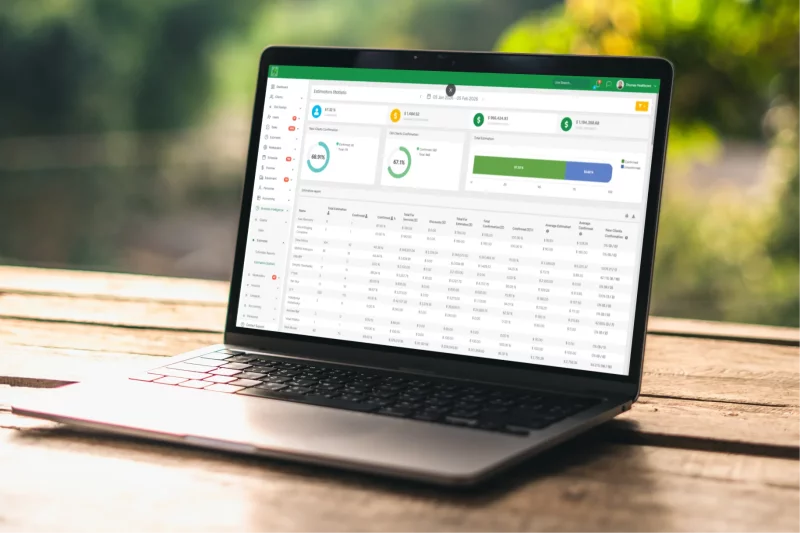
If you’re still relying on spreadsheets to price jobs, your business is running on guesswork. Managing multiple crews requires more than static files – you need intelligence that works in real time. Here’s how to bridge the gap:
Centralized Pricing Databases
Stop guessing the cost of fuel, disposal fees, or specialized gear. A modern estimating system keeps all pricing in a single, centralized database that updates in real time. When fuel prices spike, bar oil costs rise, or equipment rental rates change, every live bid instantly reflects those updates – no manual corrections needed.
This prevents underestimating job costs, ensures consistent margins across crews, and reduces the risk of last-minute surprises on high-value or multi-day projects. Advanced change order management features also let you quickly adjust estimates when project scope changes, keeping your bids accurate and your margins protected. Whether you’re bidding a quick residential trim or a $50,000 multi-crew removal, centralized pricing ensures your estimates are accurate, competitive, and profitable.
Templated Production Rates
Estimating based on gut feelings or outdated averages is a quick way to leave money on the table. Production rate templates use historical data from past jobs to predict exactly how long each crew takes to complete specific tasks. For example, Crew A might clear an acre of brush in 4 hours, while Crew B takes 5.5 hours.
By building these templates into your system and running regular estimating accuracy checks, you eliminate guesswork, reduce variance between crews, and standardize job pricing. This approach also highlights opportunities to optimize productivity, like identifying crews that outperform expectations or adjusting schedules based on real-world performance patterns.

The “Estimate-to-Schedule” Pipeline
In a manual workflow, estimates and schedules are often disconnected, which leads to overbooked equipment, double-booked crew leaders, and delays on site. A smart system links the estimate directly to the schedule, automatically calculating crew hours, equipment allocation, and project timelines the moment a client signs. By reducing estimation variance, the system ensures that predicted crew time and actual work align closely, preventing costly overruns.
For instance, if a $50,000 project requires two crews, a crane, and a whole-tree chipper, the system ensures every resource is available exactly when needed. This integration prevents idle trucks, reduces overtime, and keeps multiple crews operating efficiently across concurrent jobs. By connecting bidding to scheduling, you maintain control over job timing, maximize resource utilization, and ensure each project runs smoothly from start to finish.
Conclusion
To sum up, effective estimating is the foundation of profitable multi-crew tree care operations. Manual spreadsheets may seem “free,” but they quietly drain revenue through missed costs, inaccurate crew hours, and slow response times. Every error, from outdated pricing to miscalculated production rates, eats into profit and limits growth. Switching to a data-driven estimating system keeps bids accurate, crews efficient, and margins predictable. With integrated field productivity tracking, you can monitor real-time crew performance, identify bottlenecks, and make adjustments on the fly – allowing your business to scale without hitting the growth ceiling.