

Managing a tree care business extends far beyond climbing trees and pruning branches. From tracking leads and customer records to coordinating estimates, follow-ups, invoices, and crew communication, daily operations can quickly overwhelm business owners. This is why many companies compare CRM software before choosing a system for their tree service business. The right CRM helps centralize customer data, sales activity, estimates, communication, and follow-ups, so your team can stay organized while serving more clients.
Below we compare ten CRM software options for tree service businesses, updated for 2026. Each entry shows who the platform is best for and how it supports customer management, estimates, scheduling, invoices, reporting, and field communication – for small crews and larger tree care companies alike.
What Is Tree Service CRM Software?
Tree service CRM software is a customer relationship management system built for tree care and arborist businesses. It centralizes leads, client records, estimates, invoices, follow-ups, and crew communication in one place, so office and field teams work from the same information and fewer jobs slip through the cracks.
Unlike a generic CRM, an arborist-focused platform accounts for the realities of tree care operations: quoting by tree and site conditions, dispatching climbing arborists and ground crews, mapping job locations, and keeping records tied to specific properties. Many tree care companies use it as the single source of truth that connects the office, the sales pipeline, and the field.
1. ArboStar: CRM Built by Arborists, for Arborists
Best for: tree care companies that want CRM, scheduling, and field operations connected in one industry-specific platform.
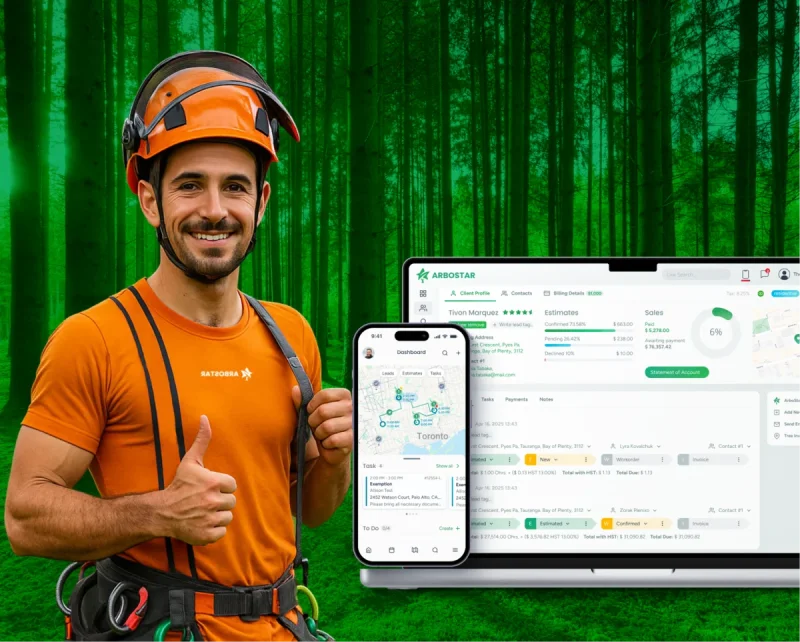
ArboStar is a strong CRM option for arborists and tree care companies because it was built around the workflows of the industry. It brings client records, estimates, scheduling, communication, reporting, and field coordination into one connected system, helping teams manage both customer relationships and daily operations.
Its mobile app also helps field teams access customer and job information from the field, including areas with limited connectivity.
Beyond core CRM functions, ArboStar supports marketing automation, VoIP integration, payment processing, and customer communication tools. This makes it useful for companies that want sales, office, and field workflows connected in one platform, though teams should still expect some onboarding and training when moving from simpler tools. You can see the full feature set on the ArboStar features page.
What does your CRM actually cost you?
ArboStar users report measurable results – not just features.
While pricing is customized based on business size and requirements, ArboStar scales effectively from solo operations to companies managing over 20 crews. Users consistently praise its industry-specific approach, with one Reddit user sharing, "ArboStar is the one that's stuck with me!! It's incredibly user-friendly" (full thread). Another satisfied customer added, "We're using ArboStar, and we love it! … They even have a tree inventory" (full thread).
2. Arborgold. End-to-End Tree Care Business Management
Best for: multi-service businesses that also handle lawn care or landscaping alongside tree work.
Arborgold offers a flexible solution for businesses that provide services beyond tree care, into lawn maintenance or landscaping. The system combines CRM functionality with scheduling capabilities, estimation tools, and QuickBooks integration, enabling comprehensive project and financial management within a single interface.
What makes Arborgold particularly appealing is its workflow customization options, allowing businesses to adapt the system to their specific operational needs. Some users mention that the interface could be modernized to meet current design standards. Starting at $129 per month, it positions itself as an accessible option for small to medium-sized multi-service businesses.
Reddit feedback has been generally positive, with one user reporting, "Arborgold ticks a lot of boxes for administrative tasks and communication" (full thread). Another shared their initial experience: "I have signed up for Arborgold as my CRM and am enjoying it so far" (full thread).
3. SingleOps. Flexible CRM for Green Industry Professionals
Best for: mid- to large-sized green-industry operations that prioritize reporting and data-driven decisions.
SingleOps distinguishes itself as a platform built specifically for mid- to large-sized businesses prioritizing flexibility and data-driven insights. The system integrates order management, comprehensive analytics, and client communication, with particularly robust reporting capabilities that help business owners make well-informed strategic decisions.
Although it offers excellent analytical depth and customization, SingleOps can place undue cost on smaller operations with its custom pricing. This shows up in user feedback, with one arborist noting, "SingleOps should solve most of my gripes with Jobber… The cost is a drag" (full thread). Some users have switched to other platforms, with one sharing, "We used SingleOps for a year… moved to ArboStar – gamechanger" (full thread).
4. Jobber. Easy Scheduling and Client Communication
Best for: small to medium service companies that want simple scheduling over deep customization.
Jobber delivers an intuitive approach for businesses that prefer straightforward functionality over complex features. The platform offers an easy-to-use calendar system, client portal access, and a mobile app that works well for small to medium-sized service companies.
Jobber is easy to integrate with QuickBooks and handles simple scheduling, making it a sensible starting point at $49 a month. However, its CRM depth may be too limited for complicated operations in larger companies. While one person praised it as "your best bet… probably the most consistent" (full thread), another cautioned, "Not happy with Jobber. Beware" (full thread).

5. LMN. CRM and Estimating for Large-Scale Landscaping
Best for: large companies running many complex projects that need tight budget and job-cost control.
LMN is focused on big companies running a high volume of complex projects at the same time. The platform offers sophisticated budgeting tools, job cost tracking, crew timesheet management, and comprehensive project scheduling. This level of detail is a major benefit when an organization needs a lot of project control.
That end-to-end functionality introduces complexity that can be painful for smaller operations — a trade-off that shows up in the learning curve users describe. One company reported, "We use LMN for estimating, invoicing, and timesheets" (full thread), while another described it as feeling "clunky, slow, not efficient" (full thread). Pricing is on request, in line with its enterprise positioning.
6. Method CRM. Customizable Workflows with QuickBooks Integration
Best for: companies whose operations revolve heavily around QuickBooks accounting.
For companies whose finances depend heavily on QuickBooks, Method CRM deserves serious consideration. The platform offers no-code customization, allowing businesses to tailor workflows to their operational processes without technical expertise.
Method's greatest strength is its seamless QuickBooks integration, arguably the most robust on the market. Combined with its customer portal and follow-up systems, it keeps customer relationships strong while simplifying financial procedures. Starting at $25 per user per month, it offers strong value for QuickBooks-dependent businesses, though there is a learning curve for proper configuration.

7. Plannit. Arborist-Friendly CRM with GPS Tracking
Best for: field-first teams that want GPS routing and a mobile-friendly interface.
Plannit concentrates on helping businesses with field crews operate more efficiently. Its GPS routing, customer history tracking, and invoicing tools are designed to streamline organization for on-the-go operations. The interface specifically considers the needs of arborists and landscapers, making it intuitive for field-based teams.
Although Plannit is highly effective in the mobile context, it integrates with third-party applications to a lesser degree than some options. Custom pricing reflects its specialized focus, and while it's less widely known than the industry giants, it's steadily gaining traction among small and medium field-service teams who prioritize mobility.
8. Service Autopilot. Automations for Tree and Lawn Care
Best for: tree and lawn care businesses that want to automate repetitive admin work.
Service Autopilot performs well for companies interested in reducing redundant administrative work. It has a strong following among lawn care providers and tree service businesses looking to simplify scheduling, routing, and client reminders. Its automation cuts a lot of time from repetitive admin tasks, letting teams focus on field productivity.
Starting at $49 per month, Service Autopilot offers accessible pricing for smaller businesses, though new users often mention a learning curve during setup. Reddit feedback reflects its dual-service appeal, with one user mentioning, "I use RealGreen for chemical apps… recommend Service Autopilot too" (full thread).

9. FieldPulse. Mobile-First CRM for Small Teams
Best for: small teams that want to run jobs and invoicing straight from their phones.
FieldPulse is designed with field crews in mind. The platform offers job management, team communication, and straightforward invoicing directly from mobile devices. Its analytics remain basic compared to enterprise CRM solutions, but that simplicity appeals to small business owners who prioritize ease of use over complex reporting.
FieldPulse sits in the middle of the price range at a recurring $99 per month, reflecting its mobile-first rather than console-first design. That placement makes it well-suited to small firms that need convenient mobile access without the complexity of larger platforms.
10. Real Green. Marketing-Focused CRM for Service Businesses
Best for: companies focused on customer retention, repeat services, and upselling.
Real Green takes a customer-retention approach that suits companies concentrating on repeat services and upselling. Alongside common CRM features, it includes comprehensive email marketing, customer segmentation, and recurring-order automation.
That marketing emphasis creates strong potential for client-retention strategies, though the cost may be excessive for small businesses. Custom pricing reflects its specialized marketing capabilities, and user feedback supports its effectiveness in the right applications. One Reddit user shared, "I use RealGreen for chemical apps. Would recommend to anyone" (full thread).
CRM Software Comparison for Tree Service Businesses
| CRM Software | Mobile App | Estimates & Invoices | GPS Tracking | Marketing Tools | Starting Price |
|---|---|---|---|---|---|
| ArboStar | ✅ | ✅ | ✅ | ✅ | Custom |
| Arborgold | ✅ | ✅ | ✅ | ❌ | $129/mo |
| SingleOps | ✅ | ✅ | ✅ | ✅ | Custom |
| Jobber | ✅ | ✅ | ✅ | ❌ | $49/mo |
| LMN | ✅ | ✅ | ✅ | ❌ | Custom |
| Method CRM | ✅ | ✅ | ❌ | ❌ | $25/user/mo |
| Plannit | ✅ | ✅ | ✅ | ❌ | Custom |
| Service Autopilot | ✅ | ✅ | ✅ | ✅ | $49/mo |
| FieldPulse | ✅ | ✅ | ❌ | ❌ | $99/mo |
| Real Green | ✅ | ✅ | ✅ | ✅ | Custom |
What Features Should a Tree Service CRM Have?
A tree service CRM should cover the full path from first inquiry to paid invoice. At a minimum, look for lead and customer records, estimating and quoting, scheduling and dispatch, a mobile app for field crews, invoicing with payment processing, GPS or job mapping, and reporting. QuickBooks integration and marketing automation are strong extras for growing companies.
Arborist-specific touches matter too. Features such as tree inventory, property-level history, and quoting that reflects site conditions are what separate a purpose-built tree care platform from a generic CRM retrofitted for the trade.
How to Choose the Right CRM for Your Tree Care Business
Choose a tree service CRM by matching it to your crew size, your workflow, and the tools you already use. Small crews usually want simplicity and mobile access; larger companies need scheduling, reporting, and field coordination connected to the CRM. If you rely on QuickBooks, prioritize strong accounting integration, and if repeat business drives revenue, favor marketing and retention features.
A practical test: map one job from lead to paid invoice and see how many separate tools it touches. The fewer handoffs and the less double entry, the better the CRM fits a tree care operation. For a deeper look at connecting office and field workflows, explore the ArboStar platform features.
Conclusion
Choosing the right CRM software for a tree service business is not just about storing contacts. A good CRM helps centralize leads, customer records, estimates, invoices, follow-ups, reporting, and customer communication, so your team can manage growth without losing control of daily operations.
For tree care professionals, better CRM processes also support better service. When leads, client history, estimates, and follow-ups are organized, fewer opportunities are missed and customers receive clearer communication from the first request to the completed job.
Investing in the right CRM is a practical decision for companies that want cleaner sales workflows, better customer management, and stronger coordination between office and field teams.
Frequently Asked Questions
What is the best CRM software for a small tree service business?
The best CRM should help manage leads, customer records, estimates, invoices, follow-ups, and job history. ArboStar is a strong option for companies that need CRM features connected with scheduling, field operations, and reporting.
What is the difference between a CRM and field service management software?
A CRM manages the customer side — leads, contacts, estimates, communication, and follow-ups. Field service management software focuses on the operational side — scheduling, dispatch, routing, and crew tracking. For tree care companies, the most effective platforms combine both, so a lead can move from first call to completed job without leaving the system.
Are there free CRM options for tree service businesses?
Free CRM tools can work for basic contact management, but they rarely support the full workflow of a tree service business. Growing companies usually need CRM software connected with estimates, scheduling, invoices, and field communication.
Do tree service companies need QuickBooks integration in their CRM?
Yes, QuickBooks integration helps reduce manual data entry between invoices, payments, customer records, and accounting. This keeps sales and financial data more organized.
Which CRM software works best for mobile tree service crews?
The best CRM for mobile crews should include a mobile app, job details, customer records, estimates, scheduling updates, and communication tools. This helps office and field teams work from the same information.
How do I migrate tree service customer data into a new CRM?
Most CRM platforms offer import templates or migration support. ArboStar also provides onboarding and data transfer assistance to help move client information, job history, and sales records into the platform.