

Scalable Business Ideas: How Service Businesses Grow Without Losing Control
Quick summary. A scalable business is one whose revenue can grow much faster than its costs and headcount, instead of moving in lockstep with them. Classic scalable business examples include SaaS, subscription products, and franchise systems – all built on operating leverage, where one more customer costs you almost nothing to serve. The most accessible scalable business ideas for service owners are recurring-revenue maintenance contracts, a franchise model, paid online courses, niche SaaS, and digital products. Field service is a special case: a crew-based company can’t ship software to a million users overnight, but the right field service software lets one owner run ten crews on the admin load of two – which is the most realistic form of scale for tree care, lawn, and home-services businesses.
There are roughly 692,777 landscaping companies in the United States, the industry is worth about $188.8 billion, and not a single one of those companies controls even 5% of the market. The top 50 firms combined hold only around 20% of revenue. The typical operator employs two or three people. Tree care alone counts about 175,000 businesses inside a $39.5 billion trimming market growing at roughly 6% a year.
Read that again: a huge, expanding, profitable market – and almost nobody in it has managed to get big. That gap is the whole subject of this article. It isn’t that service owners lack ambition. It’s that most service businesses are wired to grow the hard way, adding a truck and a crew for every increment of revenue, until the owner becomes the ceiling. Scalable business ideas are simply the models and add-ons that break that one-to-one link between growth and grind.

What Makes a Business Idea Scalable
What is a scalable business, in plain terms? It’s a business where you can serve the next customer – or the next thousand – without adding a proportional amount of cost, labor, or your own time. The technical name for that property is operating leverage: you carry a base of mostly fixed costs, and once revenue clears that base, additional sales fall through to profit instead of being eaten by new hires.
The cleanest way to see it is to compare three models.
-
A solo consultant sells hours. Double the revenue and you have to double the hours – there’s no leverage, and the ceiling is the calendar. This is not a scalable business model; it’s a high-paid job.
-
A SaaS product sells the same code to customer 10 and customer 10,000. The cost of serving one more user rounds to zero, so growth compounds. The financial markets reward this: companies built on recurring revenue have grown about 4.6x faster than the S&P 500 over the past decade.
-
A franchise sells a proven system to operators who fund and run their own units. The franchisor grows output and royalty income across hundreds of locations without staffing every one. U.S. franchising is now an 845,000-establishment, $921 billion sector contributing close to 3% of GDP – built almost entirely on this leverage.
Notice the common thread in these scalable business examples: revenue is decoupled from headcount. The question for any owner evaluating scalable business ideas isn’t “can this make money?” – it’s "can this make more money next year without me hiring in exact proportion?"
Scalable Business Ideas for 2026
Below are the strongest scalable service business ideas to build, bolt on, or pivot toward in 2026. For each one: what it is, why it scales, the numbers behind it, and – most importantly for a crew-based owner – how it actually applies to a field service company.
1. Field Service Software (Vertical SaaS for Your Own Trade)
What it is: Software that runs the operational guts of a service business – scheduling, dispatch, work orders, invoicing – sold as a subscription, often built by an operator who knows the trade.
Why it scales: It’s SaaS, the textbook scalable business model. Once the platform exists, each new subscriber adds revenue at near-zero marginal cost.
The numbers: The U.S. field service management software market sits around $3.1 billion in 2026 and is growing about 7.5% a year; global estimates run from roughly $6 billion today toward $20+ billion by the mid-2030s at double-digit CAGRs. About 72% of U.S. service organizations already use mobile workforce apps, so adoption is mainstream, not speculative.
For a field service owner: Few owners will build their own platform – but you are the ideal customer for one, and a handful of operators do productize their internal processes and license them to peers. At minimum, understanding why vertical SaaS scales tells you which tools are worth paying for.
2. The Franchise Model
What it is: Packaging your operating system – brand, process, training, supplier relationships – and selling the right to run it to independent operators.
Why it scales: You grow units and royalty income without funding or directly managing each location. The median royalty is about 5% of gross sales, paid in perpetuity, across every unit.
The numbers: Franchising added more than 12,000 units in 2026, and commercial & residential services are among the fastest-growing categories at 3.2% a year. Franchises also fail less: roughly 20–25% close within five years versus about 50% of independent startups. Service-format franchises typically cost an operator $100,000–$500,000 to open.
For a field service owner: This is one of the most direct paths to tree service business growth, lawn, or cleaning at real scale. If you’ve systematized estimating, routing, and quality control well enough to hand someone a binder and have them replicate your results, you have the raw material for a franchise.
3. Niche (Vertical) SaaS
What it is: Software solving one narrow problem for one specific industry 00 permit tracking for fencing contractors, dosing logs for pool services, compliance records for arborists.
Why it scales: Software margins plus a tightly defined audience that’s easy to reach and slow to churn. Nearly every company now runs on subscription software, and recurring revenue is exactly why investors prize the model.
The numbers: The broader subscription economy reached about $492 billion in 2024 and is projected to pass $1.5 trillion by 2033, with software a leading segment.
For a field service owner: You sit on years of frustration with tools that "almost" fit your trade. That frustration is product insight. The same domain knowledge that makes you good in the field is what generic software companies don’t have – and what a niche product can be built around.
4. Online Courses and Certification Training
What it is: Turning your expertise into structured paid education – a course, a certification-prep program, a training library.
Why it scales: You produce it once and sell it indefinitely. Online training also requires 40–60% less time than in-person instruction, which is part of why corporate buyers love it.
The numbers: The global e-learning market runs into the hundreds of billions of dollars in 2026 and is compounding at double digits; Coursera alone reported around 197 million registered learners by the end of 2025.
For a field service owner: In trades with formal credentials – ISA arborist certification being the obvious one – exam-prep and skills training are a natural, high-margin product. You’re already training your own hires; packaging that curriculum for the wider trade turns a cost center into a scalable revenue line.
5. Subscription Maintenance Contracts
What it is: Converting one-off jobs into recurring agreements – seasonal pruning plans, monthly lawn programs, annual inspection memberships billed on autopilot.
Why it scales: It’s the most underrated scalable small business idea for service owners because it scales revenue predictability rather than output. Recurring contracts smooth cash flow, raise customer lifetime value, and slash the cost of constantly re-selling.
The numbers: Around 67% of the landscaping business model already runs on subscriptions. Annual subscribers are about 40% less likely to cancel than monthly ones, and roughly 70% of subscription revenue comes from existing customers – meaning every contract you sign keeps paying without fresh acquisition cost.
For a field service owner: This is the single highest-leverage move available without changing what you do. You keep your crews and equipment; you just change the billing model from transactional to recurring. It’s the closest a crew-based business gets to SaaS economics.
6. Digital Products and Templates
What it is: Selling downloadable assets – estimate templates, safety-plan kits, contract packs, pricing calculators – to other operators.
Why it scales: Zero marginal cost and zero inventory. Build it once, sell the file forever.
The numbers: It rides the same recurring-revenue economics that let subscription businesses outgrow the S&P 500 by nearly five to one.
For a field service owner: Every spreadsheet and checklist you built to run your own shop is a potential product. It won’t replace your core income, but it’s a low-risk way to test whether you can sell to your own industry before committing to something bigger like SaaS or a franchise.
7. Remote Staffing and a Virtual Back Office
What it is: Moving estimating, scheduling, customer service, and bookkeeping to remote staff or a centralized virtual office instead of growing on-site overhead.
Why it scales: It breaks the assumption that more field volume requires proportionally more in-house administrators – directly improving operating leverage.
The numbers: Service organizations adopting mobile and remote workforce tools report meaningful efficiency gains, with predictive and automated systems cutting some operating costs by up to 30%.
For a field service owner: A remote coordinator handling intake and dispatch for several crews costs a fraction of a full back-office team and lets you add field capacity without ballooning fixed cost. It’s scalability applied to the part of the business customers never see.
8. E-Commerce for Equipment and PPE
What it is: Selling the gear your trade depends on – climbing equipment, PPE, parts, consumables – online, to peers and DIYers.
Why it scales: Inventory and fulfillment can be standardized, dropshipped, or third-party-logistics-handled, separating sales growth from your labor entirely.
The numbers: It plugs into e-commerce infrastructure that already processes a large and growing share of all retail, with subscription replenishment models layered on top for consumables.
For a field service owner: You already know exactly which products work, what fails, and what’s hard to source – credibility that generic retailers can’t fake. An equipment storefront, or even a curated affiliate catalog, monetizes that authority without sending a single crew into the field.
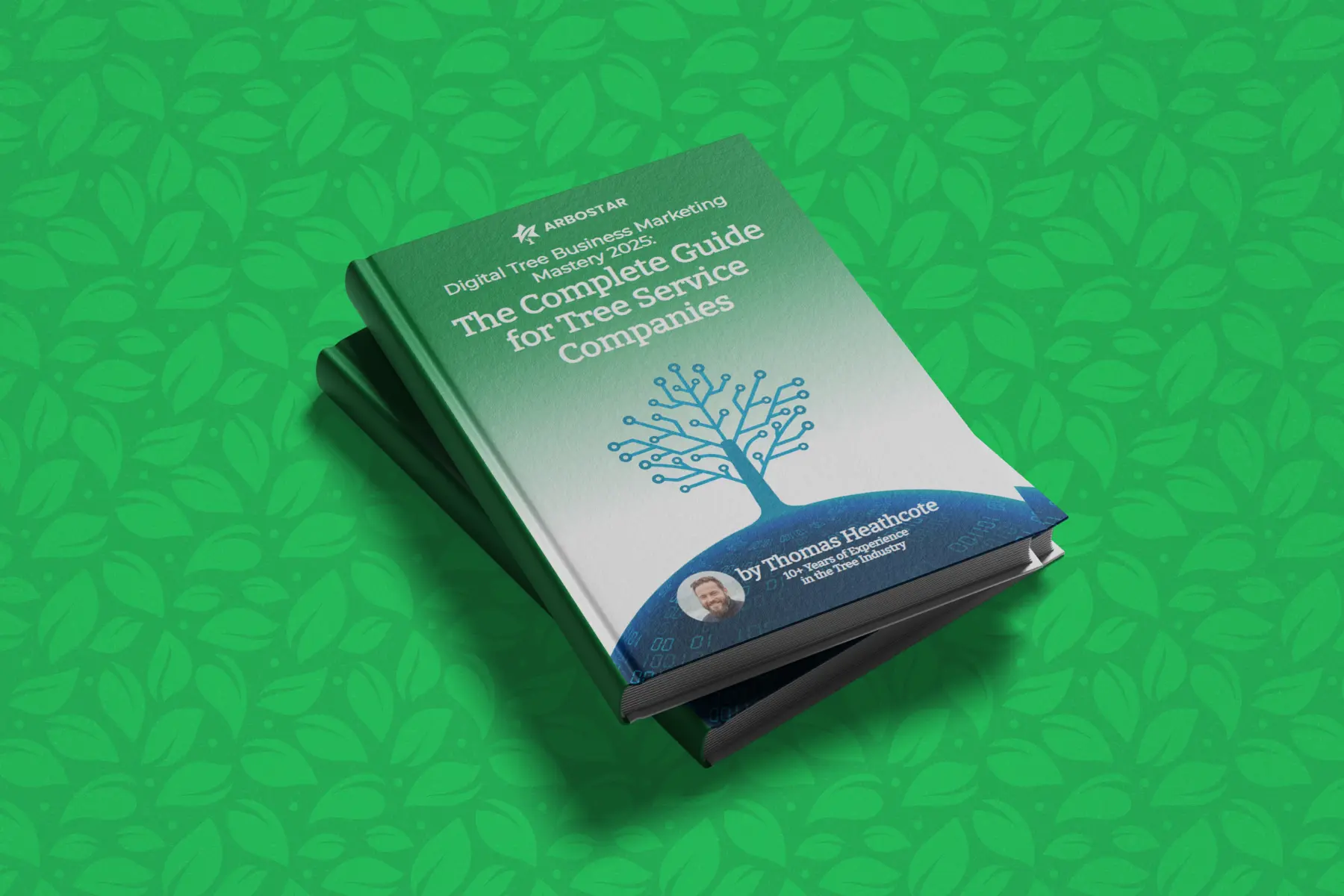
Maximize Your Tree Business Growth in 2025!
Unlock the secrets to success with our ultimate guide! The Digital Tree Business Marketing Mastery 2025 eBook is your go-to resource for staying ahead in the tree care industry. Discover cutting-edge strategies, proven digital marketing tactics, and expert insights that will revolutionize the way you attract clients and grow your business.
What’s inside?
✅ The latest trends in tree care marketing
✅ Must-know strategies for lead generation
✅ SEO, social media, and Google Business optimization
✅ How to automate your marketing and scale faster

Scalable vs. Traditional Service Business
The difference between scalable and traditional models isn’t effort – plenty of owners work brutally hard and stay stuck. The difference is what happens to costs and to you when revenue doubles.
| Dimension | Traditional service business | Scalable service business |
|---|---|---|
| Growth mechanism | Add a crew/truck for every revenue increment | Add customers without proportional headcount |
| Cost behavior | Costs rise roughly in line with revenue | Mostly fixed base; new revenue is high-margin |
| Revenue type | One-off jobs, re-sold every time | Recurring contracts or repeatable products |
| The owner’s role | Becomes the bottleneck – dispatch, estimates, quality | Oversees a system that runs without daily heroics |
| Ceiling | Hours in the day, trucks in the yard | Capital, systems, and market size |
| Example | Hourly tree removal, paid per job | Maintenance memberships, franchise units, a SaaS tool |
Make it concrete. Picture a tree care company with two crews. The owner can dispatch by phone, write every estimate personally, and track jobs in a notebook or spreadsheet. It works because the owner is the system.
Now picture the same company at ten crews. The notebook approach quietly hemorrhages money: double-booked appointments, follow-ups that never happen, completed work that never gets invoiced, customer calls that go unreturned. Revenue grew, but so did chaos and overhead – and the owner is now working more hours for thinner margins. That’s linear, traditional growth hitting its wall.
Swap in field service software and the picture changes. Routing optimizes itself, every job becomes a digital work order, the CRM remembers every customer, and invoices fire automatically on completion. The owner can supervise ten crews on roughly the administrative load that used to cover two. The crews and trucks still scale linearly – that’s physics – but everything around them stops scaling against you. That’s the realistic version of field service business scalability.
What Drives Scalability in a Field Service Business
Crew-based work will never have pure software margins. But the operational layer absolutely can scale, and that’s where field service business scalability is won or lost. The drivers are unglamorous and specific:
-
Job documentation. Standardized digital work orders mean any crew can execute any job the same way – and nothing falls through the cracks. This is also the prerequisite for ever franchising.
-
Routing and dispatch. Optimized scheduling squeezes more billable work out of the same crews and fuel, which is the margin you create without selling a single new job.
-
A real CRM. Customer history, recurring-contract status, and follow-up triggers in one place are what make subscription maintenance plans actually manageable at volume.
-
E-signatures and automated invoicing. Closing the loop from completed job to signed approval to paid invoice – automatically – is where most growing companies stop the revenue leaks that scale invisibly with them.
This is precisely the problem ArboStar is built to solve: an all-in-one platform that unifies CRM, scheduling, routing, work orders, e-signatures, and invoicing for tree care and field service companies, so that adding crews adds revenue instead of adding chaos. Knowing how to scale a service business, for most owners, comes down to installing this operational backbone before the wall, not after.

How to Choose a Scalable Business Model
You don’t need to chase all eight ideas. You need the one that fits your assets and your growth stage. Run any candidate through this checklist:
-
Does revenue outpace headcount? If growing 2x requires hiring 2x, it isn’t scalable. Look for models where the next sale costs you almost nothing to deliver.
-
Is the revenue recurring or repeatable? Contracts, subscriptions, and digital products beat one-off jobs because you stop re-selling the same customer from scratch.
-
What’s the marginal cost of one more customer? The closer to zero, the more scalable. Software and digital products win here; crews don’t.
-
Can it run without you? If it depends on you personally – your estimates, your judgment, your hands – document it into a system first, or it can’t scale.
-
Does it build on what you already have? Your trade knowledge, customer base, and reputation are unfair advantages. The best scalable business ideas extend them rather than starting from zero.
-
How much capital does scaling require? A subscription contract program needs almost none; a SaaS build or franchise infrastructure needs real investment. Match the model to your runway.
Conclusion
The reason hundreds of thousands of service companies stay small isn’t a lack of demand – it’s a growth model that adds cost for every dollar of revenue. Scalable business ideas break that link, whether through recurring maintenance contracts, a franchise system, paid training, niche software, or simply the field service software that lets one owner run ten crews on the overhead of two. Choose the model that fits your stage, then build the operational backbone that makes scale survivable. See how ArboStar helps service businesses grow without losing control – book a demo today.